
Sep 25
A Democratic Revolution Needs Revolutionary Constitutional Politics
In reply to T.E. Moon, Steven R. argues that fighting Trumpism means supplanting the Constitution with rule by the working-class majority.
by Steven R.
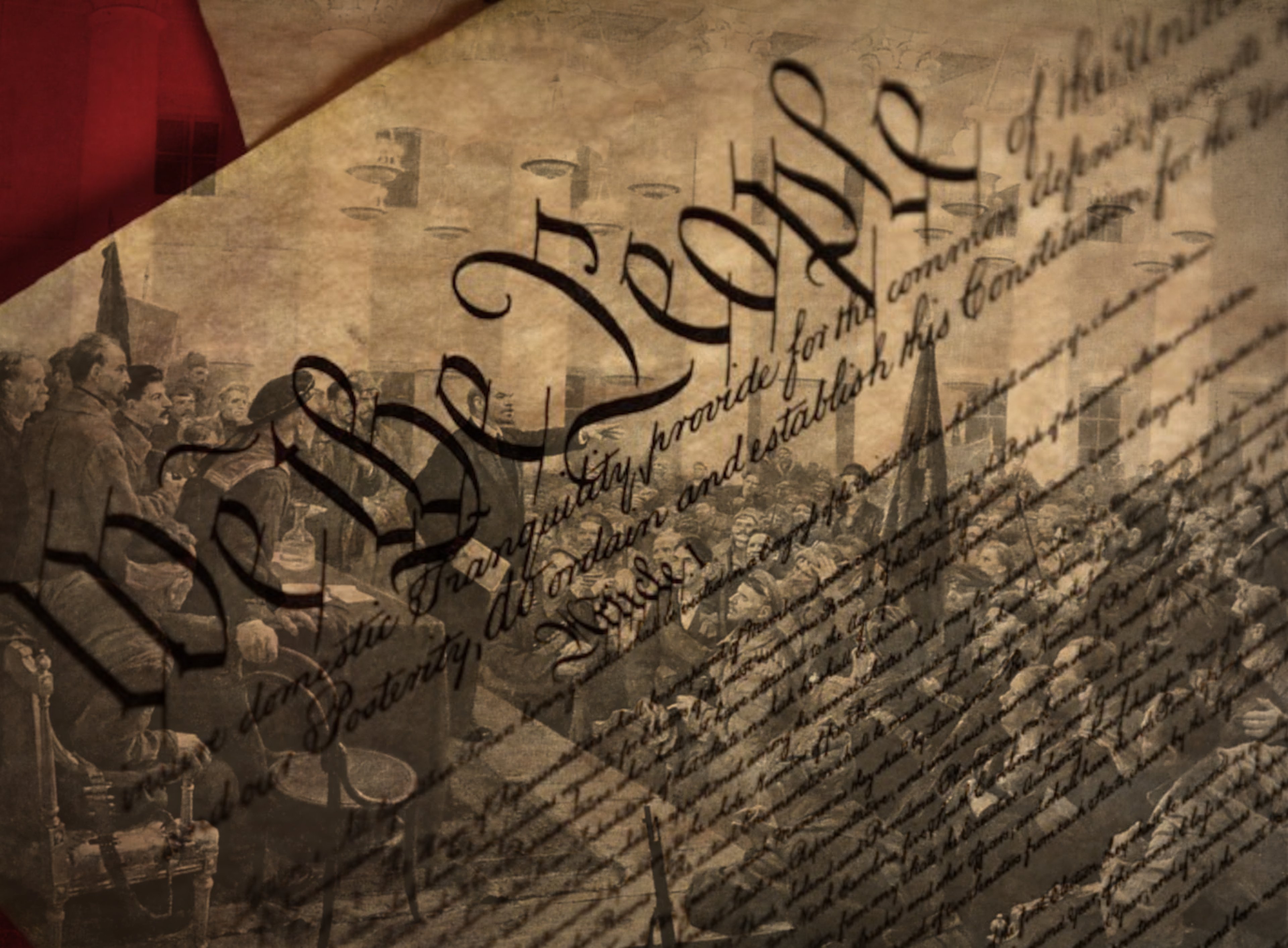
In “For a People’s January 6th,” T.E. Moon offers an audacious analysis of where the present constitutional crisis is heading. The premise that the Trumpist Right has been winning a kind of cold civil war since January 6th and is poised to overthrow the 2028 Presidential Election seems to be vindicated daily as the Trump administration lays the groundwork for a dress rehearsal for exactly such a coup ahead of this year’s midterms. The vision Moon offers in response—a “people’s January 6th,” or a defensive democratic revolution to force the Right to cede power to a left-populist administration—is compelling.
Still, there are some important threads Moon leaves unpulled. What if the Right’s coup happens before the election, instead of during the transition? Alternatively, what if MAGA holds onto power against the popular will, but by indisputably legal means? But the most important question Moon’s piece begs is the question of constitutional politics: who must rule, and how?
If we are to have any hope of transforming the upcoming transition of power into a democratic revolution, we cannot merely mount a defense of existing American political norms from Trump. To challenge the political order that produced Trumpism in the first place, we must supplant the Constitutional order of minority rule with one of universal and equal political rights. Opposition to ICE will be a critical flashpoint for this struggle, as we dare to define a revolutionary democratic alternative to both reaction and restorationism.
Who must rule, and how? No power without constitutional politics
Constitutional politics give a class its identity as a subject in history—the disparate struggles of individuals and fractions of a class become class struggle when they unify around a vision of how to constitute political power in society.
For the Bolsheviks, “All Power to the Soviets” was an accessible distillation of a comprehensive theory of constitutional politics. The slogan popularized their program of unqualified state sovereignty for the worker-peasant majority, allowing them to construct a mandate to topple the provisional government in October 1917 and begin the more arduous work of building a “democratic dictatorship of the proletariat and peasantry.”
In contrast, the lack of such a comprehensive and clearly articulated constitutional politics greatly contributed to the 2020 George Floyd uprising’s disintegration and subsequent failure to erode police power or racial capitalism. Demands to abolish or defund the police captured the imaginations of millions, but without a unifying positive program to define mass rule or a party capable of offering one, the rebellion succumbed to exhaustion and cooptation. Its heroic ambitions have spent the last five years in the stockade of public opinion, decried by a shrieking Right, mocked by a ruling-class media intent on manufacturing crime panic, and abandoned by onetime allies on the Left.
For the democratic socialist Left to avoid this pitfall and assume leadership of the democratic struggle against Trumpism, we must present a clear alternative to the political order that made this administration possible in the first place.
The current constitutional paradigm in America is a product of over two centuries of class struggle constrained by the state America’s colonial elite created in 1787. Thanks to those struggles from below and the reform efforts reflected back on them from above, Americans now expect things that would be alien to the “Founders,” for instance, a right to vote that formally transcends race, gender, and wealth, or a government that imposes social obligations on private enterprise. But the Constitutional principle of unequal suffrage persists in the Senate and Electoral College, the unelected Supreme Court, “states’ rights,” and contingent citizenship. Trumpism should not be understood as a divergence from that political order, but as a mutation of it, exploiting the logic of constitutional hardball to roll back the compounded gains of class struggle while accelerating the expansion of executive power to suppress its opposition.
If the Left took the Presidency after defeating a MAGA autogolpe in 2028, its efforts to stamp out Trumpism, let alone to pursue a positive program of its own, would be hampered from day one by the unequal geography of political power under the slaveowners’ Constitution. The new administration would face conditions like those the Popular Unity government faced in Chile in the early 1970s: a right-wing opposition intent on seizing back power from the Left, a security apparatus unwilling to submit to civilian oversight or reform, and an obstinate international capitalist class devoted to undermining the project at every turn. Moreover, any left-populist President elected in 2028 would certainly need to contend with majority opposition in the Senate, seditious state governments, an army of Republican judicial appointees captained by the Supreme Court, a hostile Federal Reserve, and, last but not least, the threat of capital strikes as a response to progressive legislation.
Of course, problems like these confront every revolution. Lenin’s cabinet faced similar counterrevolutionary threats as Allende’s, just in a different form. Victory is never either certain or impossible; it is always a question of relative power and organization, and in the wake of a hypothetical “People’s January 6th,” the working class could meet every obstruction with the threat to resume Moon’s proposed strikes and occupations.
But permanent mobilization is not a sustainable answer to the problem of state power. People are finite—eventually, they need to return to work, school, safe homes, ordered lives. And when they do so, for the revolution to survive, they need to leave behind new forms of state power that disorganize and disadvantage the old ruling class, just as the current forms do for the working class. The forms of state power matter; they are the “means of production” of political hegemony. To the extent the people at large acknowledge and participate in them, they answer the question of who should rule and how through public discourse on rights, law, and constitutionality instead of permanent civil war. Mass action may win a government, but it cannot sustain it forever.
Thus, to have any hope of long-term success, an ascendant Left would need to transform the state both in orientation and in form, and do so according to a constitutional politics that takes the principle of “one person, one vote” to its logical conclusion: the transfer of sovereignty from the reigning capitalist minority to the disfranchised working-class majority. The Senate must be eliminated outright, the courts disempowered, the executive power subordinated to an expanded and proportional House, state-level reactionary fiefdoms bulldozed by the march of universal rights, citizenship expanded to include everyone who lives or works here, and the organs of state-sanctioned violence completely remade to serve democratic, egalitarian ends. In short, to ensure that the gains of popular mobilization are consolidated, not corroded, we must resume the unfinished work of what W.E.B. Du Bois called “abolition democracy.”
What if the coup is legal? Constitutional disloyalty
Fulfilling the promise of a revolutionary democratic constitutional politics through mechanisms of change consistent with the existing Constitution is impossible. The logic of white minority rule that has frustrated the Left (and even the reform-minded Center) for generations is baked into the process of changing the Constitution itself, which requires the consent of three-fourths of the state legislatures to amend and unanimity among the states for any amendment that might challenge the system of unequal suffrage embedded in the Senate. Just a handful of filibustering state senators from the whitest, least populous states, collectively representing perhaps one-fifth of one percent of the population, could block an overwhelming supermajority from lawfully affecting any of the fundamental changes necessary to make a democratic socialist government viable. With the stakes confronting us this century, we cannot afford to accept those terms of engagement. The Left must actively embrace constitutional disloyalty, a foundational rejection of the legitimacy of the constitutional order and a refusal to practice politics on its terms
The law matters only insofar as the body politic at large believes it does, and the American public believes in the Constitution. Our country practices a civic religion Aziz Rana calls “creedal constitutionalism”: the hegemonic idea that Americans are more free, and their government more democratic, the more faithfully the country embodies the perfect wisdom of the “Founding Fathers,” especially the minoritarian principle of “checks and balances.” This founding myth is the bedrock of a reactionary American nationalism that is deeply suspicious of political imagination, hostile towards majority rule, and deferent to ancient “norms.” It is absolutely corrosive to any kind of emancipatory political project. We have no choice but to contest and replace it with a new hegemonic ideology that reflects our constitutional politics, or any attempt at socialist governance at a national scale will be defeated before it even begins.
Attempting to subsume creedal constitutionalism into the project of left-populism would leave the door open to counterrevolution by agreeing in advance to terms of engagement that favor the ruling class. By maximally exploiting or ignoring the letter of the law. Consider, for example, how few of the one million people who voted for Zohran Mamdani would heed the call if the mayor asked the people of New York to take to the streets and confront the NYPD’s racist tyranny, given that he made the strategic choice not to use his campaign to agitate against police power. By that same principle, would a democratic socialist President who ran for office in deference to the Constitution be capable of inspiring mass action to prevent her removal for blatantly subverting it in office?
Further complicating Moon’s narrative, the nonviability of a democratic revolution without constitutional disloyalty might make itself felt well before a democratic socialist candidate ever has the chance to assume the Presidency. If, as Daniel Newgarden advocates in Jacobin, the Left hopes to realize its constitutional politics without breaking with the existing Constitution, how will it meet the moment if Trump’s successor wins the Electoral College despite losing the popular vote by millions, as Trump did in 2016? MAGA is too dangerous to be allowed to remain in power without a democratic mandate just because a piece of paper buried in the National Archives says it should—but how can a Left loyal to the Constitution justify a defensive democratic revolution to its base when the threat to democracy comes from the Constitution itself?
For a democratic revolution to be possible in the wake of a contested transition, the election leading up to it must be a referendum on a new system of governance incompatible with the existing one, a referendum in which the democratic camp plainly rejects any standard of victory except a freely cast majority of the popular vote. The campaign itself must be the event that disintegrates creedal constitutionalism and asserts the hegemony of a radically democratic alternative, thus paving the way for new centers of political power to take form and supplant the old ones. Whoever DSA endorses, we must campaign on the message that a vote for our candidate is a vote for a new democratic constitution and against the undemocratic structures of the American state that suppress mass political activity.
Going on the offensive: Arrest ICE!
If the democratic socialist camp waits for the regime to make its move before leaping into defense of popular sovereignty, our mandate may well be complicated by election results spoiled by wanton voter suppression. It is imperative that we shape the terms of the people’s confrontation with the regime by going on the offensive.
We know the Right will enjoy a disproportionate advantage in the 2028 elections thanks to the unequal suffrage baked into the Constitution, hence the importance of DSA and our endorsees standing by the demand to abolish the Senate and Electoral College. We can also expect that the Trump administration will try to further stack the deck by using ICE, which it has spent the last year transforming into a sprawling private army, to suppress the opposition’s votes and crush dissent. Our movement therefore needs a line of attack that contains within it the constitutional politics of democratic revolution, one which measures up to the urgency of the fact that ICE will overthrow the election and kill us for dissenting if we let them. Geese Magazine has already landed on a compelling one: It’s Time to Arrest Them.
The existing movement against ICE already contains some of the raw material of a democratic revolution. While sanctuary policies walk the thin line of legality in some states, the underlying demand to eject ICE from our cities, campuses, workplaces, and wherever else it might rear its head is a radical challenge to the de facto plenary power of the imperial executive sanctified again and again by the courts. In an election where the ruling clique will almost certainly use ICE for election interference, the logical extension of the sanctuary demands many in DSA are already struggling for is to demand our state and local governments buck federal authority by using all necessary force to prevent ICE agents from violating our democratic rights. Arrest them. Let justice be done, though the heavens fall.
DSA is uniquely poised to advance this demand. DSA-endorsed “Socialists in Office” (SIOs) occupy public office in most states in the country. That includes state and local legislators in contested states where both media attention and the threat of voter suppression will be highest, including Georgia, Minnesota, and Florida. A concerted effort to force the question of ICE’s authority with buy-in from these SIOs could upend the national political landscape.
As election season rolls around in 2028, DSA should push our state and local electeds to rally around the demand to protect the right to vote from ICE interference. Socialists in state legislatures and city councils could bring forward legislation designating expansive “ICE-free zones” around polling places and post offices, prohibiting ICE/CBP activity within their state or city during early voting and on election day, and mandating the use of police power to enforce these policies. Socialist mayors could issue executive orders to the same effect. Rank-and-file DSA members could get to work drafting the text of these bills and orders right now.
Of course, none of that is legal. State and local authorities have no standing under our existing Constitution to detain federal agents in the line of duty nor pass binding judgment on which of their actions are legal. If they were not immediately ruled out of order, “arrest ICE” bills would struggle to even secure a floor hearing in hostile state legislatures. No court would uphold them, and no police department in the country would enforce them. But passing these “arrest ICE” bills is not the point; fellow legislators would not be their intended audience, and the fact that they would be completely incompatible with the hegemonic legal order would be to our advantage. The mandate to use any means necessary to prevent ICE from suppressing the right to vote comes from a higher law, one that no court can adjudicate and no constitution can qualify: the people’s absolute right to live under a government of their own choosing. In other words, if the people do it, it can’t be illegal.
Regardless of whether a single “arrest ICE” bill makes it to the floor for consideration, let alone passes into law or city ordinance, shouting the demand from the rooftops—in every government chamber we can get a foothold in, in every race we field a candidate in, on every news platform open to us, in every town square we can fill with demonstrators—would give the movement for democracy directional unity: from emergency measures against ICE to the overthrow of the undemocratic system standing in the way. Following in the abolitionist tradition, the movement could escalate from demonstrations demanding the passage of “arrest ICE” measures to mass “citizens’ arrests” of ICE agents or street blockades of targeted areas, and from there to direct confrontations with the state.
It is clear that there is a growing opposition—hatred even—for ICE across the nation. They are marching people into camps, invading cities, and killing civilians. The crisis is already before us—our task now is to use it to expose the rottenness of the Constitutional order that prevents the working-class majority from putting a stop to it.
No prairie fire in wet grass
Moon is right to urge readers not to totally write off the possibility of a revolutionary crisis in the not-too-distant future. It seems far-fetched now, but no one credibly foresaw the scale or ferocity of the uprisings of 2020 in 2018, either. As the regime and American political economy in general both careen deeper into crisis over the next two years, vast new possibilities both hopeful and fearful will open up, and old assumptions will continue to be overwritten.
That being said, whatever the results of the next presidential election, it still seems safest to bet against “successful democratic revolution” being one of them. DSA, organized labor, and social movements on the Left are still far too small and unorganized in 2026 to contemplate taking and wielding power. Even assuming massive quantitative growth between now and then, the democratic socialist camp’s qualitative ability to wage class war will still be leagues behind the antislavery movement in the 1850s or the industrial unionist movement in the 1930s, two moments of revolutionary possibility that ultimately still ended in defeat.
But to take Moon’s analogy further, “successful MAGA counterrevolution” was not one of the immediate outcomes of the original January 6th, either. The Trumpist camp lost the battle in a humiliating, discrediting fashion, yet it still won the war in the years that followed. Assuming DSA does not win a revolutionary transformation of our political system in 2028-9, how might we win the war?
Unlike Trump’s shock troops, socialists will not have the luxury of America’s constitutional machinery working in our favor. The Trumpist Right was able to deflect serious consequences for January 6th, catastrophically undermine Bidenism, and claw its way to unprecedented power come 2025 by virtue of an undemocratic state that structurally privileges its politics. Between the drastically unequal Senate and an aristocratic judiciary packed for fifty years by the New Right, MAGA could count on friends in high places to make it impossible for Biden to implement anything resembling a coherent and popular platform while they dogwalked the Democrats into conceding to MAGA’s framing on virtually every issue legible to the population at large. That much is off the table for us. But what did they do that we can emulate?
For one, we could learn a lot from their disruptive legislative tactics. In the wake of the 2022 midterms, which were praised as a historic success for the Democrats, Trump loyalists took advantage of the razor-thin legislative majorities produced by our sclerotic party system to depose establishment Republican leaders in a series of contested Speaker of the House elections that brought Congressional business to a halt and bent the entire political universe around their agenda. They did so with a cadre of partisans not much larger than the roster DSA appears poised to send to Capitol Hill this year.
Outside Washington, the forces of MAGA also carried out a discursive coup that left the Democrats contesting the form, rather than the content, of much of the Trumpist program. They saw the cost-of-living crisis for what it was, a grim reaper for incumbents everywhere, and used it as a foot in the door for a much more sweeping political vision: “The Democrats are making it impossible to live in this country because they’re letting millions of ‘illegals’ in and burning all our money on DEI programs. We need mass deportations and a revolution against the woke globalist administrative state to usher in a new golden age, and only Trump can do it.”
This narrative was padded with blood libel about voter fraud, pet-eating migrants, and campus Sharia Law. But it didn’t matter. With Bidenism completely gutted, the Democrats had no credible positive vision with which to construct a counter-narrative. So they played defense, cobbling together an incomprehensible strategy to contain Trump with fruitless efforts to disqualify him, while insisting that they could do the reprehensible things he wanted to do better. “Trumpism with a human face” handed “Trumpism without apologies” the largest Electoral College victory for a Republican since the Reagan era.
Whether the Right retains its grip on power or a centrist Democrat returns to the White House, the next administration will find itself just as incapable of resolving the crises laid at its feet as Biden and Trump were. Our task, in this event, will be to use every failure of the new administration as an opportunity to popularize the constitutional politics of revolutionary democracy. What MAGA did by lying, we can do by telling truths that the existing political order cannot reabsorb into its own hegemony: Life is becoming unsustainable in this country because we do not live in a democracy. To address the crises facing working people, we need to stop playing by the rules of an undemocratic, broken Constitution and replace it wholesale with one that will put the working-class majority in power.
The question of who has the right to rule (and with what kind of state) will remain unavoidable no matter what happens in 2028. Constructing a constituency that opposes the restrictive, anti-majoritarian logic of creedal constitutionalism is a necessary task in the quest to make a democratic revolution possible, whether two years from now or two decades from now.