
Aug 16
Genome Scans in the Morning: Envisioning a Free Association of the Producers of Science
Reforming science under capitalism has run its course. Nabi Eullmann argues for a free association of science producers, answerable to all of society.
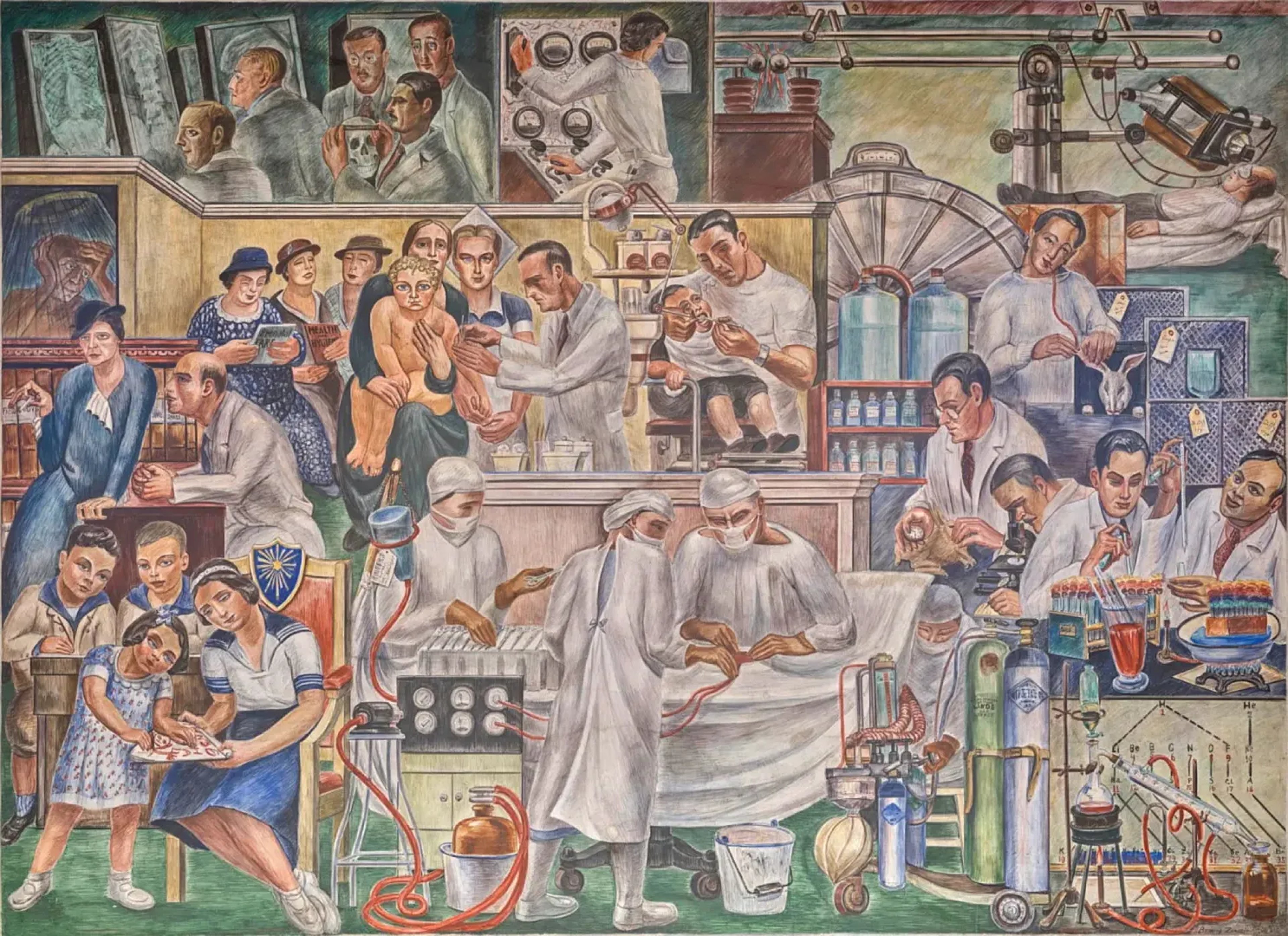
Bernard Zakheim, Modern Medicine (1935)
“As socialists, we do not criticize the commoditization of science in order to appeal for a return to the times before science became a commodity. That would be as futile as the antitrust laws, which seek to recreate precisely those past conditions that gave rise to the trusts. Our intent is different. The commoditization of science, its full incorporation into the process of capitalism, is the dominant fact of life for scientific activity and a pervasive influence on the thinking of scientists. To deny its relevance is to remain subject to its power, while the first step toward freedom is to acknowledge the dimensions of our unfreedom. As working scientists, we see the commoditization of science as the prime cause of the alienation of most scientists from the products of their labor. It stands between the powerful insights of science and corresponding advances in human welfare, often producing results that contradict the stated purposes.”
Richard Levins and Richard Lewontin, The Dialectical Biologist
The desolate landscape of the academy is littered with yearning for fulfillment, stability, recognition, and the opportunity to meaningfully contribute. I have encountered many of the archetypes. The graduate student trapped in the petty bourgeois fiefdom of their supervisor (pompously termed principal investigator, or PI); the postdoc traversing the job market for the umpteenth time, with too much of their time, effort and identity tethered to science to walk away; the liberally-minded scientific ideologues who see bad politicians getting in the way of good people doing good life changing science; the tenured PI who has convinced themselves of the notion of meritocracy; those wracked with self-doubt; those nurtured into undiminished self-assurance.
For those outside the academy, disdain for the established, and schadenfreude for the drifters, are popular and understandable reactions to such triumphs and woes. After all, “fulfillment, stability, recognition, and the opportunity to meaningfully contribute” are luxuries rarely afforded to the vast majority of downwardly mobile working class folks. Why should the academy be any exception? The communist and the utopian might respond that these expectations must not be limited to some professional strata of scientists and the like, but should be reasonable and foundational for proletarians everywhere, regardless of intra-class location or geography.
As a working early-career scientist who finds meaning in his work, though has little hope of a stable career within science, how science is currently organized - and how it might be organized in a post-capitalist world - are questions that I have found generative. This is not only the case for a limited inquiry into my own field, but for utilizing the question of scientific production as a theoretical testing space for how to coordinate large-scale projects in the absence of alienation and private property.
Central to this inquiry is the demystification of science in terms of the technical and social composition of scientific production. To democratize science in a truly revolutionary manner is to engage all of society in this fundamentally social process. In short, what might a republican conception of science look like? By republican, I refer to the Marxian dual sense of the term: each person having the right to engage in the decision making process of scientific production (i.e. one’s political freedom), and each having access to the educational apparatus to choose to engage in that scientific production itself (i.e. one’s social freedom).
Today we are a world away from such a vision. Most workers are shut out of the scientific process at every level, including how it is funded, the day-to-day nature of the work, and how scientific consensus is formed. The responsibility for such production rests with those who have undertaken years of formal training, creating a dichotomy between intellectual and manual labor that is at once both superficial and prescriptive. I want to explore how else we might organize scientific production to truly socialize this most social of processes, and argue why the form of utopianism posited here is rooted in the concrete conditions that exist today. Conversely, hearkening back to a time of better science funding and demanding a slew of technocratic fixes that - as Levins and Lewontin put it in the opening quote of this essay - seek to recreate precisely those past conditions, is an escape fantasy that has no grounding in the current moment.
Thinking beyond betrayal
As with the majority of discourse on politics, the narrative around science is one of bad people making bad decisions to ruin a largely good and universally beneficial field of study. In short, betrayal narratives dominate. The long arc of history and the conjunctural factors it produces are sidelined.
This orientation is not limited to well-meaning liberals either. The wave of democratic socialist movements in the late 2010s was characterized by a moral objection to rising inequality, and a demand for a return to state-backed infrastructure, welfare, and jobs programs. At its core was a plea for a return to the post-war boom, with a rhetorical framing centered on the immoral 1%. We see this framing in science too, where a once thriving scientific industry has become bloated with graduate students with no future prospects, a peer review system that is not fit for purpose, and geographical and economic precarity for any worker that hasn’t achieved tenure. The Trump administration’s attacks on the NIH and academia in general have fueled the active flames of such an outlook, providing an avatar of all that is wrong with an industry that is- it is argued - by no means perfect, but entirely reformable.
Although I believe there is a materialist history that shows that such reform via a Keynesian welfare state is no longer viable, this is not the primary question. Instead, I want to consider what a revolutionary overhaul of science under the free association of the producers of science might look like from a somewhat coarse-grained perspective. Such an approach inevitably invokes a strain of utopianism, often derided by those with revolutionary politics. Responding to critics of the first edition of Capital, Karl Marx derided the notion that his unveiling of the laws of motion of the capitalist mode of production should come with a set of blueprints for an alternative future society. This quotation about “cookshops of the future” has been used at various times to defer on the question of what the alternative society that we wish to build - shorn of alienation, overcoming need, and centered on freedom - might actually look like. And yet - without succumbing to rigid and formulaic schema - the onus is on those of us who see no solution within extant social relations to dream, to theorize, and to argue over what an alternative might look like.
What is crucial is that our utopian imaginings must be rooted in the current state of things, a point articulated by the Italian communist Amadeo Bordiga. He writes:
"Although the utopian does see the effects of present-day society (in fact Marx praises respectfully some of the masters of utopian thought), his error lies in deducing the shape of future society not from a concatenation of real processes that link the course of the past to that of the future, not from natural and social reality, but from his own head, from human reason."
When it comes to science, we must consider the necessary functions that facilitate scientific practice. These include coordination of large-scale, long-term projects, often with a level of uncertainty as to what the output might be, as well as the proliferation of such work. Any theory of what a communist or radical science may look like must begin with the premises of actually existing science. This short essay is an attempt to begin the task of thinking through “the real processes that link the course of the past to that of the future.”
The fundamental principles of scientific production and distribution under communism
A commonly articulated solution to the crisis in science, and in academia in general, is for state intervention to reform poorly functioning aspects of science, such as by implementing more efficient peer review protocols and a revamping of the publication system. While some point out that the state is no impartial actor that might be seized to do “good”, we cannot relapse into a fetishization of autonomy and independence.
Scientific production is a complex, cooperative endeavor. We cannot, and we should not want to start over or silo ourselves away, seeking some originary artisanal relationship toward scientific labor. An immense social infrastructure exists, currently leveraged toward the ultimate goal of accumulation. In the process, the products and achievements of science have reshaped the planet. Instead of shunning the complex web of relationships that constitute science then, what we must seek to build is a scientific republic without independence. Agency must reside with each and every one of us if we are to imagine scientific production that is not merely an appendage of state capitalism. Instead, the framework for our exploration here is that of the Group of International Communists’ (hereafter GIK) Fundamental principles of communist production and distribution. I shall give the briefest of overviews of this system that may leave many questions for those who are not already familiar with it.
Under the GIK system, workers are remunerated with labor vouchers according to the real-time hours they have worked. Goods are distributed according to their socially average production time. Individual working time is the measure of individual work; socially average production time is the measure of the product. Thus, one hour of work entitles a worker to an average social hour’s worth of goods.
Crucially, what is at the heart of the GIK system is the right of disposal. Put simply, who decides what is produced? And who decides what is done with that product? They write:
“The disposition of the production apparatus includes the disposition of the finished product. They are two different sides of the same thing. They are functionally dependent, and one is not without the other; one exists only through the other. Because the workers do not have the disposal of the production apparatus, therefore they also do not have the disposal of the finished product; thereby they are dominated, thereby they are wage laborers…As simple as the basis for domination of the working class is, as simple is the formulation for the abolition of wage slavery (even if the practical implementation is not so simple!). This abolition can only consist in the abolition of the separation of work and the work product, that the right of disposal over the work product and therefore also over the means of production is again given to the workers.”
Communism is not simply about capturing the means of production, but placing the right of disposal in the hands of all of society. What is produced is decided by democratically elected committees who are subject to the right of recall. A number of deductions to the social product must be made to account for social goods such as education, healthcare, and the needs of those who cannot work. The factor of individual consumption (FIC) is the ratio of these deductions to the total social product. A distinction is drawn between productive establishments that produce goods that can be obtained via labor vouchers, and general social use (GSU) establishments, where goods can be obtained for free. Which social goods constitute the GSU are democratically determined and will therefore change as society changes. As productivity increases within this system, more and more goods will be freely distributed, as opposed to exchanged for labor vouchers.
Attempting to summarize a rigorous treatment of what a transition away from capitalism should look like in a few short paragraphs will inevitably raise more questions than answers, particularly given the ongoing debates around the viability of the GIK system. However, the important aspect for our purpose is the GSU: social goods. As an endeavor that will not necessarily generate a product for individual consumption, and instead produces knowledge, information and data for society at large (which may or may not provide an input for downstream production), the practical activity of science would surely need to be funded as a general social good.
This raises an intriguing question. We have already stated that what constitutes the GSU will be democratically determined, so would society choose to fund science? And if so, which scientific endeavors would it choose to fund? This is anathema to most members of the intellectual strata, who - in the words of Anton Pannekoek - ”feel themselves the spiritual leaders, the class of intellect and knowledge, destined to take over the lead from the incapable hands of the present rulers.” The rise of the antivax movement and the re-emergence of eugenics have only reinforced this view. As I have argued previously, however, science is no monolith charting a singular course toward universal truths. No; the reality of science is that of an ever-changing social process. Rather than allow technocratic overseers to allocate resources to the sciences without challenge based on some abstract notion of science as a social good, the communist imperative is to raise all up to a level capable of questioning and engaging with the scientific process. I write:
“The fundamental point about notions such as ‘every cook can govern’ is not that everyone has the aptitude or interest to pursue scientific research. This is a rather uncontroversial point, and so is the notion that anyone who does have an interest should be able to engage with scientific practice. I am not exclusively concerned with equality of opportunity here, but with how science is a social endeavor that must be an ongoing dialogue between social actors. Just because someone doesn’t wish to commit years of study to perform scientific research, does not mean they should be shut out of science entirely. To democratise a system means to nurture engagement within that system.”
What this might look like in practice includes unfettered public access to scientific reports, conferences, and direct dialogue with those who are actually engaging with research. Given that education is part of the GSU, anyone who wishes to learn the technical and theoretical aspects of scientific practice should and would be able to do so. This runs counter to the global scientific industry both within and outside of the academy today, where the likelihood of becoming a scientist is more closely tethered to one's class position than any innate talent; a consequence of proletarian downward mobility under the capitalist mode of production in the shadow of the long downturn in profitability.
Even with such equality of opportunity, however, there is a distinction between the enthusiast and those who are engaging in the day-to-day practical activity of data collection and analysis. How then do we truly democratize how science is conducted when a somewhat qualitative distinction will exist between those who “do” practical science, and those who do not? The key here lies in the council form. Anton Pannekoek described the workers’ council as such:
“True organization, as the workers need it in the revolution, implies that everyone takes part in it, body and soul and brains, that everyone takes part in leadership as well as in action, and has to think out, to decide and to perform to the full of his capacities. Such an organization is a body of self-determining people. There is no place for professional leaders. Certainly there is obeying; everybody has to follow the decisions, which he himself has taken part in making. But the full power always rests with the workers themselves.”
Although there is much to admire here - the ethos of worker power and participation, not least - if we map this formulation of the conciliar form directly onto science, we will end up with scientists self-governing once more. True, there is free association amongst scientists, but the rest of society is still shut out of the organizing process.
What is needed is a mechanism whereby scientists can freely draw up budgeted research programs that are evaluated by those with enough practical and theoretical knowledge to assess the viability and utility of the proposed research, whilst avoiding compartmentalizing the whole process from society at large. Thus those engaged in scientific work are organized together in what we might call science councils, and submit proposed research programs for scrutiny to scientific congresses. Though this congress has sovereign decision-making power in terms of what is funded, the number of proposed projects is likely to be far beyond their capacity to evaluate. This function resides with elected committees that serve to administrate the scientific funding process. Crucially, this committee is elected by - and subject to recall by - society at large, and not just the science councils. Furthermore, all conciliar, congress, and committee meetings are open for public viewing. Thus, no aspect of the funding process occurs behind the backs of wider society, which has the ultimate power to depose a committee where necessary.
The GIK provides an example of how large infrastructure projects might be funded. Though their example is the construction of a new railway, I will adapt a direct quote for the purposes of funding scientific research programs. They write:
“The question then comes down to the need of society to calculate beforehand how much labor, means of production, and means of subsistence it can invest, without detriment, in such lines of business as for instance the execution of scientific research, which does not furnish any means of production or subsistence, nor produce any useful effect for a long time, perhaps even five years, while whilst it extracts labor, means of production, and means of subsistence from the total annual production…
…Therefore, if it seems desirable to fund such research, a budget must first be drawn up, stating how much social product (i.e., how many working hours) this will take up in total and over how many years it will be distributed. The character of this work is that it belongs to the type ‘public’, i.e., it burdens the budget for general social work (GSW). Although this reduces the payout factor, the costs of such research are borne by society as a whole, without breaking the link from the producer to the social product.”
Not just the link from producer (i.e. the scientist) to social product (i.e. the research), but the link between society and the producer is maintained throughout. This is the core aim of a revolutionized, communized science. At a brief glance, there are some obvious parallels here with how science is funded within the academy today, where scientists draw up research proposals, including precise budgeting, and a funding committee outsources evaluation of such proposals to fellow scientists who assess the viability and utility of the proposed research. The successful proposals are provided with funding to carry out this research. However, the links between producer, social product, and society at large are permanently severed under capitalism. Every aspect occurs behind the backs of society, with no access to research, no power by which to determine which research is funded, and the continued alienation of the scientific worker. Instead, we must place the right of disposal of both the scientific means of production and product in the hands of all of society.
What I have presented here are some very broad strokes of how scientific production might be organized under communism. The specific details of this account are not a hard-coded, singular solution, but an imagining of how and why it can be done. The main (though by no means only) logical condition necessary for a functional science enriching people’s lives in communist society is the same as that for production in general - the right of disposal, as so thoroughly outlined in the GIK. The specific form of a communist science will depend largely on the conditions and the culture that births communism.
Some practical questions
Yet, we cannot defer entirely on questions of specificity with regard to the reorganization of the production of science. Without focusing too specifically on scientific bette noires, we can look at some of the ideas that have been proposed for alternative scientific infrastructures that are functionally relevant to communist production.
Caution is needed here. It is important to avoid the lure of a technodeterminist framing with its promise of an inevitably more productive and efficient future. As Jonny Saunders argues:
“It is not the case that ‘scientific digital infrastructure’ will rise from the sea monolithically as a natural result of more development time and funding, but instead has many possible futures, each with their own advocates and beneficiaries. Without concerted and strategic development based on a shared and liberatory ethical framework, science will continue to follow the same path as other domains of digital technology down the dark road of platform capitalism.”
Although Saunders does not frame it as such, what we build will be informed by the level of class struggle, not by technocratic fixes alone.
In a sweeping, informative essay titled Decentralized Infrastructure for (Neuro)Science, Saunders contrasts the fetish for platform science with the flexibility that protocols - a set of rules that actors within a system adhere to - allow. Platforms mediate our ability to engage in social activity, offering nominally free services in exchange for data collection, surveillance, and supervision of human interaction.
The effects of reliance on platforms became evident when Elon Musk bought Twitter and utterly tanked its usability. A once vibrant scientific community was fractured, with some moving over to BlueSky whilst others attempted to continue amidst a digital ocean of bots. The fundamental problem was that each platform exists as an independent entity operating in its own vacuum. There are dozens of these platforms specifically dedicated to the science community (ResearchGate, Academia.edu, SemanticScholar, the list goes on), each its own social universe. The reliance on a service - provided by an often unidentifiable company or consortium that is harvesting data - runs counter to any emancipatory model of science. By contrast, protocols made up much of the processes of the early internet. Saunders provides the example of email via SMTP (Simple Mail Transfer Protocol). Without going into details, this protocol is the reason why I can send an email from a Gmail account to a Hotmail account, whereas being locked into a platform’s ecosystem means that I cannot send a message from my Twitter account to a BlueSky account, despite both platforms providing by and large the same service in terms of function. Protocols are flexible and are not constrained to any single platform or organization, whereas the platform is a much more rigid entity.
Saunders writes:
“By virtue of being intended for use by many independent organizations rather than under the sole control of a platform-holder, protocols are a complicated political effort that embed and facilitate systems of belief and power.”
The underlying theme of this essay is the necessity of decentralized coordination as a framework for revolutionizing science. It should be evident that protocols are a long-existing technology that can be harnessed for such purposes. Moreover, in contrast with platforms which generate their own ecosystems in isolation from the wider historical, social and technological context, “an emerging protocol should integrate or be capable of bridging with the technologies that currently fill its role.” Such “non-coercive architectures” make it easy both to engage and disengage, provided the learning curve is not excessively steep.
There are many further challenges for scientists looking to decentralized infrastructure. The storage and sharing of scientific data is vital for building on previous research and for reproducibility (a major problem in science today). Although there are numerous free-to-use centralized servers on which to store data, services such as GitHub and Data Dryad (to name just two) are dependent on a combination of grant and venture capitalist funding to survive. Indeed, GitHub provides functions that are essential to the potentialities of decentralized science. The ability to share work and to build on the work of others by “forking” off from what they have already developed has tremendous utility for tracking bugs, version control, and integration. However, GitHub has constantly turned to venture capital for funding, and has previously blocked developers in countries that are under US sanctions. In sum, the community that makes GitHub a vibrant development space has no say over how it operates, is funded, or what may happen to user data in the future.
The alternative suggested by Saunders is again one that has proven utility, namely peer-to-peer (p2p) systems, similar to torrenting, Sci-Hub, and LibGen. The premise is a simple one. He writes:
“The essential quality of any p2p system is that rather than each participant in a network interacting only with a single server that hosts all the data, everyone hosts data and interacts directly with each other.”
The flexibility and decentralized nature of p2p has many advantages, including the scaling of both speed and storage with users. As the community expands, so does the amount of storage as more peers lend their capacity. Likewise with speed, more users means more bandwidth. Most importantly, the system itself will not collapse with the loss of a data center or a failure to court enough investment.
Anecdotally, the majority of scientists I have spoken to will turn to Sci-Hub as their first port of call when seeking out a paywalled paper, despite having access through their institution. The appeal is that Scihub provides a function - provision of scientific literature - without unnecessary varnish and multiple logins and verification steps necessary when seeking access through an institution. The ethos is similar to torrents: with a simple search, download, and access process isn’t complicated by unnecessary extra steps. This is how we might harness technologies that have existed for a long time to demystify the networks that make up scientific infrastructure, rather than drown in the unnecessary mediation of data-leeching platforms.
Finally, it is worth briefly touching on peer review. Universally deemed unfit for purpose, alternatives have largely been limited to technocratic fixes such as the arXiv and eLife models. As Adam Mastroianni has pointed out, the entire peer-review and grant proposal framework treats science as a weak-link problem, whereby the overall quality of science is determined by how good the weakest works are. Such problems are fixed by improving the quality of the weakest links, or eliminating them altogether. This is how peer review works, with around 5.5 million collective days per year spent reviewing papers and grants in an effort to ensure poor quality research is not published. However, it is the most robust, well-substantiated, well-corroborated, and well-articulated ideas that have lasting utility in science (even if they are not immediately taken up).
Furthermore, the weak-link approach is simply not fit for the intended purpose of pruning poor research. A bad peer review is not cause for the submitter to reflect on the methodology and scope of one’s research. It is instead simply the impetus to try getting published in a different journal. Under a profit-driven model of science, however, there is little scope for an alternative. Publications are the currency of science, and - given the competition for funding and positions - this currency is greatly sought after. We are incentivized to remain covetous over our work, maintaining a defensive in-group mentality, as opposed to an open and generous outlook toward a truly collaborative science.
Absent such competition, open publication of ongoing work via lab notebooks, the sharing of methods and data, and the lack of anxiety over being ‘scooped’ have the potential to create a truly generative scientific enterprise. Under our proposed framework, every aspect of research is already in the public realm–so there is nothing to covet! More importantly, peer review becomes unnecessary as everything is already out in the open, with positive and critical voices able to provide active feedback as projects evolve. It is worth highlighting how inefficient the current peer review model is, where years of work might be entirely hidden from the public eye prior to publication, only to then suffer the wrath of peer reviewers who have spotted problems that might have been tackled early on in the project.
Ultimately, all claims of ownership - be it of data or accreditation as first author - dissolve as science becomes truly social. The links in the research chain are visible for all to see, and the thread that runs from our earlier conception of scientific production under communism finds not just a moral but a functional imperative. The current model of science is not fit for purpose and cannot be reformed into something more functional under a capitalist mode of production reliant on one asset bubble after another just to stay afloat.
Just as we cannot return to the days of the post-war Keynesian welfare state, neither can we simply dial back the clock to a moment where large-scale scientific production was coordinated by the state. Nor should we want to. A truly revolutionised and socialised science is not only possible, it is necessary.
Tasks at hand
“Communism is for us not a state of affairs which is to be established, an ideal to which reality [will] have to adjust itself. We call communism the real movement which abolishes the present state of things. The conditions of this movement result from the premises now in existence.”
What is the utility of an essay such as this one? It provides no blueprint, and explores an alternative model of science that is much removed from that of today. We might fold this question into the broader one of what communists should be doing in non-revolutionary moments.
In his book The Future of Revolution, Jasper Bernes argues that communists - the detritus of revolutionary conjunctures past - must still look to participate in struggles without assuming apriori that they might shape or organize them.
“In the quietness of the 1950s, however, the absence of revolutionary prospects effectively meant that it was not clear what communists could or should do in non-revolutionary times. The answer that ICO (Informations et Correspondances Ouvrières) comes up with is appealing: establish resonances, networks, and correspondences among the most revolutionary members of the class; pay attention, in order to discover the sources of class conflict, follow new contours of class struggle, and anticipate the shape of coming self-activity.”
This essay, then, is, in some modest form, an attempt to anticipate the shape of coming self-activity within the sciences by way of highlighting the theoretical and practical tools we have at hand. It is also a provocation for reframing revolutionary science within the language of republicanism. The case for reorganizing scientific production under capitalist social relations hits the same wall as any other technocratic redistributive program - we have simply run out of road. Proletarians across the political spectrum - be they scientists or not - often succumb to the seeming eternalisation of capitalist social relations. Any framework that looks beyond capitalism is shrugged off pejoratively as utopianism.
Although I just raised the question of what revolutionaries should be doing in non-revolutionary moments, the framing of this question is, of course, wrong. Between ongoing climate collapse, the capture of the state by the far right, the mobilizing of paramilitaries on civilian targets–to name but a few–revolution is certainly in the air. Although there is a conspicuous absence of coherent emancipatory forces on the ground, events change rapidly. Clearly, the liberal consensus has collapsed. In such times, arguing for tweaking the dial in order to reform peer review or better fund the sciences is a fundamental misreading of the moment. We must set our stall further and ask the hard questions of what our envisioned scientific republicanism without independence might actually look like, and how the current moment might supply the building blocks for that future. Crucially, we must name that future.
At the same time, it is important to emphasize that the academy is highly unlikely to be the motor of revolution, particularly within the ‘hard’ sciences. A survey of the class composition of producers of science can leave one demoralized. Indeed, my previous essay on the subject in The Black Lamp (and republished in Geese Magazine) might be viewed as a lament on how the technical and social composition of science workers inherently limits their political radicalization, and their recognition and engagement in class struggle. In their scathing attack on certain forms of utopianism, Phil Neel and Nick Chavez argue:
“Despite their apparent divergences, all [these certain forms of utopias] tend to operate according to a shared logic that is utopian not because it is imaginative but because it lacks any real substance or depth. Though their forms seem multifarious, such stories cast a single shadow onto that same flat surface, off-white. In other words, these utopias are unified less by the positive content of the worlds that they envision than by the fact that they all share the same glaring absences etched onto the same fictive flatness: first and foremost, we find the absence of "politics" itself, in the sense of some strategic sequence of struggle stretched between the immediate world and the envisioned utopia—after all, "utopia" is a non-place not because it cannot be envisioned but because no path can be stretched from here to there; and second, we find negative imprints left by questions that all such utopias refuse to ask.”
This portion of their essay has heavily divided opinion. Many have taken the authors to task for attacking our capacity to dream up and envision better worlds. However, this passage resonated strongly with me, because it captured the most important aspect of why utopianism is not only useful, but utterly necessary: it must be rooted in the world that exists today, in all its physical, social, and political complexity.
The road from here to there may seem obscured by the seemingly insurmountable weight of dead generations, but the very task of the communist utopian is to clear this path and shed light on what is possible. Science, then, is a highly appropriate utopian testing ground for the coordination of the free association of producers across large-scale, long-term projects. This essay merely dips its toe into such complex questions, outlining the contours and raising more questions than it answers, with the hope of building dialogue. Or - as Bernes puts it - “establishing resonances, networks, and correspondences among the most revolutionary members of the class.”
But the opening of these questions is precisely what the incoming democratization of scientific production looks like today.