
Sep 10, 2026
Ivan Roskic, an Organizer in the Communist Party of Austria, Discusses Affordability, Social Housing, and the Left’s Savior Complex
KPÖ organizer Ivan Roskic on how Austria's communists win: show up for people and turn affordability into a class fight.
by Thanos Bamihas and Ivan Roskic
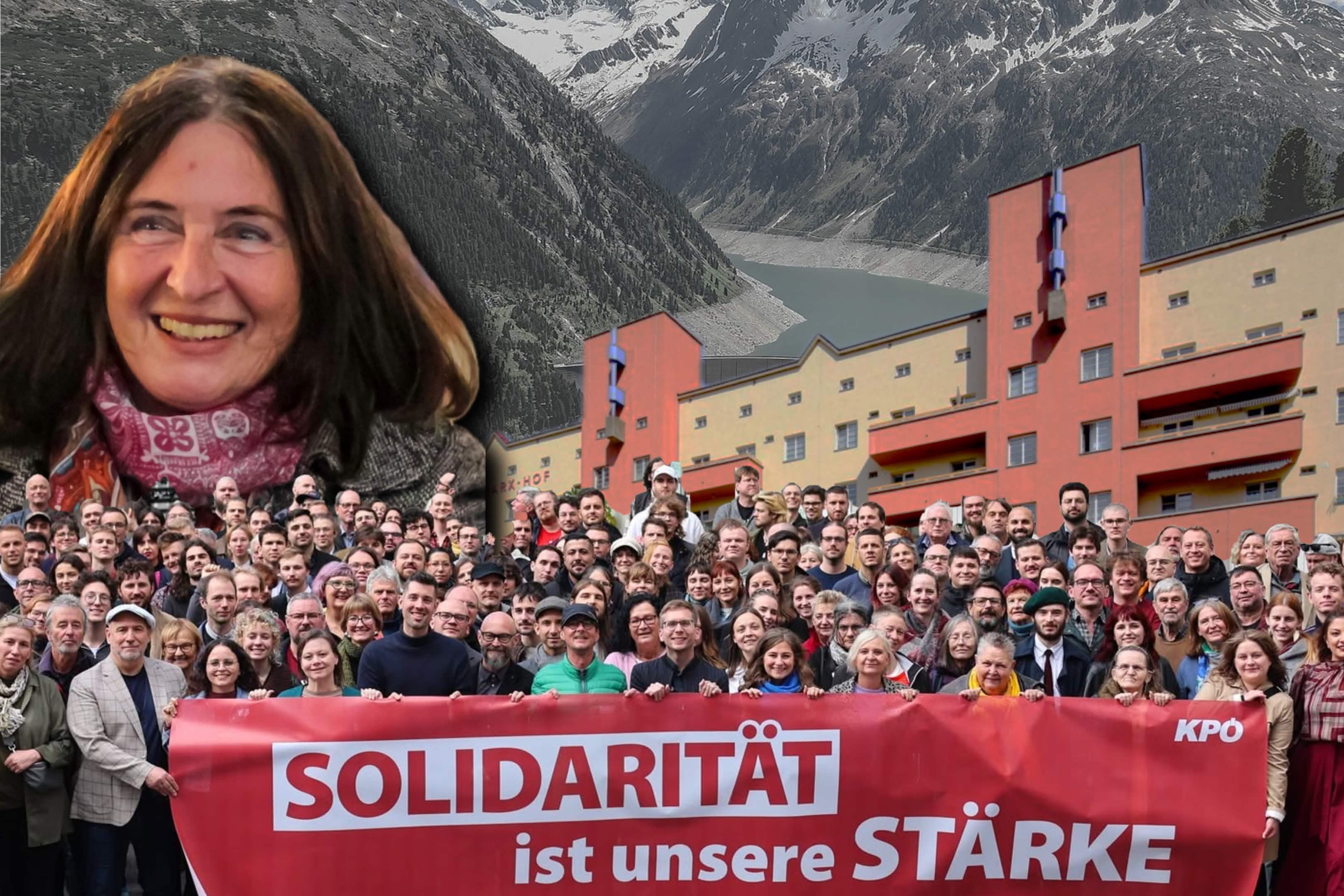
The Communist Party of Austria (KPÖ) has been and remains the primary Marxist force in Austrian politics for over a century. It has actively participated in every critical junction of Austrian political history and undergone many transformations. It has gone down from being a major force in Austrian pre-WWII politics to a sidelined protest voice since the 1970s, riddled with internal strife and internal ideological struggle. But, slowly but surely, it has managed to regain its place in national politics and challenge the status quo, offering a radical new vision for society. But how has a party—seemingly on the brink of collapse in the 1990s—succeeded in returning to relevancy? The answer is simple and lies in the roots they have developed. Despite their small size, they have become a daily and indispensable part of the lives of working people across Austria. For over thirty years they have put their focus primarily on bread-and-butter issues like housing, where many would argue that the KPÖ has built a hegemonic discourse. In a continent where the echoes of the “End of History” and the ghost of “There Is No Alternative” still linger, it would seem impossible for a communist party to reclaim its spotlight in national politics. The KPÖ shows that it is not impossible. Their recovery can teach leftists all over the world a bit about durable party structures, political strategy, and how to do communist mass politics in the age of polarization and the rise of the far right.
The following interview was translated from the original, which appeared in Greek in Εποχή. Assistance with the translation was graciously provided by Paschalis Papapaschalis.
Ivan Roskic, 25 years old, lives in Vienna and works in the tech industry. He has been a member of the Communist Party of Austria for 2 years and currently serves as the chief grassroots coordinator for the KPÖ in his district, Florisdorf. He was also elected as one of the 250 delegates for the 39th Congress of the KPÖ, which took place on 18 and 19 of December in Vienna. Despite low polling, a Gallup survey shows that 29% of the Austrian populace is favorable towards the party.
From the 17th to the 19th of October, 2025, the annual KPÖ conference took place, held against the backdrop of major changes occurring in the Austrian political landscape. What was the significance of this party conference? That is, in the context of the KPÖ's trajectory over the years and the growing instability seen all over the world stage, what was the goal of the conference?
The goal of the conference was to show to the people of Austria and the world the substantial strength that our party has gained over the last years through in all of its divisions. Finally, all of its separate parts met to discuss and decide on the short- and long-term goals of communists on the basis of material and social conditions inside and outside of Austria. We want to stress that we stand here and now, here as a force that will defend the people’s interests, as a rising force with membership comparable to that of three decades earlier.
Tell us, how did the conference do numbers-wise? Did the recent influx of members translate to more delegates as well?
In the last years, especially in 2023 and 2024, we saw a meteoric rise in our membership, around a 40% increase. A big part of that increase was young people, myself being one of them. This, of course, translated into a conference of a bigger scale—a delegation of 250. This is a much bigger group than most past conferences saw. People of all ages and backgrounds but with a shared appetite for debating and planning out the overthrow of the capitalist system.
Staying with the conference, please tell us which were the main political themes that were discussed. Were there any meaningful leftward shifts in your party’s line?
The main theme of our congress was the reunification of the party. The KPÖ had fallen into a serious crisis that ran from the mid-90s all the way through 2018. The Styrian branches of the party had broken away from the central party structure due to some minor political and strategical disputes, remaining, though, under the same name. De jure they were still recognized as a part of the party, but they were known for, let’s say, a different approach to politics and political action. In October's congress we finally achieved complete reunification of our party with that chapter, bringing an eight-year effort to an end. We were also reunited with the Communist Youth of Austria (KJÖ) and our university student wing.
Another theme discussed was the need for an anti-war movement whose goal would be the preservation of the neutrality the Austrian state is renowned for, but from an international angle aiming for disarmament and social justice. Furthermore, we spoke of drawing up a complete analysis of the geopolitical balance of global powers, a roadmap, if you will, of the KPÖ’s renewed international political strategy. We also elected a new Executive Bureau and two federal spokespersons, Tobias Schweiger (international matters) and Gunther Hopfgartner (internal affairs). Finally, the way I see it, the most important decision coming out of the congress was setting in motion a nationwide propaganda campaign targeting the raised cost of living, what causes it, and how it affects the working people of Austria. And all that, of course, would be tackled through the prism of a class-oriented analysis, something that no other party here offers. Our goal is to demonstrate the intensification of the class struggle and the creation of a real alternative for working people.
What’s the rental situation like in Austria? Does it follow the general European trend or not?
There is this misconception floating around the internet and parts of Europe that in Austria exists some kind of perfect social housing system that is fully supported by the state. Of course this isn’t accurate, and the truth lies somewhere in the middle. But let's take it from the beginning. During the last few years in Austria, everything has gotten more expensive at quite a fast pace, and the cost of living has become unbearable for many workers and for the economically vulnerable. Rent is no exception. Despite a country-wide rent freeze in 2024, rents started rising again after a forced repeal of the decision. In rent-stabilized apartments, increases will be capped at 5%, while the rest of the housing market will remain completely unrestricted. Over the last forty months, rent increased by 19%, while in neighboring countries like Germany and Switzerland, increases were kept at 6.2% and 7.4%, respectively. In general, since 2000 and following the onslaught of neoliberalism, the social housing sector was “liberated” and integrated into the broader real estate market, where it is forced to compete with private housing and landlord lobbies. The goal of the bourgeoisie and its political representatives is to undermine the class-based character of social housing through competition with greedy and predatory markets, since they view it as a “socialist fossil” from times past—a fossil that, for the sake of the market and of “progress,” must be eradicated.
Tell us more about the social housing system.
Social housing as an idea is a useful tool in the hands of the working class, useful not because I or some theoretical text said so, but because it has been proven to work. It serves the interests of the working class. It provides workers with cheap, quality housing and a tight-knit community. In Vienna, where this measure was first implemented, the social housing blocks include their own doctors, grocery stores, parks, and all kinds of services available to every single resident of a block, myself included. Furthermore, it teaches residents the value of self-management, as they themselves come to have control of the most important part of their lives: their own homes.
Historically speaking, we could say that this is the most left-wing achievement of social democracy since its inception. Of course, if we want to be fair, Austrian social democracy, especially in the 1920s, had substantial Marxist influences, and a large part of its supporters identified as Austromarxists. Austromarxism was a theoretical current with its own theoretical production and separate strategy from both the social democrats and the Marxists-Leninists. A strategy, however, that they themselves acknowledged did not clearly outline how they intended to achieve socialism. So we could say that the ambitious plan of social housing was achieved and maintained through sustained pressure from Austromarxists and the communists of the KPÖ.
Let's now shift our focus to municipal politics. Over the last couple of years, your party has secured very important electoral victories on the municipal level. These wins do not just set the stage for your best national election performance since 1967, but they also put you back on the map; you are again part of the daily conversations of left-wing people across Europe. So tell us, how did this magic happen? What is the communist strategy in municipal elections, and how do you defend social housing?
To be honest, there is no unified strategy for municipal elections. Rather, there are multiple that share some common elements. In general, what you need to do is simple: you have to come into genuine contact with the people and organize events. We call those “solidarity initiatives.” As a part of these initiatives, our members cook for the community; those of us who are teachers help the kids of the neighborhood with their homework, and, most importantly, we help those who can’t afford to pay their rent. We offer them legal aid, and that is, of course, free of charge.
Really, what you must do is show the people that you, as a communist, are here, and you will do everything in your power to fight together with your community, not for them or against them but alongside them. So you struggle together for material wins today to build the groundwork for tomorrow’s revolution. It is important to always talk to people in the streets, bringing your own viewpoint and lived experience into the conversation. We try to include everyone in these conversations, not necessarily to recruit them, but to mobilize them toward taking an interest in public affairs—to make them understand that politics are not confined to the halls of the bourgeois parliament and the upper echelons of society. Politics is here on the ground, and we are here to engage in politics with the people. When they start getting involved with politics, they start having questions, they start searching for the root cause of their problems, and they start to understand that the party is here to help them not only find these answers but also fight for the solutions. After all, that’s why they elect us—because the working people understand that we are not here to force them into anything; we are here to put their own interests forward and make these interests part of a national strategy.
Simultaneously, we fight for a politics that is explicitly anticapitalist. How are we achieving that? By creating a strong base on the municipal level in the collective affairs. By creating a base that has realized what their real financial problems are and is ready to abolish all of them. Decades of right-wing hegemony have created a system that just transfers state money to the bourgeoisie. What do we do as a counterexample? All of our party officials and representatives that get paid from public funds keep only part of their wage for personal expenses, while the rest is returned to the people through our social funds. Social funds are, of course, organized by the party and operate by distributing this money to the most vulnerable groups of society. We are the only party in Austria doing this. So in whatever we do, we always first look at ourselves; we don’t want our elected representatives to separate themselves from the working class. We want them to remain in it despite their participation in the bourgeois political system. That way, we show the people that we are not yet another cabal of corrupted politicians who remember them only when an election is coming up. Every state subsidy we receive is eventually given back to the people, whether they support us or not. We also fund all of our party through our membership dues. We are first and foremost setting an example of wealth redistribution and de-bureaucratization within our own party.
What lessons can the wider left draw from your success?
You have to accept the reality that people are living through and accept it as it is before you act in any way. If you approach them with the attitude of a savior, as someone who can lift the poor out of their circumstances, it simply will not work. It also will not work if you are constantly occupied with complex theoretical issues or if you and other leftists remain inside a militant bubble, always competing over who is the most revolutionary and radical. You need to be able to show the people what you can do right now so you keep them by your side in the future. You must always try and rebut the myriad individualistic narratives and understand that we are in this capitalist system together. We are not separate units fighting alone for their survival but masses ready to revolt and reclaim. In the end, the wider left must understand that it cannot afford to prioritize either social or material issues but instead address both in equal measure.
Yes, you will meet reactionaries and former leftists that have turned to the right wing, and you should not turn them away. Meet those people where they are and try to break through the years of propaganda that clouds their minds; show them that at the end of the day you share a common future better than wage slavery and hatred. This future is communism. It is entirely viable, and it is democratic through and through.
To conclude, what is the situation with Austrian labor unions in terms of material demands and membership strength? How do communists intervene within the unions?
In general, the trade union movement has declined substantially over the last few decades, and it has been confined to very basic demands. Unions do the bare minimum, and their goal is usually compromise with the bourgeoisie and their interests. The KPÖ has its own faction inside the General Federation of Unions, the Left Block of Unions, which cooperates with other independent left-wing unions and initiatives. The general idea is to organize the average worker in multiple ways. That’s why we must face the new reality of the 21st century, known as the “gig economy,” and react appropriately. We shouldn’t just cling onto the traditional ways of organizing that were designed for working environments with more stability. That’s why we organize professions and not necessarily workplaces. Of course, the traditional workplace environment remains dominant, but we pay particular attention to the portion of workers that rely on gig work, a section of the workforce with few rights and, in many cases, no stable income. A part of the working class that has all the right qualities to become a highly militant force in the syndicalist renaissance we aim to build.
In general, though, unions in Austria have always had a completely different role than those in other countries. They weren’t created as a reaction of the oppressed proletariat or as the initiative of a left-wing party. In contrast, they were created by the social democrats during the 1950s in order to sterilize the workers' movement. You see, by the end of WWII, many Austrian workers were already organized in worker councils, and there were many businesses that were entirely managed by their workers. The reaction of the social democrats was to create bureaucratic and cumbersome unions that gradually replaced the more militant workers' councils. Despite the fact that the unions scored some wins, in reality what they managed to do was consolidate the continued reproduction of existing class relations.
The goal of the KPÖ is to transform the labor unions from vehicles of the labor aristocracy to real tools made for and by the worker. We are trying to reconnect the unions with their class roots and replace the outdated system of delegation to representatives with direct democratic procedures.