
Jul 22, 2026
Post-Materialism and the DSA: From The Silent Revolution to The Other America and Back
Post-materialists believe they've transcended material concerns. Their values of self-expression, environmentalism, and participatory democracy say otherwise.
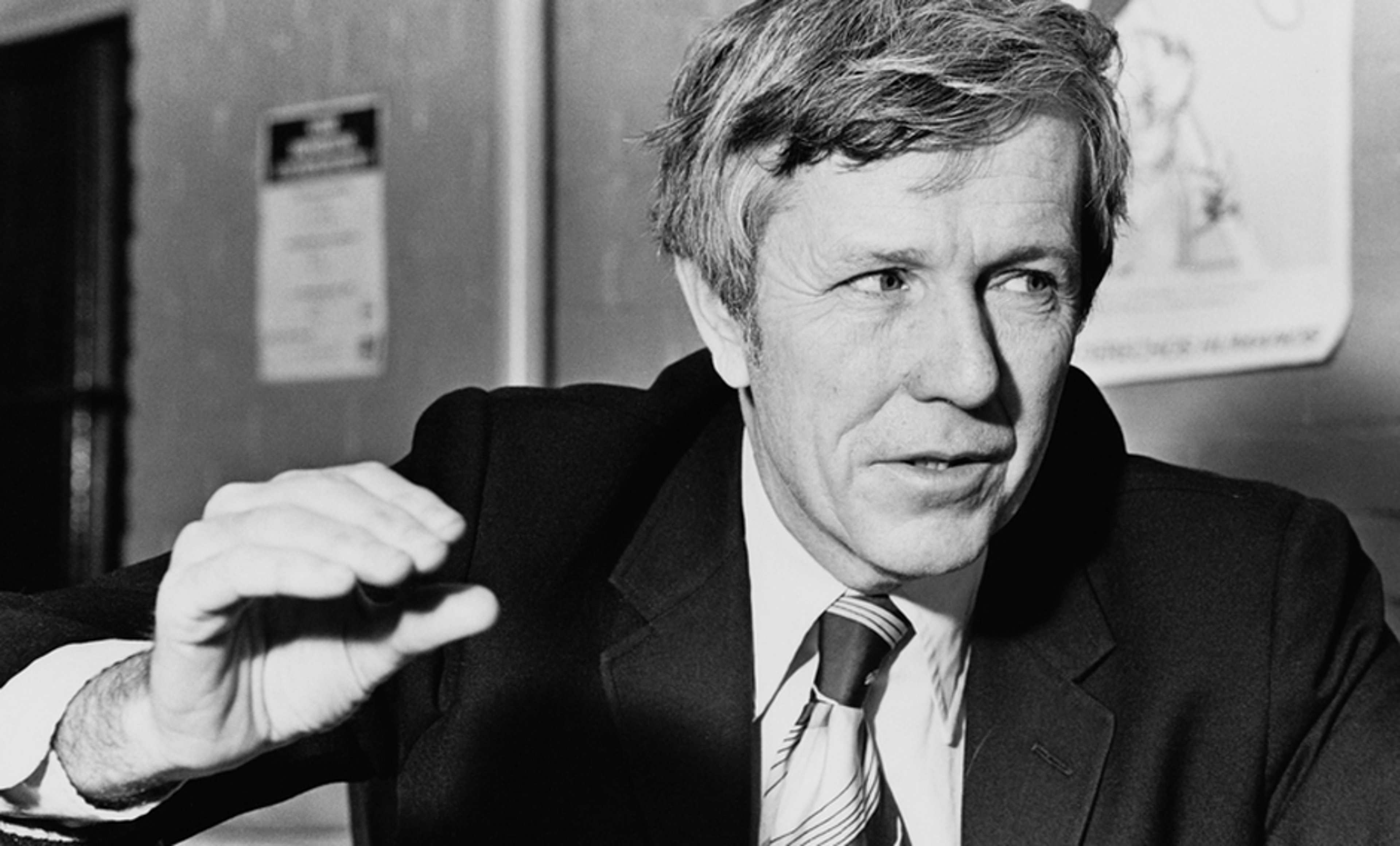
Michael Harrington | wnyc.org
On one side of the American left sits a politics of material demands: economic equality, redistribution, the eradication of poverty. On the other, a politics of values: environmentalism, gender equality, self-expression, democratic participation. These two currents are usually treated as separate, sometimes competing. They are not. They are structurally dependent on each other, and understanding why matters for how the left organizes today.
The tension has a theoretical history. In 1977, sociologist Ronald Inglehart published The Silent Revolution, documenting a shift in the values of Western publics away from material security and toward what he called post-materialist priorities: autonomy, self-expression, quality of life. Fifteen years earlier, Michael Harrington published The Other America, an unflinching account of poverty in the United States that would go on to inspire the Great Society and, eventually, the founding of the Democratic Socialists of America. The two books sit in apparent contradiction. Inglehart argued that prosperity produces a new kind of politics oriented around values beyond survival. Harrington argued that millions of Americans had not escaped survival in the first place.
Both were right.
Defining the Terms
Before tracing that argument, it helps to be clear about what materialism actually means in this context. The word carries a lot of baggage. In popular usage it tends to mean something like consumerism: an excessive attachment to possessions, a life organized around financial accumulation. That is not what is meant here.
In the Marxist tradition, materialism is a philosophical and political position. Dialectical materialism, developed by Karl Marx and Friedrich Engels, holds that reality is defined by the material world rather than by ideas. It claims that what shapes history is not consciousness or spirit but concrete, physical conditions. Historical materialism applies this framework to human society, arguing that all history is the product of struggles over an underlying economic base. As modes of production evolve, from feudalism to mercantilism to the neoliberal capitalism of today, new contradictions emerge and force new adaptations. The point is that ideas are always rooted in material conditions, and those conditions have to be understood first.
This distinction matters because the left's internal tensions are often mislabeled. What looks like a conflict between materialism and post-materialism is actually a conflict between different material conditions. The wealthy can afford to prioritize values, while the poor cannot.
The Silent Revolution
Ronald Inglehart's central argument was built on a simple observation. The unprecedented economic growth of the post-war period in Western countries had produced a generation that did not grow up under conditions of material scarcity. Drawing on Abraham Maslow's well-known hierarchy of needs, Inglehart argued that, once material needs are secured, people begin to prioritize higher-order concerns: belonging, esteem, and self-actualization. The result, he claimed, was a generational shift toward post-materialist values across Western publics: political participation, personal freedom, environmental protection, social equality took precedence over ‘bread and butter’ issues.
This was an observation Inglehart grounded in data. As founding president of the World Values Survey, a global research project tracking values across decades and dozens of countries, he found consistent evidence that economic security correlates with post-materialist priorities. Younger cohorts raised in prosperity were measurably more likely to prioritize self-expression over economic security than their parents. The shift was gradual, driven by what Inglehart and fellow political scientist Paul Abramson called Generational Replacement: as older cohorts shaped by scarcity died out, they were replaced by younger generations formed in abundance.
Inglehart identified two key mechanisms. The first, the Socialization Hypothesis, holds that basic values reflect the conditions of one's adolescent years rather than adult circumstances. The second, the Scarcity Hypothesis, holds that people place the greatest subjective value on whatever is in short supply. Together, these hypotheses produced his core prediction: post-war prosperity would produce post-materialist generations, and those generations would gradually transform the political landscape.
The theory has real explanatory power. It accounts for the social movements of the 1960s and 70s. The anti-war movement, the civil rights movement, second-wave feminism, and the early environmental movement all carried a distinctly ‘post-materialist’ character. They were driven largely by younger, educated, relatively affluent activists who opposed militarism, racial injustice, and gender inequality on ethical grounds. These were movements organized around values, not necessarily wages or immediate working conditions.
Inglehart's work also shaped policy research in lasting ways. The World Values Survey he founded has been running for over four decades, influencing how researchers measure public opinion and cultural change. His framework helped explain why wealthier democracies tend to become more liberal and participatory over time, and his connection between economic security and secularization, the gradual shift away from religious authority toward individualistic autonomy, remains influential in political sociology.
But the framework has significant limits, the most obvious is its Western-centric scope. The Silent Revolution focused explicitly on Western publics, and Inglehart acknowledges this. The problem is that the theory implies a universal trajectory it cannot actually demonstrate. In East Asia and the Middle East, substantial economic growth has occurred without a corresponding surge in post-materialist values. Cultural traditions and historical experiences shape value-formation in ways Inglehart's framework underestimates. The assumption that economic development produces post-materialism everywhere, given enough time, remains unproven.
A more fundamental critique concerns trend reversal. Post-materialist values, Inglehart's own research acknowledges, are highly sensitive to economic conditions. The stagflation crisis of the 1970s pushed many Americans back toward materialist concerns almost immediately, even among those who had previously identified with post-materialist priorities. Survey-based self-reporting of values does not always correspond to political behavior: people can express post-materialist views in private while voting on materialist grounds. The instability of the values Inglehart documents raises real questions about whether post-materialism is a durable transformation or a luxury that disappears under pressure.
The resurgence of populism and nationalism across Western societies in recent years makes this critique harder to dismiss. Societies that Inglehart's model would predict should be deep into post-materialist territory–the United States, the United Kingdom, France–have instead seen surges of economic nationalism, anti-globalism, and authoritarian politics. The deeper problem is one Inglehart never fully resolved. Post-materialism, as a framework, assumes that material concerns have already been addressed. It ignores the explanation of what happens to those for whom they have not.
The Other America
Michael Harrington's explanation for this issue was blunt. In 1962, at the height of American post-war prosperity, he estimated 40 to 50 million Americans living in poverty, roughly a quarter of the population at the time. They were invisible. Suburbanization had geographically separated the middle class from the urban poor. The mass media focused on prosperity and growth. Economic and racial segregation ensured that the wealthy rarely encountered deprivation directly.
"Here is a great mass of people," Harrington wrote, "yet it takes an effort of the intellect and will even to see them."
Irving Howe, prominent literary critic and fellow DSA member, wrote in the book's introduction: "In the 1930s, during the depth of the Depression, we were better prepared to acknowledge such dismal facts than we were in the 1960s, a time of widespread social delusion." The Great Depression had forced poverty into public consciousness. Post-war prosperity buried it again, even as millions remained trapped inside it.
Harrington's argument established that poverty in America was not a residual problem that growth would eventually solve. Failing public schools denied poor children the education needed to find employment, creating disparities in opportunity that began before children ever entered the workforce. Health systems penalized those without insurance, extracting the most from those least able to pay. Cycles of deprivation that began in childhood compounded across a lifetime, foreclosing the mobility that American ideology insisted was always available. The poor were trapped by design.
The spatial dimension of this entrapment matters. As the middle class moved to the suburbs, the urban poor remained geographically isolated from wealth and specifically excluded from the economic opportunities concentrated in wealthier communities. Economic segregation, compounding racial segregation, produced what Harrington described as a psychological as
well as a material condition: "The American poor are pessimistic and defeated, and they are victimized by mental suffering to a degree unknown in Suburbia."
Presidents John F. Kennedy and Lyndon B. Johnson both acknowledged the book's influence on their own politics. Johnson's War on Poverty and the Great Society programs, including the Social Security Amendments of 1965 that introduced Medicare and Medicaid, were in part a direct policy response to what Harrington had documented. These programs were significant, but insufficient. The vicious cycles Harrington identified in 1962 persist today. Private healthcare systems continue to extract from those least able to pay, with insurance quality rising with income and the uninsured and underinsured bearing the largest costs. Wealth inequality in the United States has grown, not shrunk, in the decades since.
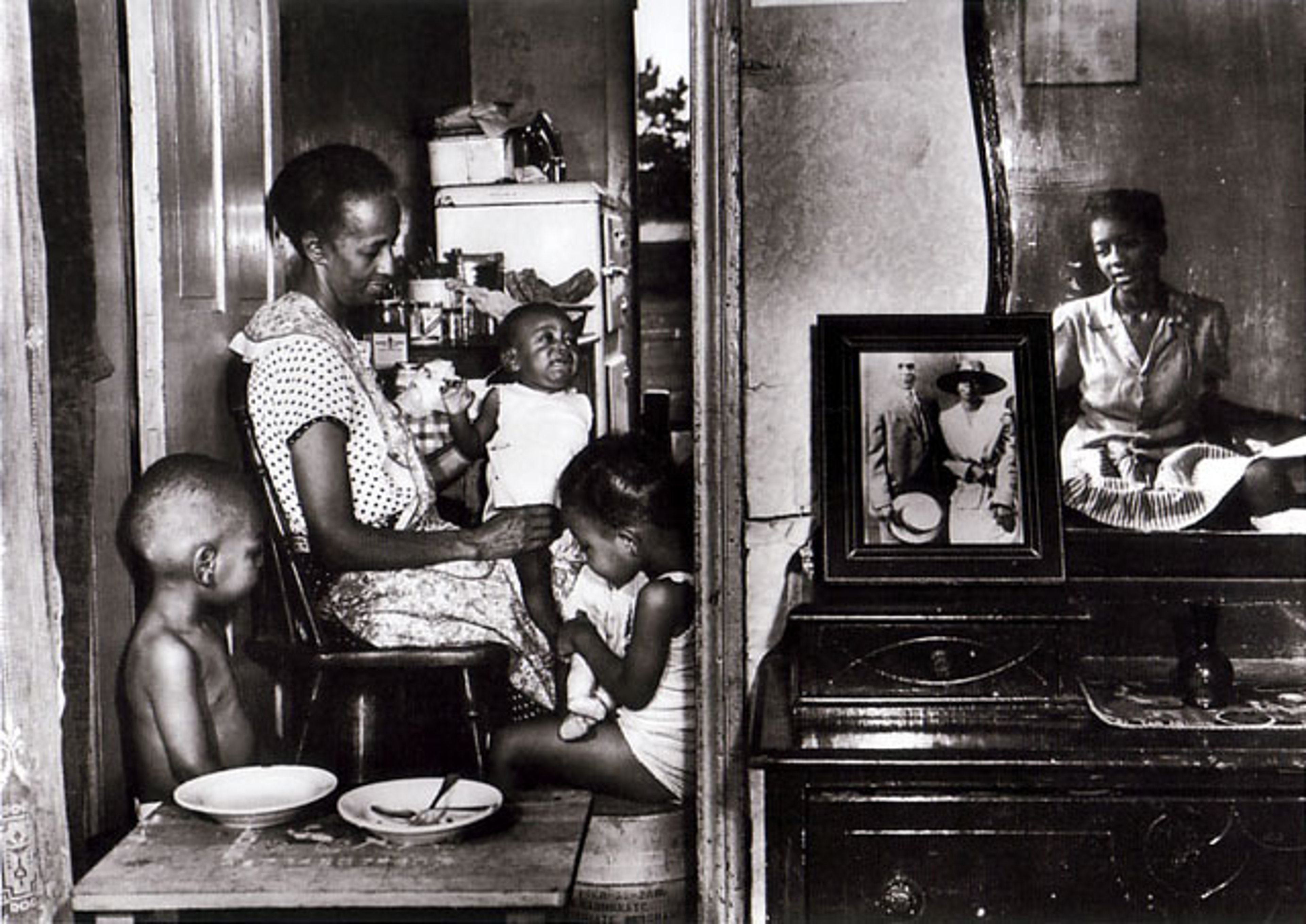
Photograph by Gordon Parks depicting life in Harlem
Harrington faced critics of his own. Barbara Ehrenreich, who would eventually serve as his co-chair in DSA, argued that his framework did not adequately address wealth accumulation, labor exploitation, and corporate power as root causes of poverty. Others noted that his framing through a largely race-neutral lens risked obscuring the centrality of racial inequality to American poverty. These criticisms are fair; Harrington was writing for a predominantly white liberal audience that needed to be convinced poverty existed at all. These choices ultimately shaped his analysis.
The core argument, however, holds: material conditions determine possibility. The poor cannot afford post-materialist politics. And the prosperity that Inglehart documented, the material security that produced the post-materialist generation, was never as universal as his Western sample suggested.
Schrodinger's Materialist
The connection between these two frameworks becomes clear when you look at the movements they each tried to explain. The anti-Vietnam war movement brought both currents together. Post-materialists opposed the war on humanitarian grounds: it was unjust, it caused suffering, it violated the values of a generation that had come of age in relative peace. Democratic socialists viewed it as an instrument of capitalist imperialism, a proxy war that served elite economic interests at the cost of working-class lives on multiple sides. Both currents ended up in the same coalition, fighting the same war, for reasons that were structurally compatible, even overlapping, even where they were ideologically distinct.
The Chicago 7 trial in 1969 made this visible: the defendants included figures whose politics ranged across socialist, anarchist, countercultural, and anti-war grounds, united by opposition to the same system through different analytical lenses.
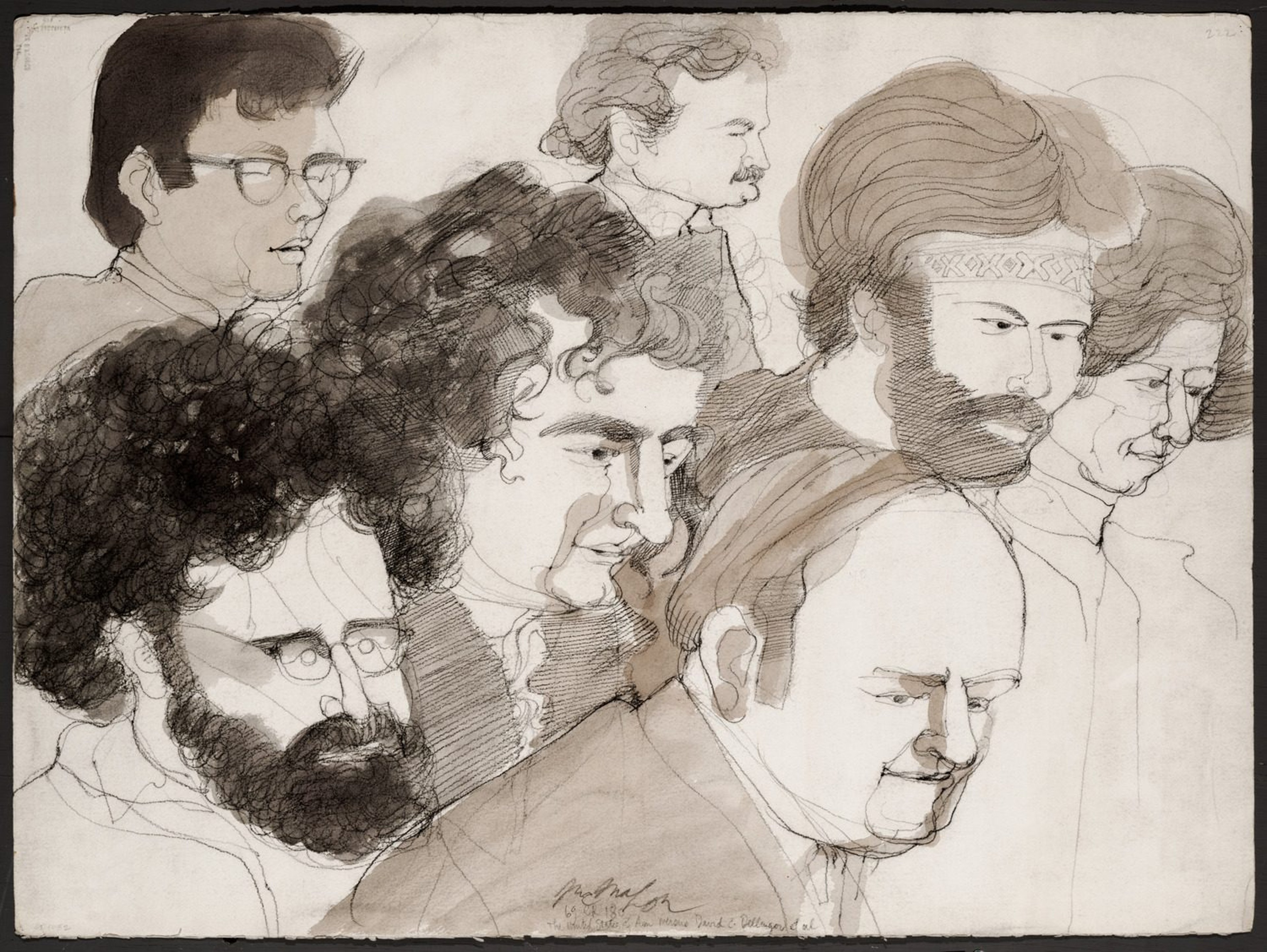
Profile view of all the Chicago Seven Trial defendants, 1969‒70. CHM, ICHi-051727; Franklin McMahon, artist
The civil rights movement illustrates the phenomenon in another dimension. Martin Luther King Jr. declared himself a socialist. His later campaigns, and particularly the Poor People's Campaign launched in 1968, were explicitly materialist in character, demanding economic justice as inseparable from racial justice. The moral arguments that drove the movement's early phase, the appeals to human dignity, equal rights, and the hypocrisy of American democracy,
depended on a recognition that racial inequality was reproduced by economic structures. Post-materialist in its ethical framing, materialist in its political conclusions and reality. The two registers were in fact the same argument from different angles.
Environmentalism follows the same pattern. Post-materialists oppose ecological destruction on grounds of preservation and quality of life: the environment has intrinsic value that markets do not capture. Socialists locate that destruction in the logic of capital accumulation, which externalizes environmental costs onto the poor and the public while privatizing the profits. The poor are disproportionately harmed by environmental degradation: they rely more heavily on natural resources for their livelihoods, lack the means to adapt to environmental changes, and are concentrated in more polluted areas because pollution makes land cheaper. The values and the material analysis point to the same crisis–just reaching it by different routes.
This is what I’d call Schrodinger's Materialist. The phrase comes from the famous thought experiment concerning quantum superposition dubbed Schrodinger's Cat, in which a cat is placed in a sealed box with a device that may or may not kill it, unknown to the observing scientist. According to the thought experiment, the boxed cat–so long as it remains unobserved–must be considered simultaneously alive and dead until the box is opened.
Post-materialists occupy an analogous position. They believe themselves to have transcended material concerns. They organize around values rather than economic demands. But these values, taken seriously, imply a material prerequisite: others must be lifted out of deprivation before those values can be universally realized. Inglehart's own framework makes this explicit: Post-materialist values only emerge once material needs are met. A genuine commitment to equality, self-expression, and democratic participation for all therefore requires a commitment to the material conditions that make those things possible. Post-materialists are, without always knowing it, making a materialist argument. They are simultaneously inside and outside the materialist framework.
The bridge between the two traditions runs through class. The poor remain materialist by necessity, focused on economic survival. The wealthy can afford to move up Maslow's hierarchy and prioritize post-materialist values. Class solidarity forms when both groups recognize that concrete systemic change is required before post-materialism can become universally available, rather than the exclusive property of those who can afford it. That recognition is where socialism and post-materialism meet.
Institutional Convergence
The parallel growth of these two currents through the 1960s and 70s fed into each other. A 1964 Gallup survey found that 48% of Americans agreed there was a definite trend toward socialism in the country.1 The same years that Inglehart documented as the crucible of the post-materialist shift were also the years in which democratic socialist organizing in the United States began to take more definite organizational shape.
In 1971, the New American Movement (NAM) was founded by activists emphasizing grassroots organizing around reproductive rights and gender equality. Its politics were distinctly post-materialist in character: locally rooted, focused on personal and social autonomy, skeptical of top-down party structures. In 1973, Harrington formed the Democratic Socialist Organizing Committee (DSOC) with 840 members, rooted in anti-war campus organizing and trade union politics. Its politics were explicitly materialist: economic equality, labor rights, structural redistribution.
By 1976, the two currents were collaborating directly. The DSOC launched Democracy '76, a coalition for full employment and corporate power regulation at the Democratic convention. This evolved into the Democratic Agenda, which by 1978 and 1979 had secured 40% of the Democratic Party's mid-term convention vote.2 Post-materialist activists and democratic socialists were building joint platforms, because their practical demands kept pointing in the same direction, notwithstanding their unresolved theoretical differences.
In 1982, the DSOC and NAM merged to create the Democratic Socialists of America (DSA). The merger was the organizational expression of a convergence that had been building for a decade. Labor-based materialist socialism fused with grassroots feminist, racial justice, and environmental activism. The DSA was from its founding a coalition of these two currents, held together by the recognition that neither could achieve its goals without the other. DSA membership grew more than 33% in the year following its founding, reaching over 8,000 members by 1983.
Democratic socialism, as Harrington understood it, was a claim about the conditions necessary for genuine democracy. The concentration of wealth in a small number of hands produces political power distributed just as unequally, voiding the democratic institutions that post-materialists also care about. This is the materialist argument at its most direct: economic structures shape political superstructures, from the means of production to the concrete laws, governance, and ideology that follow from them. A post-materialist commitment to democratic participation requires a socialist commitment to economic equality as its precondition.
The neoliberal framework that came to dominate American politics from the 1980s onward presents itself as a defense of freedom: free markets, individual choice, minimal state interference. Yet neoliberalism builds an ideological superstructure of supposed freedom to mask its materialist basis, which is the protection of elite economic interests. Materialism appears on both sides of the conflict, but in opposite directions. On one side, it could mean the accumulation of capital by those who already hold it. On the other, it means the redistribution of material conditions as a prerequisite for freedom. The post-materialist who genuinely wants freedom has to take a side.
A Dynamic Relationship
Economic downturns reliably push the balance back toward materialist concerns, and this is where Inglehart's own theories become most useful as a cautionary note.
The stagflation crisis of the 1970s interrupted the post-materialist shift almost as soon as Inglehart had documented it. The 2008 financial crisis produced Occupy Wall Street, a movement organized explicitly around material grievances: debt, inequality, the concentration of wealth in the top 1%. The post-materialist cultural framework was present in Occupy's horizontalism, its participatory assemblies, and its rejection of hierarchical leadership. But the demands were about money, housing, and economic survival. The Sanders campaigns of 2016 and 2020 drew on both currents simultaneously, combining materialist demands for universal healthcare and a living wage with post-materialist concerns around climate, racial justice, and democratic participation. The coalition held, imperfectly, long enough to reshape the terms of American political debate and build the largest socialist organization in the United States since the early twentieth century. DSA had roughly 6,000 members before Sanders announced his 2016 campaign. By 2020 it had over 80,000.
The coalition is fragile, as post-materialist values are contingent on the material conditions that produce them, as those conditions become increasingly insecure for a growing number of Americans. Wealth inequality in the United States has grown worse through every economic recovery since 2008.
The constituencies most likely to hold post-materialist values, the educated, the young, the environmentally engaged, are also the constituencies most likely to be carrying student debt, facing unaffordable housing, and working in precarious employment. The material conditions for stable post-materialism are eroding even among those who consider themselves post-materialists. This should make the convergence easier, not harder: the Schrodinger's Materialist is increasingly forced to open the box.
The contemporary climate movement makes this visible in its internal debates. Post-materialists have driven environmentalism as a values question: the planet has intrinsic worth, destruction is wrong regardless of its economic consequences. But the most influential strands of contemporary climate activism, from the Green New Deal to the proposals of Extinction Rebellion, ground their programs in economic transformation: challenging corporate power, redistributing wealth, building public ownership of energy infrastructure. Greta Thunberg's explicit statements that the climate crisis cannot be solved without addressing capitalism represent the Schrodinger's Materialist dynamic in real time: a post-materialist commitment to environmental values arriving, through its own logic, at a materialist political program.
An Unfinished Project
Post-materialism provides the cultural framework for progressive change. Socialism provides the material foundation without which that framework cannot be realized. The two are mutually dependent, and the history of the American left over the past sixty years is largely a history of what happens when they are treated as separate.
For democratic socialism to build durable majorities, it must also speak to people driven by post-materialist values: the environmentally concerned, the advocates for gender and racial equality. These constituencies are large and growing. But post-materialist politics pursued without a material anchor tends to drift toward symbolic victories and away from structural change. The history of liberal progressivism in America is largely a history of that drift: representation without redistribution, inclusion without transformation, values without the material conditions that would make them universal.
The inverse failure presents a different challenge: A socialism that addresses only economic inequality while ignoring the post-materialist dimensions of political life, the demands for autonomy, recognition, and democratic participation, will fail to build the coalitions it needs. The movements of the 1960s and 70s succeeded, where they did, by bringing these currents together. They failed, where they did, by allowing them to fracture.
Harrington understood this, and the DSA he founded was never a narrow economic organization. It was instead an attempt to hold materialism and post-materialism in productive tension, to insist that economic justice and social justice were effectively the same project approached from different angles. That the organization he built has struggled to maintain that tension, and that its recent history involves recurring conflicts between economic and cultural politics, does not invalidate the founding insight. It just demonstrates why the insight is hard to sustain without constant, deliberate political work.
The task for the left is to build the political infrastructure that can sustain both, recognizing that self-expression and economic equality are each the condition for the other. Inglehart showed us the values, while Harrington showed us the floor those values stand on. The project of building that floor, so that these values can be held, is the unfinished work of democratic socialism.