
Aug 5
The Left wins in Michigan. But the Limits of Deliverism are Starting to Show.
As wins accumulate, socialism is starting to function as a real, independent pole. But this means that the struggle against liquidation takes on a new importance.
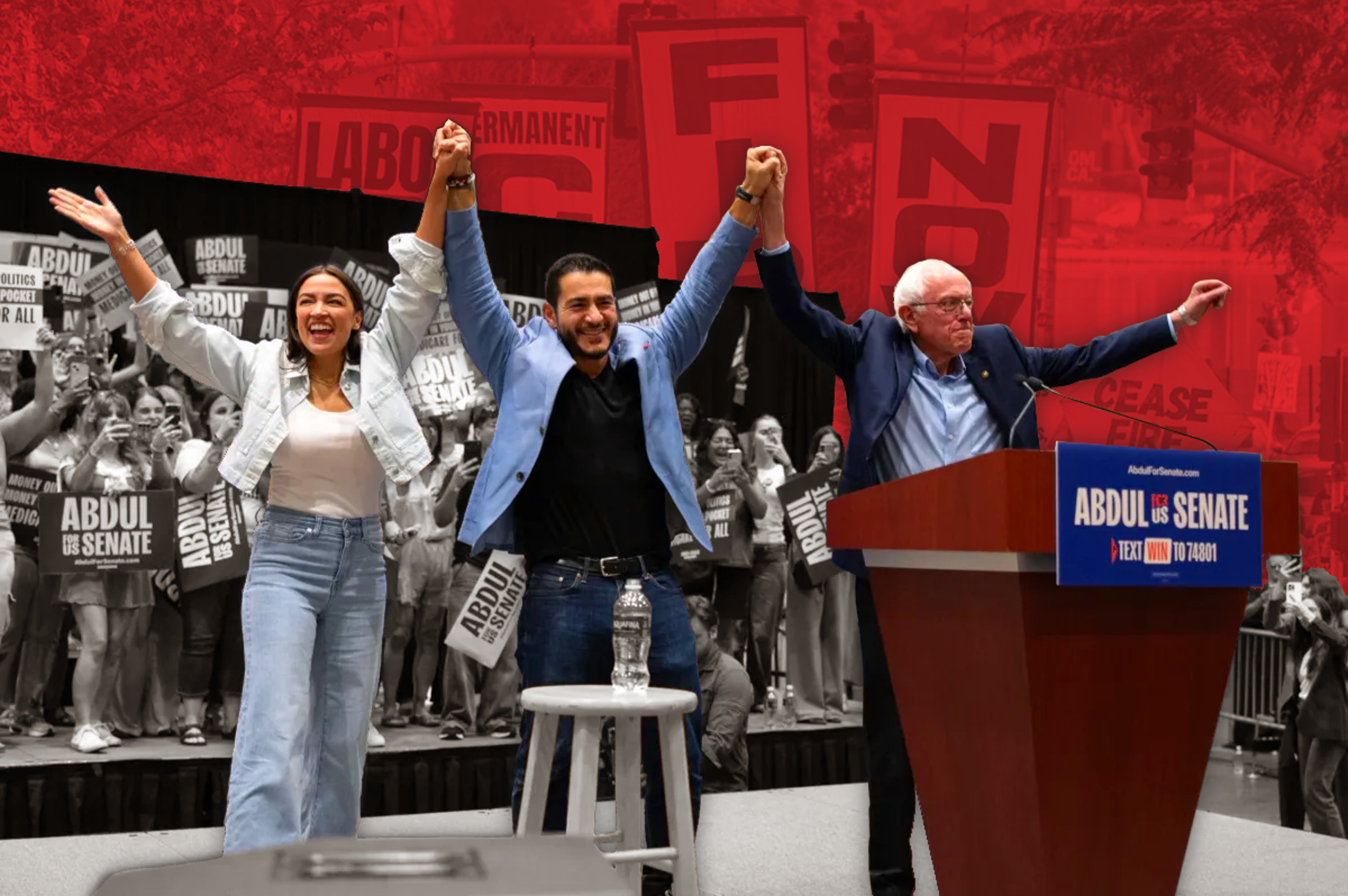
AOC, Abdul El-Sayed, and Bernie Sanders in front of a crowd.
“When people can behave like [Rep. Rashida Tlaib and Ilhan Omar], and knowing that they are Crooked and Corrupt Politicians, so bad for our Country, we should send them back from where they came — as fast as possible.”
Donald Trump on Truth Social, Feb. 25, 2026
August 4, 2026 was a watershed moment for the American left. Abdul El-Sayed won the Democratic nomination for U.S. Senate statewide; Donavan McKinney defeated an incumbent congressman in Detroit; and William Lawrence captured the nomination in one of Michigan’s most competitive House districts. These victories indicate the development of a substantial shift in American politics. Further, this isn’t the first socialist victory in recent memory; in fact, these 2026 primaries have proven to be a turning point for the left in Congress and the opening of a new phase of struggle for American socialism.
But the result in Michigan on Tuesday should be considered especially notable. This was not New York. Michigan is a swing state, one in which many said socialists and progressives could never feasibly run, let alone win. The Democratic Party strategy has long been to run ‘purple’ candidates in swing states who could appeal across the aisle to cobble together a voting bloc capable of getting them over the line. Tuesday showed that such a strategy is simply no longer capable of meeting the moment; the people want change, not triangulation.
The victory in Michigan is proof that the decades-long ideological consensus of neoliberalism has finally, irrefutably, come to a close. The predictions that these candidates could not win were not fundamentally false–they simply belonged to a previous era, one that has finally closed.
Despite the uneven character of political development, however, new tasks are emerging and become clear.
The electoral advance of democratic socialism under the second Trump administration, in many ways, mirrors the ideological advance of democratic socialism under the first Trump administration. In both cases, socialism, dormant and weak under liberalism, was able to make powerful strides in the midst of a new, dual-phenomenon: a loss of faith in the existing do-nothing Democrat leadership, and an openness to socialism as the solution to the crises heightened and clarified by the far-right’s political ascendance. The more Trump has exposed the rottenness of the American capitalist system, the more those who seek to revolutionize that system–not just manage, not just modify–gain ground on the enemy.
But it is ground won cheap. What we are seeing is not the development of socialism as an independent force, but as an appendage of social chaos. This may be structural–perhaps great and historical advances in Marxism are necessarily tied to objective social crises within capitalist politics. It may be that no political force can exist that is not wholly mired in the swamp of the era. In either case, it is necessary to define and analyze the elements of our particular crisis if we are going to arrive at a clear understanding of our relationship to it.
The key element that has been overshadowed by this great advance is that our moment is conjunctural–not merely in the sense that all events are, but that this crisis has a real, tangible, and quickly approaching horizon; that horizon is the 2028 Presidential Election. Whether or not AOC runs, the election and its results will be a judgment on the moment. Whether or not the far-right attempts or even succeeds in a coup of the White House–whether by physical or legalistic means–the far-right will be irrevocably changed.
It is hard to believe, but, in many ways, we have won. We have not won the ultimate victory, but we are at the close of the struggle against socialist marginality. Socialism has lurched out of the shadows, and is starting to function as a real political pole. The majority of Democrats and Gen-Z more generally have a favorable view of socialism, DSA dominates the media sphere and, holding it all together, has won real seats of power. The results of today show that this is not a temporary phenomenon. First, we won a few seats, then some more seats, then many seats–and how many more will we win in the next cycle? Our historical salience has been confirmed–it is no longer a question of if we will rise, but if we will be crushed, i.e., whether this insurgency will be smashed by the right or co-opted by liberalism.
At this stage, our goal is to ensure that the conclusion is as forceful and extensive as possible. The socialist moment must penetrate as deeply and as widely as possible–the destruction of the neoliberal tradition and the far-right must be so thorough that they are reduced to historical warnings. The more thoroughly the socialist moment against marginality completes its historical mission, the more sturdy our ground will be in the next phase of the struggle. This is why it is essential that AOC runs for President in 2028, and why we will be put in a terrible position if she does not–or if we fail to engage in the moment to most effectively advance our position.
To maximize the efficacy of the socialist moment, we must avoid two familiar traps: ultra-left abstentionism and right-opportunist liquidation. On the whole, ultra-left abstentionism is at a historical ebb. But it seems as if now the core of the socialist movement has, more or less, accepted that politics is an essential (if not primary) field of struggle, and that the tasks of the electoral struggle are expansive and oriented towards disarticulation of the neoliberal leadership and formation of an explicit socialist political pole. It feels, sometimes, like everyone is calling each other economists. Ultra-left abstentionism, as a serious threat, remains at worst a dangerous distraction–it is the sway of the rickety bridge, or the tantalizing apple, that threatens with its simple sweetness to lead us to serious and dire mistakes. We must maintain vigilance and avoid it at all costs.
Even so, abstentionism has been reduced to just that: a mistake, i.e., a deviation. It is not the path that the Marxist movement today currently moves on, as it once was; it exists at the edges and polarizations of our politics rather than constituting it substantially. Today, a different enemy emerges–and this enemy, like economistic abstentionism before it, is not particular, but general. It defines our movement as a whole–including, consequently, Geese Magazine. “Unfortunately, if Dante is delving into Hell, we are right behind him.”
This enemy is liquidationism: a politics that conceptualizes the break with marginality and towards the masses as a question of winning their support, rather than of mobilizing and advancing them as political actors. It is a theory of passive revolution against active revolution–against the idea of socialism as the flood of the people swallowing the old and the evil in its wake. In a word, it is deliverism: this viewpoint fundamentally conceives of socialism as fixing things–rationalizing society, it does not want to seize the state and break that rationality.
Before developing this path, it is worth fending off the theoretical ankle-biters who claim that they have predicted this the whole time. In the lead-up to this impressive result, countless socialists and communists organized and canvassed for DSA candidates like Donovan and aligned ones like Abdul El-Sayed. Have they done anything wrong? The answer is, categorically, No! The partisans of abstentionism are just as wrong today as they were yesterday–just as confused about the basic elements of dialectics as they were yesterday, just as confused about the character of mass struggle. Without the electoral victories achieved by the socialists, our position would be significantly weaker and there would be no question of next steps. It is these victories that have made the contradiction of liquidation the salient, primary contradiction–and they remain essential. We must continue waging this struggle, fighting for figures like Abdul El-Sayed, Francesca Hong, and Alexandria Ocasio-Cortez, even as we identify our own independent positions and tasks.
Without this basic understanding, the struggle against liquidation is stunted from the beginning. Instead of challenging liquidation, we liquidate ourselves practically and hide that face from ourselves through revolutionary phrase-mongering and communist conceit. In fact, the struggle against liquidation today is a higher form of the struggle yesterday–not just a one-sided negation. The electoral advance has opened the door for real Marxist politics, if we are able to take it.
But the figures we elect, by and large, will not do that for us. This is for a variety of reasons, such as the incentives of electioneering and mass politics, the limits of the largely incoherent concept of socialism among the American left-intelligentsia, or the awkward balancing act between socialism and liberalism that characterizes the current period. This is a passive analysis. It helps us understand why we are here abstractly, but does not analyze the factors in terms of what can be done to alter the balance of forces. This does not matter, what we know is that they will not do it for us and, for those of us who believe in the necessity of the party, we do not want them to represent us either. Both then and now, Geese has insisted that the primary question of all mass struggle is politics–that politics is in command. This does not erase the other factors of the struggle. But it is the clearest and most determinative element, as the element that coheres and condenses each other element of society in its own nexus.
What are the political problems of the current phase of struggle?
Francesca Hong is a case example for identifying this. She is particularly interesting, here, because she represents to me someone who is actually rather more left than many of the other elected candidates endorsed by DSA. In a recent interview with CNN, however, she stated that she was against defunding the police and abolishing prisons. Once, in the past, it seems, she was for the abolition of prisons. Things have changed, and, in the same interview, Hong clarified that she does not identify with the DSA program and touted her lack of endorsement as a plus, saying “I do not support the full platform of the national DSA and I am not endorsed by DSA National.”
Within DSA and the broader left, the reactions were mixed, leaning negative. Some condemned her for abandoning the abolitionist struggle. Others condemned her for rejecting the DSA program, or at least for not treating it more kindly. There were easy responses to both. The fact that national DSA has not endorsed Hong, that DSA does not have those types of expectations or requirements for endorsed candidates, and that endorsements generally don’t work that way, are all sound reasons for why Hong would not feel obligated to defend the organization’s program. I think this is correct. ‘Workers Deserve More’, DSA’s latest national program, as it stands, is a fine statement of principles articulated in a manner non-offensive to its internal conflicts and arrangements. It has proven extremely effective in terms of the permanent campaign–its clauses on abolition of prisons and the Senate have been particularly effective as incendiary slogans–but there is little reason to extrapolate that into a rule that all endorsed candidates must bind themselves to this statement of principles regardless of their campaign or conditions. A program of a new type is ultimately necessary–one that lays out the specific demands and transitional shifts required to achieve the elaborated principles, and which can cohere a real movement.
The question of abolition is significantly more interesting and essential for our purposes. There were two tracks in the defenses of Hong: the first, obviously, rejected the principle of abolition altogether. Fine, but, granting that Hong still does not want to defund the police, it is clear that what we can expect from her governorship is police reform at best–and not any serious attempt to actually transform the police force or replace its functions with different, more democratic bodies. Police reform–in any shape–is not the same as closing prisons, reducing headcounts, and taking away money from police departments. This is itself something that resolutely must be struggled against.
The second defense is more interesting, and more revealing of the contradictions of our task. In the same interview, Hong explains that her rejection of defunding/abolition is not a shift away from her socialist politics. Instead, she believes that, as governor, one must “be tough on causes if we're going to be tough on crime.” “Tough on causes,” of course, refers to social programs that would improve the quality of life of people such that they would be less likely to commit crime in the first place. For those defending Hong, this was a clever way for her to answer the question without falling into the ‘trap’ of defending abolition and without giving up her socialist principles.
It is the clean-ness of this formula that should repulse us. The struggle against liquidation in the current period can be sloganeered as: deliverism vs. democratic revolution. Every revolutionary upsurge begins to temper itself before reaching its conclusion; it begins to exhaust itself, to lose its momentum to friction. We must carry out the permanent campaign–we are the permanent antagonism in society, the restless, questing element that refuses to stop pushing; we must be Jacobins. The steam that drives our current engine depends on coal that is being quickly exhausted–left to its own devices, the train will crash, whether ‘crashing’ means far-right dictatorship or total co-option by liberal ideology.
The demands of abolition are not the demands of rational policy. Abolition is not directed towards achieving outcomes that flatter the values and sensibilities of the managerial strata. It is directed towards human freedom, expansion of people power vs the State, and a means through which individuals are brought into the management of their community and, by extension, their society. The error is not in rejecting this approach, but in reading it as a question of abstract policy, viz., reading it as a matter of being “tough on causes” rather than a matter of weakening the power of the far-right and strengthening the power of the progressive, multiracial working class.
Not so long ago, Zohran was asked a question about whether Israel has a right to exist. He said, “as a state with equal rights.” The reception was decidedly positive on the left: here, Zohran had condemned Israel without falling into the ‘trap’ of saying it did not have a right to exist. Yes, it was quite a clever answer. I remember a time when a driving complaint of the anti-zionist movement was the host of “supporters” who, knowing the whole time the truth about the genocide, when confronted with actual stakes, were happy to say all sorts of clever answers that avoided directly addressing the issue.
Israel does not have a right to exist–cleverness here is unnecessary; it is a retreat.
Zohran has achieved massive strides. Once again, we must be wary of the deviation–Mamdani is the Bernie of our time, someone who has revitalized and advanced our movement massively. But life is not black and white: what Zohran and what everyone else in society offers us is not wins or losses but the terrain upon which we can act. He–along with a large portion of the socialists in New York City–has accepted the massive pressure of New York’s real estate lobby, and opted to cut their losses on preserving public housing and NYCHA and focus on investments with a better political ROI. He has retained Jessica Tisch, the first NYPD chief in 60 years to be carried on from one mayoral administration to another.
He knows how to play the game–and this may be good. His endorsements in the recent Congressional primaries were undoubtedly decisive and ensured socialists like Darializa or Claire Valdez were able to win their races more or less handily. He is the most popular politician in America, and socialism’s current opportunities cannot be separated from him. We might say that he has a role to play, despite our criticisms; that he is limited by his position and has no other options. He is doing the best he can. This may be true.
The only response we can offer is that we are also limited by our position, and also out of options. The question of democratic revolution is existential–it concerns the existence or non-existence of the progressive, multi-racial proletariat of the United States. Respecting the limits of his position, to fight here is to do the best we can in our own.
What happens when 2 years have passed, and a Republican wins the Presidency? The second Trump administration has been more devastating than the first because of the far-right’s improved organization and enhanced boldness: their work now is an accumulation upon what they accomplished previously. Over the years, they have grown smarter (or at least more focused), more organized, more ambitious, and more radical.
If they successfully steal the election, their power will be virtually unchecked.
Already, in the current administration, we have seen the President deploy the National Guard to suppress an oppositional Democratic state–we have seen them target people for their beliefs, such as in the Prairieland cases, and we are watching as they tighten the noose in the form of the NSPM-7, which directs federal agencies to target left-leaning political entities, civil society groups, and activists under the umbrella of countering domestic terrorism. They are putting people in concentration camps.
They are telling us, to our faces, that they want to lock us all up, deport us, and be done with it. They want us gone.
If a Republican wins the 2028 Presidential election, the decisions they make will be more vicious compared to the current administration to the same degree that the current Trump administration is even more vicious than the first, in 2016. The opposition will only be more demoralized and depleted, and the enemy will be that much more emboldened and empowered.
No amount of popular support or policy will protect Zohran–or Hong, or Janeese Lewis-George, the DSA-endorsed Democratic nominee for the mayorship of Washington, D.C., and someone whom Trump has already threatened, or anyone else. In 2020, Joe Biden was so intolerably progressive that the far-right attempted a coup–they are only that much more thirsty for our blood.
In the context of Zohran, our options are limited. It remains necessary to maintain pressure on the police, particularly by emphasizing demands for retraining, restaffing, and shrinking the department. The Office of Community Safety is a strong step in this direction, if there is meaningful follow-up.
But the real crisis is not at the level of New York City. It concerns Alexandria Ocasio-Cortez and the left’s role in the Presidential election and campaign. In Zohran Mamdani Must ‘Project 2026’ New York City, Nik M. and I write:
What Mamdani will find is that, unlike de Blasio or Dinkins, he will not be afforded the privilege of simply being a good and progressive mayor who does his best to improve the quality of life of New Yorkers. Instead, Mamdani is a socialist—he has already been identified as, and elected as, an out-and-out open socialist, during an extremely intense period of class warfare. He is staring down the barrel of Trump’s federal pistol. He is caught in the sweep of radical economic and political changes that are already irreversibly transforming the possibilities of action, and which are rendering in a matter of years old styles of politics irretrievably anachronistic.
The worst case scenario is that, just like Dinkins and de Blasio, Mamdani is determined by history to be nothing more than an ephemeral phenomena and ultimately a footnote. But history often has greater expectations of its charges: despite Mamdani’s intentions, he will have no choice but, over the course of the next four years, to confront the enemy and fight him—he will be forced into realizing that he must, because of his position, do more than ‘deliver.’ The hope is merely that by emphasizing the essential elements of political governance and sketching out its potential practical form, the radical left, and perhaps Mamdani, will be better prepared for the gauntlet when it is inevitably thrown down.
We are approaching the moment when the gauntlet will be thrown down, and we must be prepared. Neither clever answers nor lithe maneuvering will save us here–only democratic revolution.
Zohran is in the position that he is in. We are in the position we are in. He may strive to be a good mayor–but if he wants to stay a good mayor, if we want to keep winning elections, if we want to stay out of camps, we must strive for more. The worry is ultimately not located at the level of New York City–but at the level of the nation, where AOC seems by all indications to adopt the ‘deliverist’ standpoint, all the more because both Zohran’s success and socialism’s current popularity more generally have been thematized along the lines of deliverism. If “affordability” is winning, why deviate?
The answer is simple. There is no popular revolution, there is no socialism, without the democratic revolution. The democratic revolution is the real logic underlying what the established forces formally present as deliverism for opportunistic reasons. If deliverism worked, Biden would be the most popular President in American history. Mamdani’s success cannot be separated from his extremely acute political nose, his mastery of the permanent campaign as a mode of politics, and his narrative function as the charged figure identified with the socialist pole–against genocide, for people–each of which are the real substance of his popularity.
The reason that Mamdani is so popular is because people want to fight back. They want to challenge the status quo. The people of the United States are in a collective political crisis. The old has died, and no one is quite sure what the new will be. The consequence of forgetting this is that, in a few years, we will all be caught completely flat-footed by our misapprehension of the moment.
But this has happened before. America has convulsed before. There have been political crises before. Sometimes, the dissidents win. Mostly, they lose. But there is always an end to the sequence.
If AOC runs, there is already plenty of preparation for what demands we will make of her. Some argue that we should use her to catalyze the program largely popularized by Carnation Program of Medicare4All, abolishing ICE and an arms embargo on Israel. Even if she loses, she will hopefully have polarized the issues such that whoever wins will commit to these demands in their campaign.
This would certainly be an achievement. But it is hopelessly inadequate for our moment. The shift is already happening–the arms embargo is quickly, for us, becoming less of a thing we must convince others of than a bludgeon we can use to attack the wavering and rightist elements of the Democratic Party. Medicare4All is quite an achievement; it is certainly “tough on causes.” Abolishing ICE remains more ambiguous, even as it gains more ground, and is the exception. Just like abolition generally, abolishing ICE restructures the State to be more pro-people and disempowers the undemocratic far-right. Either way, it is hopelessly inadequate. These demands are totally compatible with the traditional Democratic mode of politics, and each is quickly being co-opted.
More importantly, these demands, despite their valuable agitational role in previous moments, are limited in the immediate period. If AOC ascends to the Presidency, she will be faced with a government that is largely hostile to both her and her politics, except in their most milquetoast versions. She will become an Obama–incredibly popular, beloved, and ultimately a failure. Any decisive changes will be blocked by either Congress or the Supreme Court. Her staffers and appointees will largely borrow from the existing Democratic intelligentsia. Beneath her, a movement that is only freshly joining serious politics and articulating itself will be her only ally–a movement that is itself torn on its feelings towards her.
For every policy failure, we must have an opponent. For every obstruction, we must have an explanation. The explanation is that our society is structured in a fundamentally undemocratic manner. The opponent is anyone who stands against this democratization. It is not that the government does not serve the people effectively enough, which is the ultimate horizon of social democracy (and the ultimate content of the distinction between communist abolitionism and being “tough on causes”). It is that the people do not constitute the government substantially–that the sum of the Electoral College, the Senate, the Supreme Court, gerrymandering, gutting the Voting Rights Act, etc. function to maintain the power of the right and limit the activity and political participation of the people. Each of these is a question of not only political power, but political agency. Each of these is a real means through which the progressive multiracial working class is demobilized, disenfranchised and, ultimately, defeated.
The American working class must become a protagonist of its own political development. But it cannot just be cajoled into doing so. The structure of the State itself structures the character of the citizen. Questions of voter apathy and polarization are not arbitrary–they are the product of specific configurations of how individuals relate to power, whether they are incentivized by having their vote count, whether they have real options on the ballot, etc. As a tool of the elite, the State’s greatest weapon against the people is its ability to demobilize and thus defeat the proletarian subject–often without putting forward a single edict or firing a single bullet.
The model of the coming period is the sword and the shield: we must be the shield that supports AOC against the right, while remaining the sword that attacks her on behalf of the people and organizes the masses along a line that centers an immediate and comprehensive solution to the threat posed by white supremacy and the far right. The democratic revolution is key because it fills this function–it allows us to organize and advance the working class without either abandoning them out of abstention or shirking our duty through liquidation.
We must be the voice of this democratic revolution, embodied in documents like Project 2029. This is, importantly, the only means by which we can retain the radical edge and genuine independence of the socialist movement without falling back, once more, into practical marginality.
We must be the current in American society that relates all questions back to the question of the power of the people–that ceaselessly fights for their political agency.