
Jul 11, 2026
The People Kicked Graham Platner off the Ballot, not the "Establishment"
For months, Platner's campaign had absorbed scandal after scandal, but only when the people decided it was time to go was he kicked off the ballot.
by Gigi G
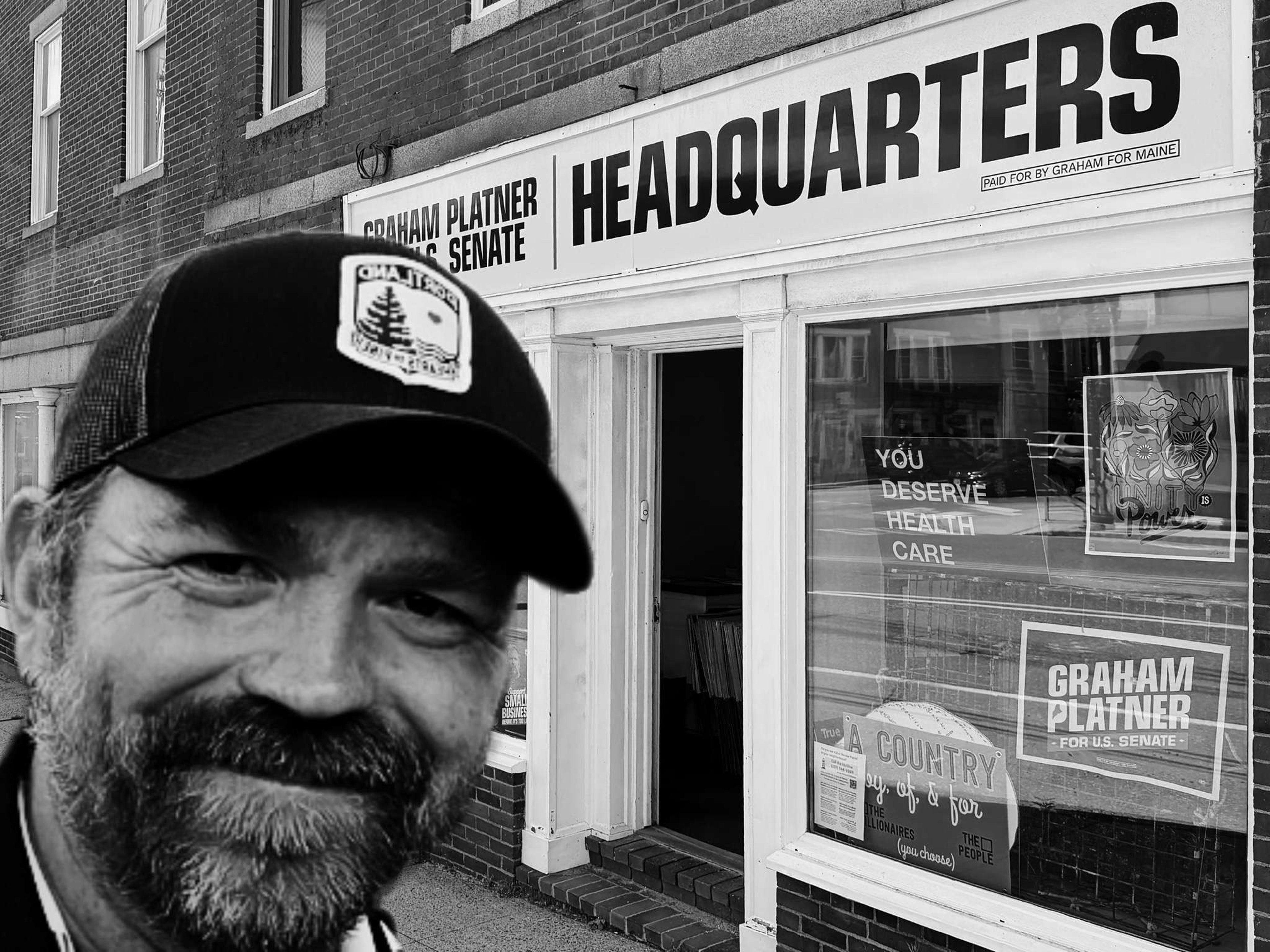
Graham Platner and his Campaign Headquarters.
Graham Platner, the Marine veteran and oyster farmer whose insurgent populist campaign captured more than 150,000 votes in the June 9 primary—a record for a Democratic Senate candidate in Maine—withdrew from the race this week after a former romantic partner accused him of sexual assault. His campaign had weathered months of earlier controversies, but this one had all the hallmarks of a credible accusation and collapsed his support almost overnight, with countless former backers urging him to step aside. On Friday, at the last possible minute, he filed the withdrawal paperwork with the Secretary of State, making his exit official and clearing the legal path for a replacement.
For months, Platner's campaign had absorbed scandal after scandal: his resurfaced social media posts, his ‘Totenkopf’ tattoo (a neo-nazi-affiliated symbol), leaked texts, and extremely concerning reports about how he had spoken of and treated women. Despite this, his polling, volunteer support base, and financial support continued to grow. And arguably, it should have: politically motivated scandalmongering has been the norm for decades, and treating every drip of scandal as disqualifying is no longer an option.
Voters did not, however, ignore Platner’s scandals; they weighed them, and found that without hard proof of anything further, and compared against a lab-grown establishment alternative whose politics include tolerating genocide in Israel and rolling over like a lapdog for the rich, Platner was still the more credible man and the lesser risk. Despite their often-stated misgivings about his behavior, Maine Democrats were prepared to send him to the Senate.
The Democratic Party voters have begun to take the lessons of the #MeToo era to heart. The Democratic establishment has not; for decades it has treated sexual assault and misconduct as a weapon. An accusation of any type is a hot commodity when their target is a populist threat. However, when the man is a useful insider, the party will run decades of coverups. In New York, Andrew Cuomo resigned the governorship after the state attorney general substantiated harassment allegations from eleven women, and the same media and political apparatus that attacked Platner immediately tried to launder disgraced sex pest Cuomo back into the mayor’s office—until a populist democratic-socialist campaign finished him at the ballot box. Zohran Mamdani and the people who voted for him.
In the Epstein era, institutions that behave this way have forfeited any standing to tell anyone who is trustworthy and who is not, and Maine voters knew it.
The scandal that finally moved the people did so because it was different in kind. One person came forward, for herself, to make a serious accusation. She did so with nothing to gain, and as a woman, a supporter of populist and democratic-socialist political ideas, everything to lose. The people identified her story as unmistakably credible. The volunteers who had knocked doors throughout the campaign stopped showing up. The small-dollar donors closed their wallets. The supporters who had shrugged off every scandalous drip for months accepted the truth about Platner, and withdrew their support immediately. Not the consultants, not the donor class, not insiders only party organizations, the people.
By the time populist leaders like Zohran Mamdani and Bernie Sanders demanded Platner withdraw, they were merely rubber stamping a verdict the grassroots had already rendered. The populist leaders followed the people, not the other way around. This is populism's theory of legitimacy—ordinary people are the competent judges of our own political life—and we alone give our candidates all of their legitimacy and power. Populism did not fail Maine this week. One candidate did—and the people, to our lasting credit, refused to fail with him.
Platner’s first instinct, before withdrawal, was to dismiss the accusation as smears "coached and coordinated by out of state establishment operatives." In a video, Platner insisted that "accusations are supposed to be the beginning of things, not the end," claimed a corporate media system and the political establishment had acted as "judge, jury and executioner," and told his supporters that "we're not doing it because of the allegations" but because those in power were stripping his campaign of the structures it needed to survive. He conceded only that "for the movement to continue it can't be me." Platner flails around for martyrdom as the movement abandons him.
The ballot line belongs to the people of Maine. Now, we have an opportunity to choose again.
Under Maine law, because Platner withdrew before the second Monday in July, the party may name a new nominee—but only until 5 p.m. on July 27. That gives the Maine Democratic Party a window of just over two weeks to design, publicize, and execute a statewide nomination process from scratch, in a race that could decide control of the U.S. Senate.
On Wednesday evening—before Platner had committed to filing his withdrawal—more than 100 members of the party's state committee convened an emergency meeting and voted to hold a ‘nominating convention’, contingent on his exit. Within a day, the party had stood up a dedicated public webpage laying out the process, an FAQ explaining why it was happening, and a candidate declaration portal.
The Maine Democratic party’s work is remarkable for how much open democracy it packs into so little time. This is not a smoke-filled room. Candidates must formally declare by July 15 and gather petition signatures from Democratic voters in at least eight of Maine's sixteen counties—a requirement the party's executive director, Devon Murphy-Anderson, framed as ensuring contenders actually talk to Maine voters rather than simply raising a hand. County-level caucuses are being scheduled to select delegates, and a convention of roughly 600 of them will choose the nominee before the deadline. This is effectively another primary.
As of this writing, at least eight Democrats have declared candidacy. The two most notable candidates are:
Troy Jackson, the fifth-generation logger from Allagash and former state Senate president. He filed exploratory paperwork with the FEC while Platner was still deciding whether or not to withdraw. Fresh off a competitive gubernatorial primary, where he campaigned alongside Bernie Sanders, Jackson is the most obvious heir to Platner's coalition.
Nirav Shah, the former Maine CDC director is the field's moderate, establishment candidate, his launch-day declaration is a rather confusing statement that "establishment politicians have failed us [...] we need an outsider.” If anyone finds out what he means by this please let us know.
Other candidates include Dan Kleban, Shenna Bellows, Jordan Wood, and David Costello.
Nearly every one of them is some form of Platner imitator, each feeding on the same popular energy.. The entire field, establishment included, is now running against the ‘establishment’. Platner's campaign may be dead, but the people’s energy lives on.
The convention will be held Saturday, July 25,-two days before the legal deadline. At the convention, voting for the senate candidate will proceed in rounds with the lowest vote-getters eliminated until someone commands a majority, a form of ranked choice voting that makes it hard for a plurality favorite of any faction, insurgent or establishment, to be jammed through without consensus. The whole thing will be livestreamed.
It will feature 601 delegates drawn from all sixteen counties. 101 members of the Maine Democratic State Committee are guaranteed seats, a totally unnecessary privilege for the standing party activists - but one unlikely to change the result if there is a clear populist favourite. Alongside 500 delegates elected at the county level.
The ballot line belongs to the people of Maine. On July 25, we will show up to claim it.