
Nov 19, 2026
The Purist and the Pragmatist: The Left-Communist Case for Deng Xiaoping
Facing post-Maoist China and its controversial chief architect.
by Finn S.
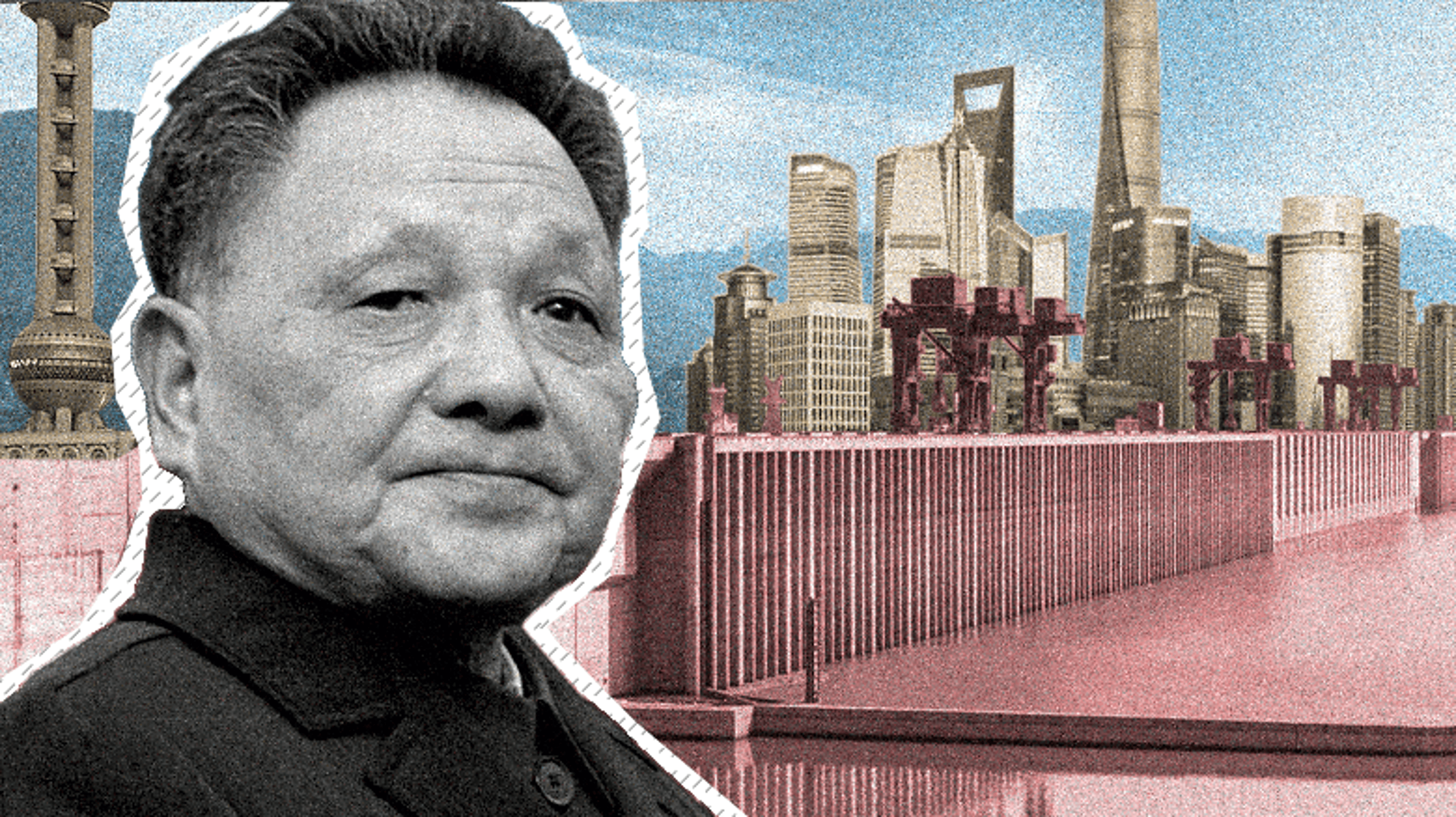
China today is one of the world’s most formidable economic powers. It has the world's second largest gross domestic product, and the strongest purchasing power parity. [1] It leads in sustainable energy, manufacturing, and STEM, and is undeniably one of the most important countries in the world.
Upon presentation of this information, there are generally three reactions, each corresponding to a political position. The Right will recoil in fear, hissing about the ‘communist threat’ which supposedly threatens to destabilize the Western World. The majority of the Left will condemn China for its capitalist turn, citing imperialism in Africa, mistreatment of workers, and so on. Then there are the sympathizers (some would even call themselves Dengists), who, though small in number, maintain that China is following a coherent Marxist line which follows from Lenin to Mao to Deng to Xi.
Deng Xiaoping represents a key transitional figure from a rapidly industrializing, but still mostly peasant nation, to the advanced technological society that is contemporary China. His legacy is either understood as a vindication of the necessity of the capitalist free market, the tragic but historically necessary degradation of socialism which arises from pre-capitalism, or the ushering in of an altogether new conception of socialism.
Overviewing Deng’s Marxism in its entirety is a task for a different article. However, a brief exposition is necessary. Deng’s political philosophy was based on his understanding of the specific conditions of China. Deng saw Mao’s Great Leap Forward and Cultural Revolution as well-intentioned disasters:
[I]n 1958 we made a mistake by initiating the Great Leap Forward. We neglected the laws governing economic development and consequently production dropped. Thanks to the three years of readjustment of the economy, the national economy resumed a fairly smooth development. But then came the ‘cultural revolution’, a disaster for the nation, causing economic chaos. For this reason, we have to take a few years to readjust the economy during our modernization drive. In short, we must act in accordance with economic laws. [2]
One of Deng’s staple rhetorical-theoretical tools is the idea of a “universal truth of Marxism” which must be concretized into “the concrete realities of China”, [3] as is implied by his concept of “Socialism with Chinese Characteristics”.
Secondly, there is his emphasis on the development of the productive forces. Deng’s conviction was that, were socialism to truly be the better economic system, it should enrich the people which it governs; thus follows his famous line, “to get rich is glorious”.
Deng was a simple thinker on the surface. Many of his concepts appeared rough around the edges, and he was in general focused more on leadership than developing a philosophy. There are no key “Dengist texts” in the same way that there are key Leninist or Maoist texts. But at the same time, Deng presents a profoundly interesting problem for Marxism, one that has been tackled in some way by almost every one of the most important Marxist thinkers: the tension between theory and practice. The unity and legibility of these concepts is formed around the horizon of communism; and of all those on the socialist left who have theorized this notion, it is the left-communists that, I argue, have the clearest vision. Their close-reading of Marx produces a vision of a world without commodity production or class struggle, to be achieved by a workers-led, internationalist struggle that opposes all structures of external domination. This fundamental vision for communism is the one that most resembles Marx’s own.
Left-communism, it should be noted, is a very broad and complicated intellectual history, one which contains multiple and contradictory expressions in different historical moments. Throughout this article, I refer mostly to the Lenin-inspired left-communists. In my view, this represents the most common and the most important of the left-communist positions. There are additionally the Hegelian or ‘Humanist’ Marxists, whose contributions to Marxism are both unique and relevant to the discussion at hand.
Despite the broad nature of the term, the left-communists do have some points of unity; perhaps the most important of those being the critique of the state. It is their clearest, most incisive point about ‘Actually Existing Socialism’. We begin from the understanding that the socialist society is without a state. Engels writes: “the state is merely a transitional institution of which use is made…to keep down one’s enemies by force”, and that once the enemies cease to exist (i.e., class struggle is eradicated), “the state as such ceases to exist”. [4] From there, the remaining state (insofar as society must be managed by some entity) becomes universalized to the point of obsolescence, and is done away with. The moment when the proletariat uses the state in the above-described manner is known as ‘the dictatorship of the proletariat’.
The difference between the dictatorship of the bourgeoisie and that of the proletariat is not a difference on the level of leadership or policy; the very nature and substance of the state itself is changed in the course of revolution. The state undergoes a profound process of democratization, whereby the government becomes more transparent to the working class or, to put it another way, the working class’ rule is made transparent to itself. From a theoretical perspective, all this is immanent to the activity of working-class rule, but from a practical one it is an arduous task during which the working class must combat various counter-revolutionary tendencies, from both within and without.
Thus we can see that the proletarian state, which Lenin calls a “semi-state”, [5] is viewed by left-communists as a necrotic state: one that only exists out of temporary necessity, and which will soon vanish as the bourgeoisie emits its dying breaths. Additionally, for the more Humanist-inclined Marxists, the state represents the site of a profound alienation. In his early writings on Hegel, Marx says “the abstraction of the state as such belongs only to modern times because the abstraction of private life belongs only to modern times. The abstraction of the political state is a modern product”. [6] Here Marx reads the progression of history, not in the cold economic calculus so often associated with him, but with the movement of the becoming of the various ‘spheres’ of life: the political, economic, social, and so on. Whereas in monarchy, all spheres of life become formally subsumed under the political and must be “revindicat[ed]” at the cost of their “private essence”, this first form of alienation (the negation of all spheres to the political sphere) is sublated by the invention of the constitutional republic. In this process we arrive at the above-mentioned abstraction of the state; in the negation of the negation, the state brings about a new alienation, the alienation of political life from the other spheres of life (hereafter called the ‘civil spheres’). Therefore in monarchy, the flaw was the absolute domination of the other spheres by the political, and in capitalism we are faced with the absolute separation between the other spheres and the political. Hegel saw the “unofficial” civil spheres and the political sphere as in conflict, only finding their desired unity within the state, while Marx saw in the state the expression only of a given level of human activity, which divides itself into spheres and undergoes a process of alienation. Thus in the Marxist concept of the state we are confronted with the unavoidable conclusion that it is a product and proliferator of capitalism and alienation.
Moving beyond theory, there is also the practical question of how one can maintain socialism within a capitalist world. This was the problem raised by Stalin in his doctrine of Socialism in One Country (though, a more poorly named theoretical development there never was). He writes: “the overthrow of the power of the bourgeoisie and establishment of the power of the proletariat in one country does not yet mean that the complete victory of socialism has been ensured…the victory of the revolution in at least several countries is needed…the revolution which has been victorious in one country must regard itself not as a self-sufficient entity, but as an aid, as a means for hastening the victory of the proletariat in other countries”. [7] Stalin, though semantically incorrect in his use of the word socialism here, nevertheless accurately reflects the opinion of Marx and Engels: “Will it be possible for this revolution to take place in one country alone? No”. [8] It was their belief that those countries which were furthest along in capitalist development would face revolution first, and such a revolution would usher in a domino effect across the global chain of capitalism.
This, as we know, did not exactly come to pass. It was in fact the feudal and semi-feudal countries of Cuba, Vietnam, China, North Korea, the former Soviet republics, etc., that found themselves swept up in the currents of revolution of the twentieth century. However, the majority of these countries have either fallen, retreated into themselves completely, or been forced to open up to foreign markets in some way. In short, despite the promise which they showed, we do not yet have global socialism. All countries which tried to do away with the bourgeois state failed to do so, and as such failed to do away with capitalism itself.
That the Marxist practice and the Marxist theory are seemingly contradictory is not so surprising. Here exists an important historical dialectic, one very similar to what Domenico Losurdo called “the dialectic of revolution”. He writes: “In the wake of the struggle against inequality, privileges, discrimination, injustices―and against the oppression of the old regime and its particularisms and exclusivism, with the old ruling class condemned for its pettiness and egoism―the most radical revolutionaries are driven to express a strong, inspiring and high-sounding vision of the principles of equality and universality”. This universalizing cause must be expressed concretely and determinately, but “it’s precisely this determined and concrete content that is seen as a betrayal” to the universalizing values of the revolution. [9] In the battle between Stalin and Trotsky we should therefore read the two poles as two distinct spheres of revolutionary thought. In Trotsky we see the representation of revolutionary universalization; in Stalin we see the concrete expression of this universalization. We can additionally (and tentatively) identify Trotsky with theory, and Stalin with praxis.
But, given that this is a dialectic, it cannot be that one side is absolutely correct. If we begin from universalism, we shall say that when the workers seize the state, they must immediately begin breaking it down, universalizing its functions to all members of society until it serves no necessary function. But this theory is only intelligible within a given social practice (itself determined by a given economic and political moment in history). Thus we are here forced to move into practice, a practice which forces us to engage with the very systems that theory makes us condemn. This leads certain leftists to espouse a complete withdrawal from all electoral politics. Because they espouse a politics of universality and equality, they also see, roughly, an equality in the evil of the bourgeois parties. But the refusal to engage in any bourgeois system is an abstract negation of practice itself (since socialist practice necessarily takes place in bourgeois systems). This refusal is therefore a negation theory as well, insofar as theory must be in relation to practice. But here we have a contradiction: on the one hand, theory asks us to universalize, to find the relations between concepts and objects, and to understand how these relations create a newer world; practice asks us to specify, to engage in the very relations which theory critiques.
This is why practice seems to constantly betray theory; the movement which births a new world can only be the sublation of the theory upon which the movement is based.
Nevertheless (and this is what makes Deng so fascinating), China remains committed to the idea that it is socialist, despite not having abolished classes, despite still having a state, despite still producing commodities, etc. Deng, in his writings, is always concerned with the development of socialism and the proof of its superiority to capitalism, but rarely does he define socialism, or explain how the policies he implements are themselves socialist.
In his mind, the victory of socialism has already been established. He says, for example, that “it doesn't matter if a cat is black or white; if it catches mice it's a good cat.” But he does not explain how the goodness of the cat furthers the socialist cause qua socialist cause. Instead, he will say that “the aim of socialism is to make all our people prosperous”. [10] Thus Deng saw all policies that furthered national prosperity as socialist. In doing so he seemed to transform socialism from an economic system into a moralist one, where good corresponds to socialism and bad corresponds to capitalism. In short, Deng, though being a flawed theorist, was a very successful pragmatist.
Most on the left argue that China operates in a capitalist economy. In this, they cite its continued commodity production, use of the market economy, the continual existence of private ownership, and the state―rather than withering away―only growing stronger. All of these would be considered hallmark features of a capitalist society. To this Dengists will respond that the USSR too had these features under Lenin’s New Economic Policy, to which the left will respond that the NEP constituted a tactical retreat, whereas the Dengist reforms seem to be aimed at a much more long-term strategy.
Herein lies the issue: is the difference between the NEP and Dengist reforms merely quantitative or additionally qualitative? And if they are qualitative, what kind of fundamental changes have they introduced?
Lenin, in a report on the NEP, described it as a “strategical retreat”, which aimed to “retreat and reorganise everything, but on a firmer basis”. [11] Since the world had proven so hostile to socialism, the USSR needed a strong base on which to stand, which their partially pre-capitalist economy did not allow for. But in developing this base further, in re-introducing capitalist relations to the young proletarian state, the question was raised: “who will win, the capitalist or Soviet power?” To this, Lenin gives no definite answer, instead saying:
Either the capitalists succeed in organising first—in which case they will drive out the Communists and that will be the end of it. Or the proletarian state power, with the support of the peasantry, will prove capable of keeping a proper rein on those gentlemen, the capitalists, so as to direct capitalism along state channels and to create a capitalism that will be subordinate to the state and serve the state.
Thus Lenin describes the NEP as “a capitalism that will be subordinate to the state and serve the state”. As has been well-documented, the NEP was a great success, as the Soviet economy soared to unseen levels, as well as paving the way for the controversial (but undeniably effective) five-year-plans of Stalin.
But how sustainable is this? It is clear that Lenin, especially as the prospects of socialism receded into the horizon, was worried about the future of the proletarian experiment: “the [state] apparatus we call ours is, in fact, still quite alien to us; it is a bourgeois and tsarist hotch-potch”. [12] It is equally clear, though, that regardless of the adoption of the NEP, the development of socialism would be hindered. Lenin goes further to say that “there has been no possibility of getting rid of [the bourgeois state] in the course of the past five years without the help of other countries and because we have been ‘busy’ most of the time with military engagements and the fight against famine”. Thus the USSR’s inability to combat the bourgeois state comes not from an economic policy but rather the international political situation.
We can extrapolate from this that Lenin, the theorist, believed the economic relations of the USSR to be capitalist ones. He certainly called the NEP such, and given his description of the Soviet state as “a bourgeois and tsarist hotch-potch”, it seemed he thought that capitalism in the USSR ran deeper than the NEP. Yet, in an outline on the prospects of socialism written in the same year as the above quotes, he says that “Summing up: this means success is possible, there is in fact success” and that “the prospects are excellent” in spite of “an alien machinery”. [13] And furthermore Lenin, the politician, said that “it is our duty to say that our Soviet Republic is a socialist republic because we have taken this road [the socialist road]”. [14] For Lenin there are two socialisms: the formal definition as put forth by Marx, and the socialist movement itself. Thus the NEP, while being a formal retreat from socialism, by the second definition is a definitively socialist policy.
The fundamental problem Lenin had to navigate was the same as that of all subsequent socialist projects: having a socialist government in a capitalist country. Here, amusingly, we see many Left-Communists take on an almost Althusserian reading of socialism, one where there exists no meaningful subjectivity in the field of history. For an ideology that prides itself on its emphasis on the potency which the working class holds as the historical subject, it seems odd to assume that socialism as a movement cannot exist within capitalist economic relations.
Here Lenin’s separation between the socialist road (the movement) and formal socialism — one so fitting for a man having to deal with the realities of revolution (as Deng was) — is key. If the subjective power of the working class is to be maintained, then it follows that even within a capitalist economy, socialist power can be maintained. The left-communists, rightly, point out that the movement has not yet abolished capitalist relations; but their invocation of dialectics (and of Hegel) ought allow them to see that said relations are only a part of the movement.
It is perhaps best to understand socialist power in terms of Leninist dialectics; Lenin’s most crucial contribution to dialectics is in his understanding that they involve “a development, so to speak, that proceeds in spirals, not in a straight line; a development by leaps, catastrophes, and revolutions; ‘breaks in continuity’”. [15] Radical change (be it revolutionary or reactionary) is not clandestine for Lenin. More than anything, it is characterized by a break in continuity which occurs simultaneously on the levels of consciousness, social relations, and government. Without this break, development cannot be said to have proceeded to its next stage; thus, in the case of China, there remains a consistent stage from Mao to Xi, just as there is one from FDR to Trump, despite the fact that in both cases there is a dissimilarity in thought.
It will be protested that since Deng, China has refused to lend support to communist movements, and indeed has on a few occasions (most notably in the Phillipines) lent indirect support to anti-communist oppression. [16] My first response, on the level of practicality, has already been elaborated in a previous article. My second, on a theoretical level, is twofold. If you wish to give China the ideological benefit of the doubt, then you must see that China’s position is incredibly precarious. They are one of the few remaining communist nations, and they’re by far the most important one in the global order. If they were to begin funding communist militias around the globe, they would risk an open war with the United States and its allied bourgeoisie; a war which, if they were to lose, would be disastrous for the prospects of world socialism. If you wish to be cynical about China, then this is unsurprising, since China must participate in the world-capitalist system in order to survive, and itself operates under a capitalistic economy. What China presents to leftists, if we are to look at it with a sober lens, is what socialism looks like in the most unfriendly and unpleasant of worlds. It is tragic to see that socialism has been reduced to such a crude form―and yet, it is heartening to see the strength of the communist resolve.
What makes the left-communists so appealing is their dedication to the close-reading of Marx. It is they who have most carefully reconstructed the Marxist vision of the world, and the dynamics which move it from capitalism to socialism. Their failure, however, is in their insistence that there is nothing to learn from theorists which deviate from Marx. It is true that Deng is wrong theoretically; he is wrong about capitalism and socialism in the formal sense. And yet, what he represents is the state of Marxism in concrete, capitalist reality. In a sense Deng embodies the pure concreteness of theory; he believes and acts through a distorted Marxism, a Marxism in media res. But it is a Marxism that nevertheless continues its own ideological reproduction, and which, despite it all, is definitely a Marxism.
Footnotes
[1] International Monetary Fund, "China," IMF DataMapper, accessed November 17, 2026, https://www.imf.org/external/datamapper/profile/CHN.
[2] Deng Xiaoping, “To Build Socialism We Must First Develop the Productive Forces” (1980), Marxists Internet Archive, accessed November 17, 2026, https://www.marxists.org/reference/archive/deng-xiaoping/1980/101.htm.
[3] Deng, “Opening Speech at the Twelfth National Congress of the Communist Party of China,” September 1, 1982, Marxists Internet Archive, accessed November 17, 2026, https://www.marxists.org/reference/archive/deng-xiaoping/1982/167.htm.
[4] Friedrich Engels, “Engels to August Bebel in Zwickau,” March 18–28, 1875, Marx-Engels Correspondence 1875, Marxists Internet Archive, accessed November 16, 2026, accessed November 17, 2026, https://www.marxists.org/archive/marx/works/1875/letters/75%5C_03%5C_18.htm.
[5] Vladimir I. Lenin, The State and Revolution: The Marxist Theory of the State & the Tasks of the Proletariat in the Revolution (1917; first published 1918), Lenin Internet Archive, accessed November 17, 2026, https://www.marxists.org/ebooks/lenin/state-and-revolution.pdf.
[6] Karl Marx, “Critique of Hegel’s Philosophy of Right” (1843), Marxists Internet Archive, accessed November 17, 2026, https://www.marxists.org/archive/marx/works/1843/critique-hpr/ch02.htm#078.
[7] Joseph Stalin, “III. Theory,” in The Foundations of Leninism (1924), Marxists Internet Archive, accessed November 17, 2026, https://www.marxists.org/reference/archive/stalin/works/1924/foundations-leninism/.
[8] Frederick Engels, The Principles of Communism, trans. Paul Sweezy, in Selected Works, vol. 1 (Moscow: Progress Publishers, 1969), 81–97, Marxists Internet Archive, accessed November 17, 2026, https://www.marxists.org/archive/marx/works/1847/11/prin-com.htm.
[9] Domenico Losurdo, Stalin: The History and Critique of a Black Legend, trans. David Ferreira (2020), PDF, accessed November 17, 2026, https://counter-hegemonic-studies.site/wp-content/uploads/2023/08/Domenico-Losurdo-David-Ferreira-Stalin_-The-History-and-Critique-of-a-Black-Legend-2020.pdf.
[10] Deng, “Unity Depends on Ideals and Discipline,” March 7, 1985, Marxists Internet Archive, accessed November 17, 2026, https://www.marxists.org/reference/archive/deng-xiaoping/1985/102.htm.
[11] Vladimir I. Lenin, “The New Economic Policy and the Tasks of the Political Education Departments,” report to the Second All-Russia Congress of Political Education Departments, October 17, 1921, trans. David Skvirsky and George Hanna, in Collected Works, 2nd English ed., vol. 33 (Moscow: Progress Publishers, 1965), 60–79, Marxists Internet Archive, accessed November 17, 2026, https://www.marxists.org/archive/lenin/works/1921/oct/17.htm.
[12] V. I. Lenin, “The Question of Nationalities or ‘Autonomisation,’” December 30–31, 1922, Marxists Internet Archive, accessed November 17, 2026, https://www.marxists.org/archive/lenin/works/1922/dec/testamnt/autonomy.htm.
[13] Vladimir Ilyich Lenin, “Notes for a Report ‘Five Years of the Russian Revolution and the Prospects of the World Revolution’ at the Fourth Congress of the Comintern,” written before November 13, 1922, in Collected Works, vol. 36 (Moscow: Progress Publishers, 1971), 585–87, Marxists Internet Archive, accessed November 17, 2026, https://www.marxists.org/archive/lenin/works/1922/nov/13b.htm.
[14] V. I. Lenin, “Third All-Russia Congress of Soviets of Workers’, Soldiers’ and Peasants’ Deputies,” January 10–18 (23–31), 1918, trans. Yuri Sdobnikov and George Hanna, in Collected Works, vol. 26 (Moscow: Progress Publishers, 1972), 453–82, Marxists Internet Archive, accessed November 17, 2026, https://www.marxists.org/archive/lenin/works/1918/jan/10.htm.
[15] V. I. Lenin, Collected Works, vol. 21, August 1914–December 1915 (Moscow: Progress Publishers, 1964), PDF, Marxists Internet Archive, accessed November 17, 2026, https://www.marxists.org/archive/lenin/works/cw/pdf/lenin-cw-vol-21.pdf.
[16] Lucas Webber, “The Philippines’ Maoist Guerillas Vow to Resist ‘Imperialist China,’” The Geopolitics, July 21, 2021, https://thegeopolitics.com/the-philippines-maoist-guerillas-vow-to-resist-imperialist-china/.
Works consulted:
https://www.sciencedirect.com/science/article/pii/S0967067X96800225
https://www.marxists.org/reference/archive/deng-xiaoping/1980/217.htm