
Jul 25, 2026
The Tactical Street Movement Must Also Have Strategy
A reply to Zach H's "ICE, Riots, and Revolution" on state repression, insurrection, and hegemonic struggle.
by G.W. Brown
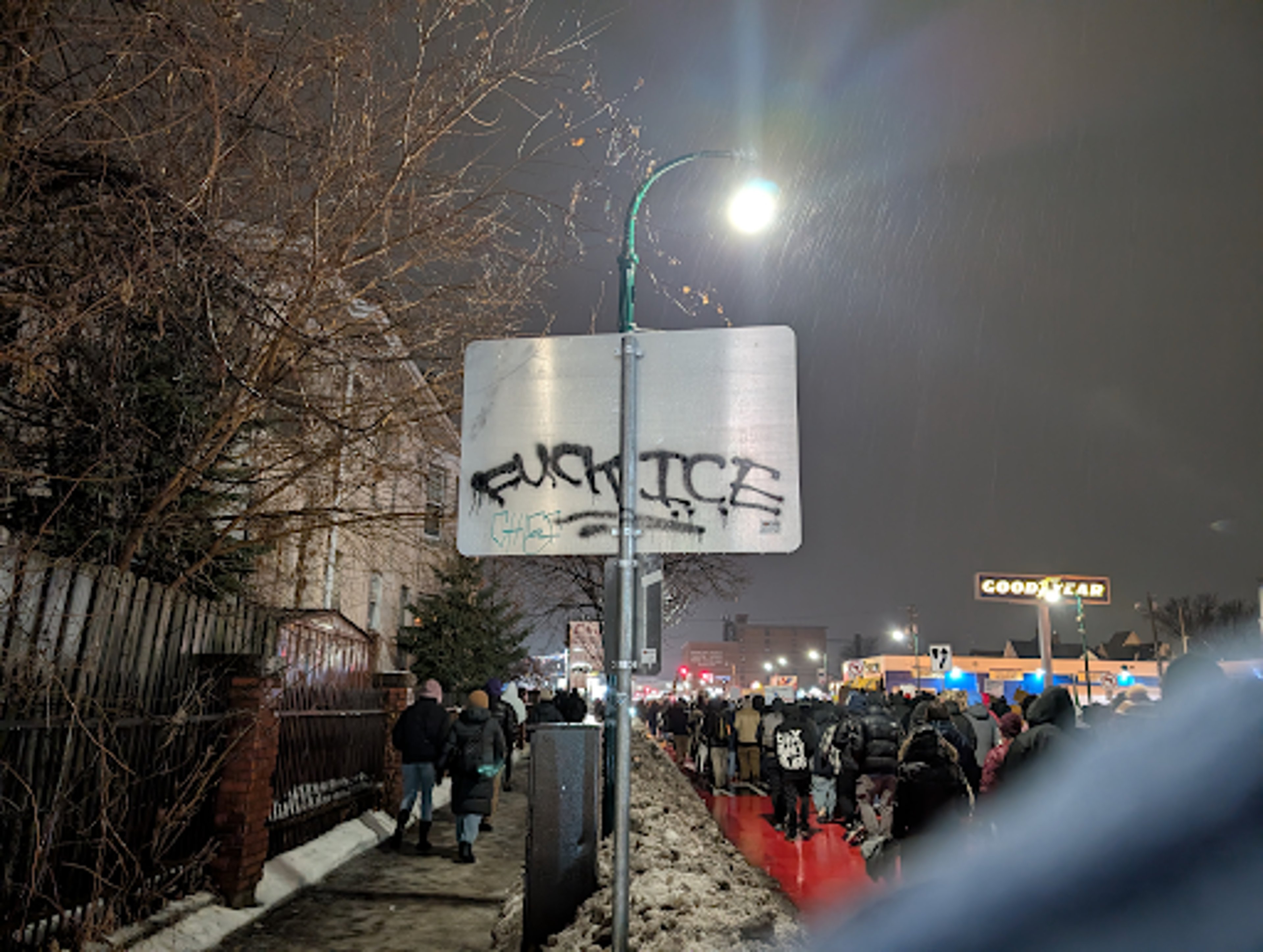
A graffitied street sign reading “Fuck ICE” at a night-time protest.
I live in Minnesota a short drive from the Bishop Henry Whipple Federal Building, which contains both the DHS command center for immigration enforcement in the region and the holding cells where the majority of detainees kidnapped during Operation Metro Surge were kept. The Whipple Building was the site of many protests turned violent by both DHS and local law enforcement. As scenes full of teargas and riot-clad cops played out there, it was hard not to be reminded of similar moments at the Broadview ICE Detention Center in the Chicago suburbs. And when supporters of prisoners on hunger and labor strike inside of Delaney Hall were first met with the same repression, I couldn't help but see flashes of the Whipple. I write in response to Zach H. having never stood beside him on the front line but knowing his struggle.
In his article, "ICE, Riots, and Revolution: A Report from the Ground at Delaney Hall," Zach lays out the failure of his comrades to advance the struggle against ICE past "petty personal jabs" yelled in their direction. He declares, "when the ICE agents stepped back, we did not step forward." Advancing when the enemy retreats is among the most basic functions of any fighting force. To not step forward was a tactical failure in the real battle on the streets of Newark but also represents the weakness and timidity of the movement writ large. The physical dynamic described here stands in for a metaphysical critique. Zach challenges his comrades and readers to believe and act as if revolution "is something that we can make right now."
There were compelling reasons for this kind of militancy at Delaney Hall. Direct confrontation with ICE was a strategic imperative to block the transfer of strike leaders out of the facility. The primary tactical challenges revolved around winning these confrontations, to stop transfers but also to build pressure in support of the strikers' demands. The threat of escalating direct action and the media frenzy surrounding it helped to secure some results, including the release of all pregnant detainee's, but protesters ultimately failed to overcome the flood of New Jersey State Troopers sent to enforce a curfew around Delaney Hall. In the aftermath, nearly 300 strikers were transferred, conditions inside the facility continued to deteriorate, and strike demands were not met.
But let's say the courageous strike supporters outside Delaney Hall had stepped forward. What then? Would winning the street battle that night have avoided the intervention of state and local law enforcement the next day? What was the long-term plan for preventing transfers as the police presence and tactics intensified? In what ways would stepping forward have materially advanced a working class revolution?
These practical questions, largely unaddressed in "ICE, Riots, and Revolution," point to a deeper theoretical gap in the struggle against ICE about how to harness organic working class outrage against mass deportation into a revolutionary movement. Too often missing from the discourse in anti-ICE organizing is serious grappling with how to overcome state repression, the distinction between insurrection and revolution, and the terrain of hegemonic struggle. Throwing ourselves at the enforcers of fascism will not alone secure victory by the sheer weight of its moral righteousness. The tactical street movement must also have strategy.
State Repression
This spring, activists in Alvarado, Texas were convicted of domestic terrorism in federal court over a noise demonstration outside of the Prairieland ICE Detention Facility. One defendant, who did not even attend the protest, received a 30 year sentence simply for moving a box of zines. Last month, 15 Minnesota activists were federally indicted for much of the same. We have entered the NSPM-7 era of federal lawfare against the left. There is integrity in Zach’s call “to be prepared” for incarceration, but even “a fully established prisoners' movement” may fail to stop political prosecutions from demobilizing large sections of the street movement. Beyond legal battles, there is also the ever-widening gap in asymmetric struggles with militarized police. Any strategy that relies on ordinary people defeating the state by force, a need that may only become more urgent as the contradictions of fascism heighten, will have to navigate this reality.
The first test any local street movement against the Trump regime must pass is building high participation fast — fast enough that when political prosecutions begin, the movement stands emboldened by its prominence rather than isolated by its marginality. Prairieland and Minnesota show this dynamic from opposite sides. With no acute crisis to mobilize everyday people, the Prairieland activists acted alone, cut off from anything resembling a mass movement. Their arrest drew little resistance or public outcry beyond the legal nonprofit world and erased any possibility of sustained protest at the Alvarado detention facility. In Minnesota, tens of thousands participated in and witnessed resistance to the ICE occupation — so when the earliest arrests came, they failed to intimidate the tens of thousands still fighting.
The history of the Black freedom struggle indicates that the worst is yet to come. Black organizers have faced decades if not centuries of surveillance, intimidation, and political prosecutions, from the suppression of Black communists in Alabama under "criminal anarchy" laws to the indictment of W.E.B. DuBois to COINTELPRO. Recently, law enforcement at every level devoted untold resources to monitoring and disrupting the Black Lives Matter movement from as early as 2014. Lawfare is only the beginning. The FBI murdered Malcolm X and Fred Hampton, Philadelphia police bombed MOVE headquarters, and urban uprising is always met with brutal police violence. Any attempt to build power in the streets that threatens white supremacy or capital will be met by the full force of the state, although never right away. Riot lines, curfews, indictments: these are what white supremacist "order" requires today. Behind them wait assassinations, police-sanctioned vigilante terrorism, and tanks rolling through the streets.
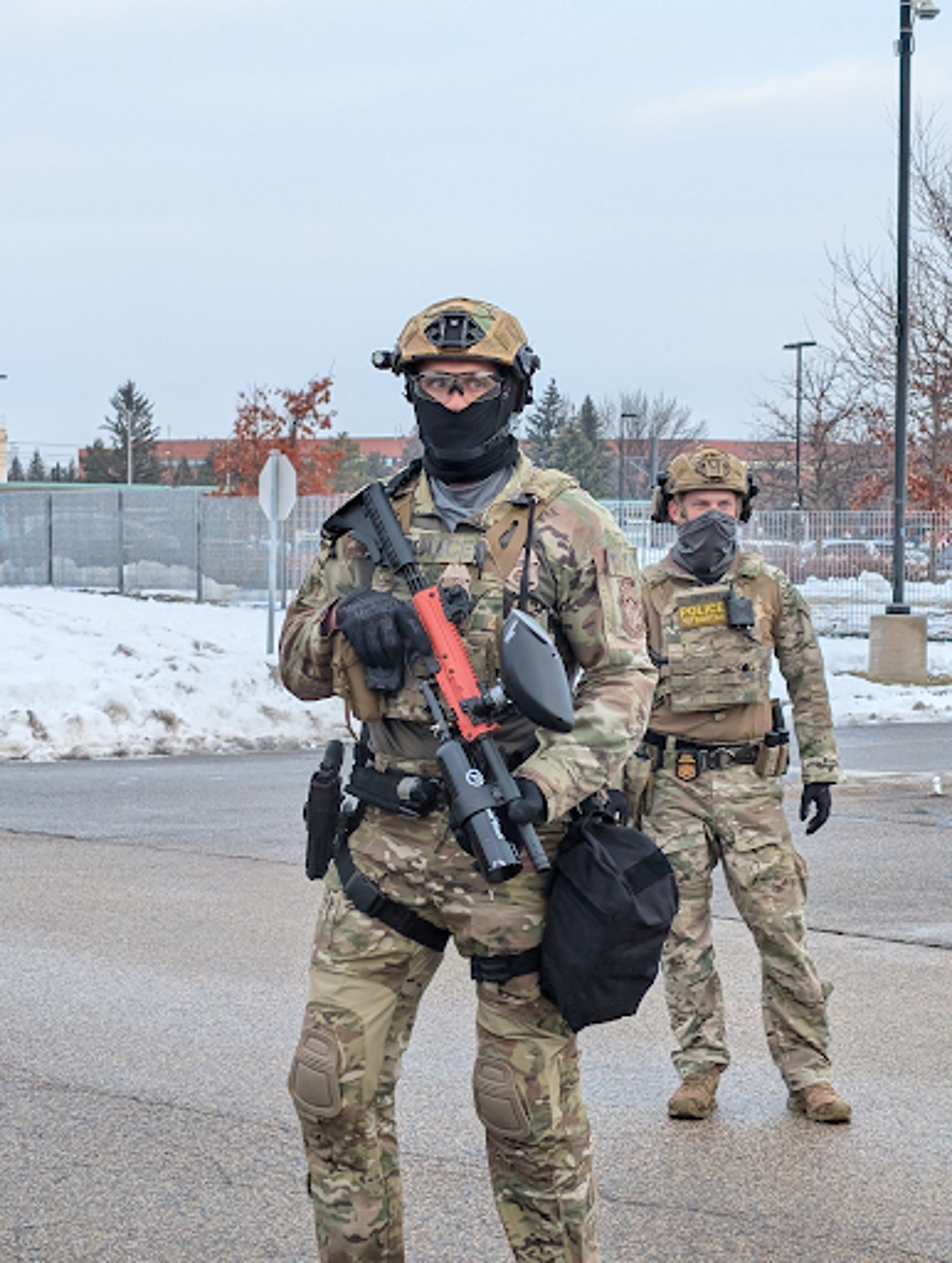
A DHS thug in camo tactical gear guarding the Whipple Federal Building with a pepperball gun.
The next challenge any street movement will face is surviving the crackdown. Despite unprecedented mobilization, the 2020 summer of rebellion was crushed by the National Guard in 15 states, just like in Ferguson six years earlier. This pattern has played out again and again. Student encampments for Palestine were evicted, Cop City was eventually built, even the January 6th rioters failed to prevent the 2020 election certification after the National Guard was eventually called in to stop them. The evidence suggests that conflict with militarized police can build support for a movement, but rarely does the conflict itself win full demands. Street movement organizers must contend with the fundamental question of whether their aim is momentary catharsis through violent self-expression against the state or the permanent overturning of relations of injustice and exploitation. In other words, do they seek insurrection or revolution?
Insurrection vs. Revolution
Revolutions are the stuff of legend. Young radicals idolize tales of Mao's long march or Fidel and Che's guerilla campaign through the mountains. But, in an over-eagerness to emulate their heroes, many revolutionary hopefuls skip over the most important part of these histories: in the end, the revolutionaries won.
The "first step in the revolution by the working class," as laid out in The Manifesto, "is to raise the proletariat to the position of ruling class." While insurrection is the classic vehicle of revolution (although not necessarily the only vehicle), the act of rising up against the state should not be confused with actually seizing power. An insurrection can fail to become a revolution. Zach’s appeal to treat the revolution as “something that we can make right now” is guilty of this confusion. A sober analysis of how the revolution will in fact be made is obscured by his infatuation with the “romance” of “facing off against heavily militarized state thugs.” Far from overcoming the “radical roleplay” that he critiques, the romanticization of insurrection ends by chasing revolutionary dreams that will never come true. Engels is again clarifying on this point. He writes in Revolution and Counter-revolution in Germany:
Firstly, never play with insurrection unless you are fully prepared to face the consequences of your play. Insurrection is a calculus with very indefinite magnitudes, the value of which may change every day; the forces opposed to you have all the advantage of organization, discipline, and habitual authority: unless you bring strong odds against them you are defeated and ruined.
Play with insurrection and your revolutionary movement will be crushed before it even begins. The socialist left in the US is only now reemerging from a long hibernation. Our position remains precarious, still struggling for power just within organized labor and progressive social movements. If revolutionaries were not nearly organized enough to seize upon the popular rebellion of 2020, what suggests that we are ready now? Lacking mass organization of the working class, much less anything resembling dual power or a revolutionary army, insurrection now is doomed to fail. These are exactly the calculations made by Lenin in his call for the October Revolution. Although "it could have been argued, without violating the truth, that the correct thing to do was to take power" at an earlier opportunity in July, Lenin rebuts that “the objective conditions for the victory of the insurrection did not exist.” The support of an already building “revolutionary upsurge of the people” is the necessary condition for success.
Critique of insurrection as an end in itself should not be taken to mean that there is no value to a revolutionary movement in the kind of confrontation practiced in anti-ICE protests. Watching the state respond with aggressive force to a call for justice is a radicalizing experience. Confrontations with militarized police can serve the essential function of breaking the hegemonic hold of liberal reformism on the minds of protest participants, a hypothesis confirmed by the data. When Zach or others sense a change in what is possible as the crowd around them starts to boil over, this feeling is not an aberration. The movement really is beginning to challenge the legitimacy of the whole social order, but it still lacks the power and political direction to bring about something new. To turn the radicalization of movement participants into a political instrument capable of overcoming state repression and establishing the rule of the working class, organizers must engage the battle for ideological hegemony.
Hegemonic Struggle
In 1971, fearing the genuine end of the "American free enterprise system", soon-to-be Supreme Court Justice Lewis Powell drafted a plan for the US Chamber of Commerce to promote capitalist doctrine through influence in higher education, television, print media, and elections. The Powell Memo proved to be a critical turning point in capital's consolidation of power after the turbulent 1960s. It ushered in a new era of class struggle defined by national coordination of corporate power through the rapidly expanding Chamber of Commerce and an explicit focus on conquering all arenas of potential ideological dissent. The following decades witnessed the collapse of the American left and labor movement and an explosion in inequality. Big business cemented its belief system as common sense and turned both major parties into vehicles for deregulation and austerity. The forces of capital had secured ideological hegemony.
Today, the fascist right and its billionaire backers are adept in this terrain of struggle. First capturing our attention in as many ways as possible, fascist influencers and MAGA media pundits push out synchronized talking points to steer the public discourse: the country is overrun with dangerous migrants, there is chaos and violence in the streets, all protesters are ANTIFA terrorists.
Hegemonic struggle, contesting and defeating the official Trump regime narrative is an essential task of the anti-ICE movement and an essential and often ignored factor in our limited victory in Minnesota. Mass participation in the resistance and the murder of Renee Good concentrated national media attention such that when Alex Pretti was killed shortly thereafter it became an all-consuming story. A myriad of "typically apolitical online spaces" were transformed by the people into anti-ICE discussion forums overnight. Paired with a historic strike, the tides began to turn. The Republican coalition in Congress showed warning signs of fracture, Greg Bovino and Kristi Noem were fired, support for Trump's immigration policy cratered, and the White House toned down its mass deportation rhetoric.
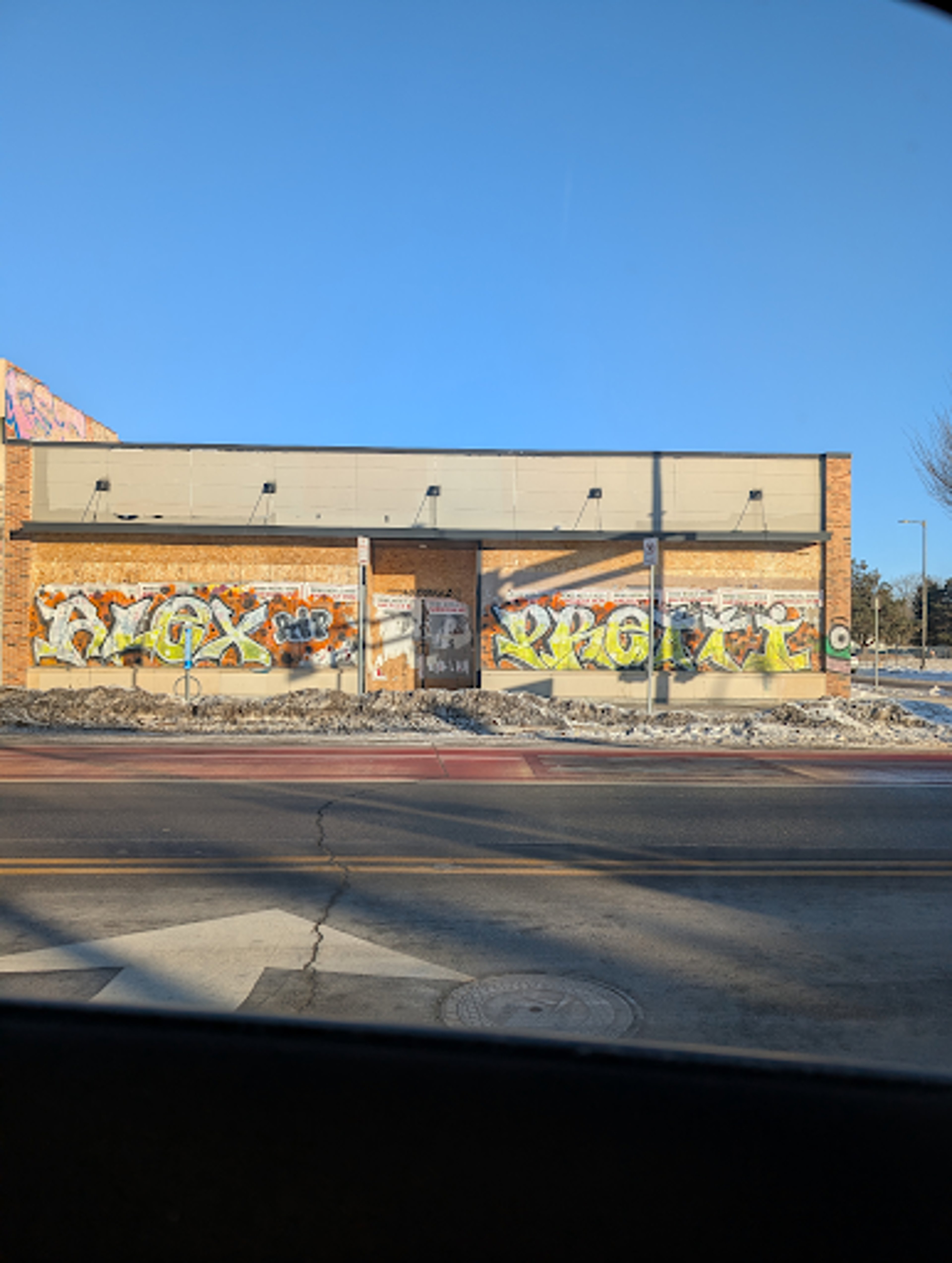
A boarded-up storefront with colorful “RIP Alex Pretti” graffiti spray-painted onto a layer of “Renee Nicole Good: American Mom” posters.
Learning from our wins, the anti-ICE movement must become a counter-hegemonic ideological force, a bullhorn through which revolutionaries can articulate not just a critique of white supremacist capitalism but an alternative. Zach acknowledges that protesters at Delaney Hall lacked “connection to the material base of our struggle, particularly immigrant communities,” but offers no plan for “reaching the masses” other than greater confrontation with the state. This myopic focus on street tactics papers over strategic questions about how to actually grow our base with a faux-revolutionary facade. Without a unifying vision of a better world that connects the deportation machine to class struggle, the anti-ICE movement risks losing the organic working class anger that animates it to internal fragmentation and external co-optation. Marxist thinker Marta Harnecker elaborates this dynamic:
Impoverished urban and rural sectors, lacking a well-defined plan, have risen up, seized highways, towns and neighbourhoods, ransacked stores and stormed parliaments, but despite being able to mobilise hundreds of thousands of people, neither their size nor their combativeness have been enough to move from mass uprisings to revolution. They have overthrown presidents, but they have not been able to conquer power and initiate a process of deep social transformations. On the other hand, the history of triumphant revolutions clearly demonstrates what can be achieved when a political instrument exists that is capable of raising an alternative national program to unify the struggles of diverse social actors behind a common goal; that helps to cohere them and elaborates a path forward for these actors based on an analysis of the existent balance of forces.
Insisting that revolutionaries "be at the service of popular movements, not replace them," Harnecker posits our role as expanding the political horizons of today’s struggle so that it may become tomorrow’s revolution. Promoting a cogent alternative to the prevailing logic of the status quo both strengthens a movement’s position in the battle for hegemony and draws it into alignment with a broader program for social transformation.
To bring the revolution so close that it truly becomes "something that we can make right now" is not a question of whether we choose maximal aggression towards the state, but whether we succeed in this counter-hegemonic project to unite the working class behind a demand for nothing less than the whole world.