
Jul 18, 2026
The Vibecession is Real, Paul Krugman is Fake
The economists say the numbers are good. The numbers are not the economy.
by Gigi G
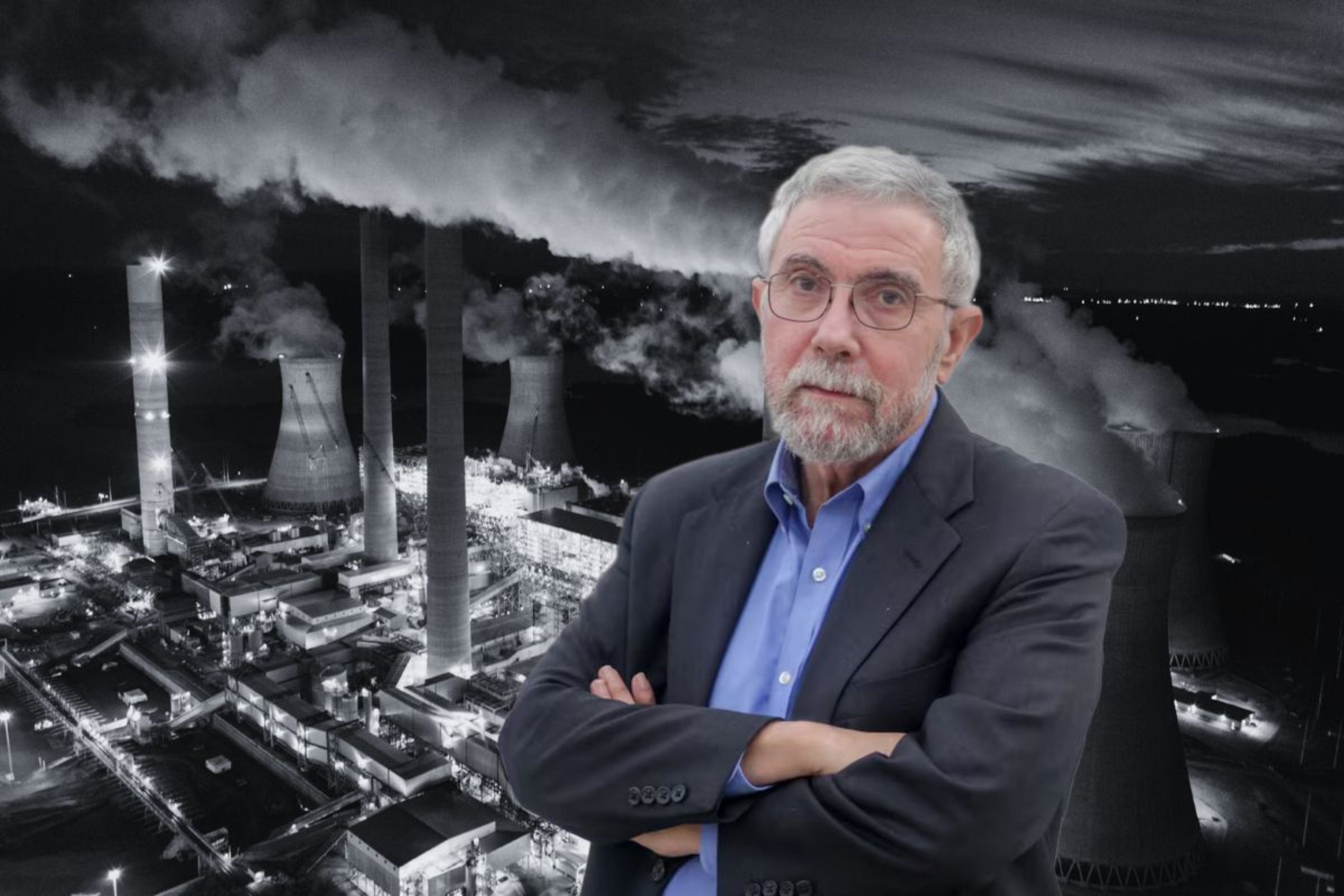
Something is profoundly wrong with the American economy.
We have entered a golden age of productivity. Gross Domestic Product and the stock market are reaching record highs, unemployment figures are historically low. Yet, the vast majority of Americans believe we are spiraling into a recession.
In 2022, Gen Z Economic Influencer Kyla Scanlon coined the term "vibecession"—a portmanteau of vibe and recession—to describe the disconnect between official macroeconomic metrics and mass economic distress.
Scanlon suggested the term as a starting point for inquiry. If the macroeconomic indicators say things are great but the people are miserable, she argued, economists must inquire about what their data is missing: she suggested looking at the psychological toll of living in a “price pressure cooker," the cost of buying a home skyrocketing out of reach, and stagnant wages.
But our foremost economists don’t want an inquiry.
"We've heard a lot about the 'vibecession,' in which many people insisted that the economy must be in bad shape because it felt that way to them; part of that is vibeflation, in which people take the actual inflation we've experienced recently — which has indeed been disturbingly high — and, um, inflate the numbers based on their feelings about the amount they spent on groceries a few days or weeks ago. And maybe I can use this moment to show why that's a bad idea. Now, I go grocery shopping myself, and am occasionally startled by the total at the cash register — although that's usually because I wasn't factoring in the price of that bottle of scotch I picked up along with the meat and vegetables.”
- Paul Krugman, Ph.D., Nobel Laureate in Economic Sciences, Distinguished Professor of Economics at the Graduate Center of the City University of New York, Professor Emeritus of Economics and International Affairs at the Woodrow Wilson School of Princeton University, Centenary Professor at the London School of Economics, President of the Eastern Economic Association, Recipient of the John Bates Clark Medal, Recipient of the Prince of Asturias Award from the King of Spain, Consultant to the International Monetary Fund, the World Bank, the United Nations, and the Federal Reserve Bank of New York, Research Associate of the National Bureau of Economic Research, LIS Senior Scholar, Former Senior International Economist on Ronald Reagan's Council of Economic Advisers, Former Ford International Professor of Economics at the Massachusetts Institute of Technology, and Former Professor at Yale University and Stanford University
Paul Krugman shrinks from offering a concrete economic explanation for our economic crisis, an explanation in the field that he is nominally expert in, preferring instead to dabble awkwardly in fields he doesn’t understand.
Our foremost economist doesn’t have a solution for America's dual economic crisis. He doesn’t have a rational economic explanation for it, and more to the point, he doesn’t even think he owes us one, because he doesn't think it’s real. He is content to appropriate the term vibecession to deny that there really is an economic crisis at all–that his metrics are right and we are wrong, and the fact that people increasingly becoming homeless, committing suicide, living in studio apartments covered in mold, collapsing in exhaustion and burnout at work, all while drowning in debt, is a vibes problem that cannot be explained through economics.
Kyla Scanlon laments in “It’s More Than Just Vibes” that discourse about the recession has "gotten lazy", that establishment economists “are talking about how people feel like 'yeah buddy sorry you’re feeling that way'...” Scanlon criticizes those that misuse her term this way: “Things are hard. It’s not just vibes.”
To Krugman, the economy has data, rules and theories that determine that the health of the economy is “good”. The real problem is that we have stopped believing in the economy that he and other economist pundits have defined for us. To explain this crisis of faith, economists offer many shallow answers. Maybe it's “narratives from social media”. Maybe it's political polarization. Maybe the teachers have failed and we are just stupid and bad at interpreting economic data. Maybe it's mass psychosis. Maybe we’re exaggerating for political expediency and greed. Maybe we don't know how good we have it, and our sheer entitlement to a decent life is the problem. After all, our vibes would be quite a bit better if our standards were quite a bit lower.
Press an economist, and they will frown and concede a few points: Housing is unaffordable. Medical debt is the leading cause of bankruptcy. Life expectancy is falling in the richest country in human history. Then, they will happily explain that those are distributional issues. Composition effects. Tails of the distribution, not the mean. A Gini problem, not a GDP problem. The economist has an expansive toolbox from which to assert that they know more than us about the economy, and therefore are correct when they say it is good, all while denying the basic reality of it.
People like to call economics a "soft science," which is generous. Psychology is a soft science. A majority of psychological studies can't be replicated but it's struggling against inconvenient ethical constraints to describe phenomena that definitely exist, which is that people are fucked up.
Paul Krugman is not a scientist whatsoever. He, and other economists, do not take interest in what phenomena exists in the first place because it is often inconvenient for their dogmatic constraints. He does not test hypotheses against observable reality and revise them when they fail. He begins from the conclusion that capitalism works when the metrics are met, and arranges analysis to confirm it. When mass distress contradicts his reality, Krugman simply discards it.
"The economy isn't actually bad [sic] — in fact, it's in remarkably good shape [sic]. Furthermore, most (although of course not all) Americans are feeling fairly good about their personal financial situation. Yet somehow there's a pervasive sense that the economy is bad.”
Krugman believes he has uncovered a paradox. Americans say we are personally fine, but we know the economy is terrible. To him, this is incoherent – if you're fine, the economy must be fine, and if you think it isn't, something has gone wrong with your perception. It does not occur to him that we might be doing exactly what an economist ought to do: look past our own immediate circumstances to assess the system as a whole. We are, in fact, doing his job much better than he is, since the majority of us are not blind to the failing economy and preoccupied with metrics and overpriced scotch. We can make rent this month and still understand that the economy is structured such that we will not be able to make rent forever, we will not be able to retire, we will not be able to afford children, and the golden age of productivity we are ushering in is building coal plants and data centers instead of solar panels during a global warming crisis.
What's most important to our foremost economists is that you understand there is nothing you can do about it. Since some of the metrics they've concocted and say are important look good, nobody else is going to do anything about it either. But while he throws his hands up at the mystery of the "vibecession," socialist economists do explain what Krugman cannot.
When a man builds an automatic loom, the hand weaver becomes worth less, and the man who operates the loom becomes worth less relative to the man who owns the loom. This is because the man who owns the loom owns the product of the labor of the men who built it, while the loom operator only owns his own labor.
The more wealth we produce, the cheaper we become. The market value of a man decreases in direct relation to the increase in value of the world of things we've already produced.
When a man makes an AI bot that denies legitimate health insurance claims, this is quite productive. A cruise missile fired at a school is productive. Rebuilding that school is productive.
Kidney dialysis for an infant, who would have died if their father had not driven himself into debt to afford it, overtime to afford the debt, lifelong disability from the overexertion, unemployment, no healthcare, and an early death for him and his son to repay his efforts, is productive.
To Krugman, each of these facets of our modern economy is illuminated by excellent economic indicators, and of course some personal misfortune. Misfortune caused by the structure of the economy, which Krugman dares not question, and which he assures us is good.
To Krugman, the question of what we produce, in what quantities, for whom, in exchange for what - i.e. the real economy - is beside the point.
"Productivity isn't everything, but in the long run it is almost everything. A country's ability to improve its standard of living over time depends almost entirely on its ability to raise its output per worker."
There was a time when Krugman's thesis was less obviously wrong, and amateur economists could have been forgiven for espousing it. A time when American productivity meant steel mills, kit houses a working family could build, cheap pharmaceuticals that kept people alive, only a few industries of outright scams, and a military industrial complex that briefly fought the Nazis. Today, a paper-mâché house costs $300,000, a single cruise missile destined for genocide in Gaza costs a neighborhood of houses, and you cost $22 an hour if you're a little lucky. If you're exceedingly lucky you are able to access healthcare most of the time.
Krugman tells us the metrics show productivity is at an all-time high, we are living in the richest, most comfortable society in human history! He is lying. We are not. He would rather gesture at diagnosing the entire country with a psychological disorder than admit it.
The measure of a society's standard of living is not the quantity of goods it produces, but the quality of the time its people have—how long they live, how freely they live, and how well they live. Productivity is a factor of this. If a porcelain factory can consume 400 man-hours to make 10,000 toilets, it provides an incredible amount of quality time and freedom compared to a communal ditch.
But the realm of freedom really begins where obligatory work, determined by society's needs and a rational utility, ends. A society that boasts of record productivity while its people work themselves to burnout, hustle side gigs, and an early death having enjoyed less and worse free time than their parents has not enriched itself.
Capitalism had been justifiable insofar as it began to create the democratic society and productive capacity we need to truly liberate ourselves. Today, it is taking us backwards.
What makes capitalism backwards today is not any particular policy. In 2005, Paul Krugman began advocating for "Medicare for All" in the New York Times, backing Senator Ted Kennedy’s call for it. He argued that government-provided universal insurance would save over two hundred billion dollars a year. He said the advantage over private insurance was obvious and that “Good economics is also good politics.” Medicare for All was a theoretical possibility within capitalism - proof that the system contained the tools to fix itself, that you didn't need to overthrow anyone, that the right policy managed by the right people could solve the problem. As a theoretical idea, it was an enormous asset. It displayed the potential energy and flexibility of capitalist society.
Then Bernie Sanders made it a political demand in his democratic socialist campaign for president. It was no longer capitalism's theory. It was socialism's opening argument. And if Medicare for all passes as a socialist victory, then it implies capitalism could not solve the problem on its own, which means Krugman's faith in market-based reforms—and by extension, capitalism itself—was wrong. This was unacceptable to Krugman, who turned against his own idea and his own economic justification.
“Mr. Sanders is calling for [Medicare for All], which is something I would like to see, too. But the problem with such a move is that it would probably create many losers as well as winners — a substantial number of Americans, mainly in the upper middle class, who would end up paying more in additional taxes than they would gain in enhanced benefits.” - Paul Krugman, Ph.D.
Capitalists theoretically could pass Medicare for all. They could build affordable housing. They could cancel medical debt, shorten the working day, fund public transit, and guarantee a dignified retirement. The required economic and political power exists. Krugman himself is senior staff of this power.
The problem is not that capitalism lacks the capacity to do these things. The problem is who controls that capacity, and in whose interest they deploy it. Those who own productive property decide what is produced, in what quantities, for whom, and at what human cost. They decide what our golden age of productivity builds—houses or cruise missiles. They decide what it funds—dialysis or surveillance. They decide whether the surplus of human labor is returned to us as freedom or extracted as profit. The wonderful arrangement Krugman defends that immiserates us is the same arrangement that enriches them.
Those with property, outside a handful of activists, do not attempt to justify the arrangement themselves. They retain a stratum of professionals to do it for them—economists, columnists, consultants—and compensate them with petty titles that confer a decent life, institutional prestige, and the appearance of independent intellectual authority. These titles come with speaking gigs and op-ed pages, at which the only thing our foremost economists are free to hem and haw and say anything except that capitalism itself is the problem. Capitalism is the thing they are retained to defend. If capitalism is the problem, then their profession is the problem, and the institutions that credentialed and decorated and published them are the problem, and the entire pseudo-scientific edifice of capitalism in which they hold petty fiefs so long as they remain loyal to the crown is the problem.
When you tell another human being you are dying, this usually alarms them. Our foremost economists however have been trained, "disciplined," like a fanatic monk or beaten dog—to look past your suffering towards the charts proving that the kingdom of god has been built on earth already and is thriving without you.
Capitalism has created the potential for a democracy and economy where everybody has the right to life, liberty, and the pursuit of happiness, but the only political force willing to unleash that potential is socialism.
Krugman is content to collect his salaries, publish his columns, and preside over the slow-motion immiseration of the American public while we squander a golden age of productivity on things that do not make anyone's lives better. He cannot explain why millions of Americans are turning to democratic socialism, and he cannot stop them. He seems to know everything about the economy except what it is like and how to fix it.
So yeah, the vibes are off.