
Oct 31, 2026
Carceral Municipalism and the Socialist Left’s Rehabilitation of the Prison-Industrial Complex (Part 2)
Criminalization is class war. Nathan Yaffe & Linda Luu argue that the prison-industrial complex threatens every pillar of Mamdani’s affordability agenda.
by Nathan Yaffe and Linda Luu
Credit: Andy C
Part II
Will Mamdani’s Carceral Municipalism Position Us to Combat Carceralism Later?
The first year of Mamdani’s administration has given us no reason to believe the order of operations thesis (discussed in part one of this two-part piece) is viable. From the start, the NYPD and its backers have held the upper hand vis-à-vis Mamdani. Even before taking office, Mamdani caved to business interests that wanted him to retain his predecessor’s police commissioner, Jessica Tisch, a law-and-order zionist heiress whose main NYPD accomplishment is building a 24/7 surveillance dragnet. Early in his tenure, Mamdani capitulated to a bill criminalizing protest near houses of worship, overtly targeting the protesters opposing Israel’s barbaric and genocidal acts in Palestine. In his first budget cycle, he proposed expanding the NYPD headcount (later abandoned in the face of a groundswell of criticism). Mamdani has also signalled support for the NYPD gang database, apparently softening on his campaign pledge to eliminate it.
Moreover, under his watch, quality-of-life policing—the type of poverty criminalization that his Department of Community Safety is theoretically meant to render obsolete—has increased. Vehicle stops, which increased at an alarming rate in 2025, showed no signs of slowing in the first two quarters of 2026. Court watchers who track court appearances found (yet again) the majority of arrests made across NYC were for low-level or non-criminal offenses that disproportionately targeted people of color. Racist stop and frisk practices continue unabated, as does the NYPD’s haphazard citations spree.
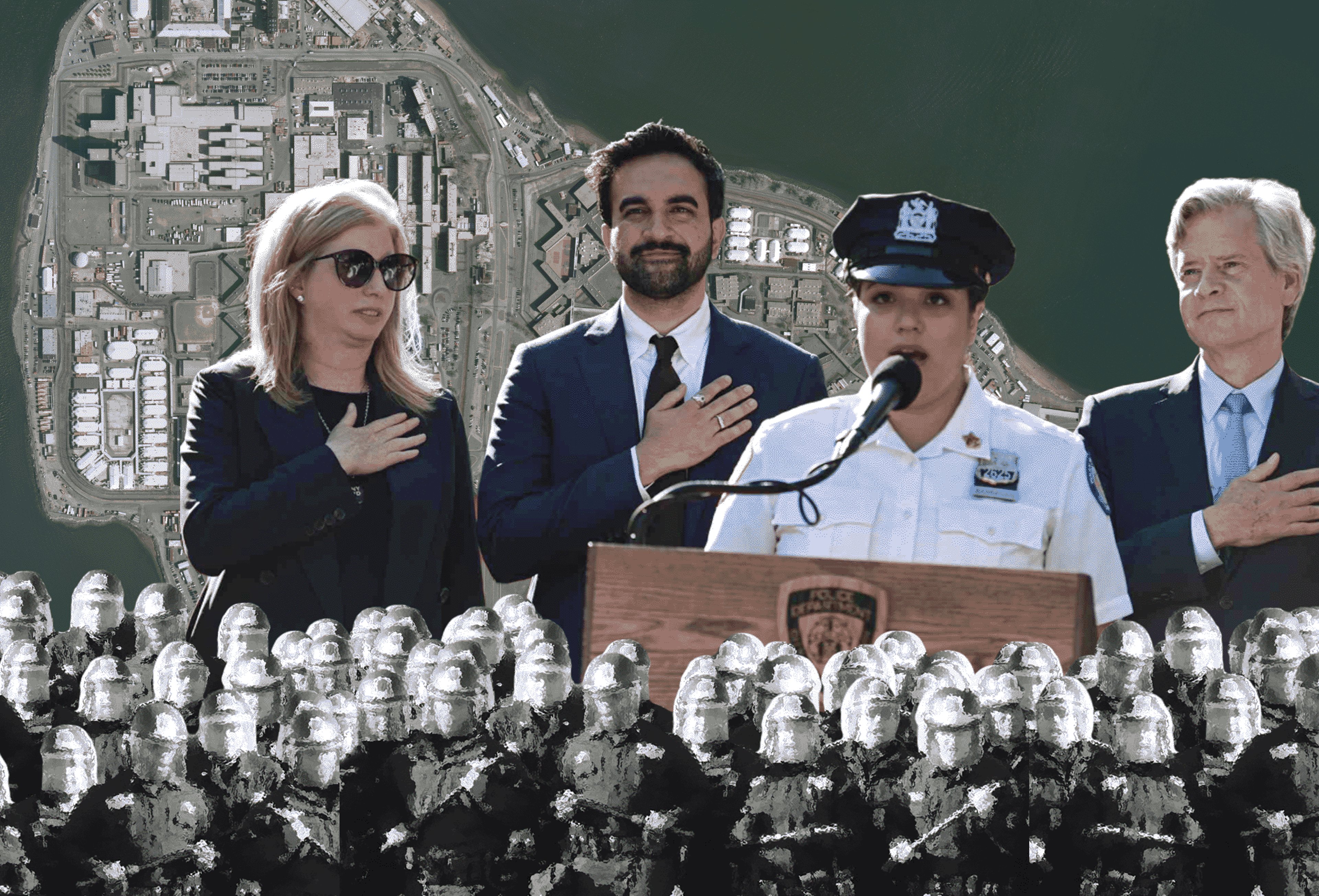
Meanwhile, Mamdani has affirmatively sought to rehabilitate the image of the punishment bureaucracy. He has celebrated the NYPD in stump speeches and defended them after deadly police shootings. He elected the first formerly incarcerated person to be in charge of the city’s jails, and has visited the jails multiple times to offer messages of support (even as the city locks up roughly the same number of people as when he took office). He has bragged about the new 104-bed secure hospital wing for seriously ill incarcerated people to receive medical care as a model for delivering “real care” (even though one incarcerated person has already died there). If, as Fahd Ahmed said, we are in the midst of a Gramscian war of position characterized by consensus-building, the carceral consensus is winning in Mamdani’s New York.
Even if policies such as arrest practices could evolve—say, if the DCS materializes and receives funding as promised—the same cannot be said for Mamdani’s massive carceral infrastructure investments. Cages, once built, remain cages, even if the jailers change. The borough-based jails will inevitably be simply another tool for warehousing Black and Latinx New Yorkers (90% of the Rikers population).
Rather than closing Rikers by arresting fewer people, as abolitionist organizers advocated, Mamdani has embraced the rationale used by jail builders throughout history: humanitarian reform. The humanitarian imperative to close Blackwell’s led to the opening of Rikers in 1935, which was pitched as more rehabilitative and less brutal. After the old “Tombs” jail was ordered to close in 1974, the new “Tombs” was built and opened in 1983 and was, like Rikers, billed as a state of the art facility. Before long, both Rikers and the New Tombs were denounced—like the jails they replaced—as squalid, overcrowded, and inhumane. Mamdani’s decision to embrace the BBJs, despite having full awareness of this cycle, is a colossal concession to the carceral status quo.
Not only will this saddle the city with new carceral infrastructure, but it is far from clear the BBJs will even lead to the closure of Rikers. Originally enacted with no closure mandate, the BBJ plan received legislative reinforcement in 2021, when City Council set a deadline of August 31, 2027, for the Department of Corrections (DOC) to transfer all Rikers facilities to the Department of Citywide Administrative Services (DCAS), thereby taking them out of the business of human caging. Despite the deadline and a semi-annual review requirement, DOC refused to transfer even empty facilities throughout Mayor Adams’ reign. Although transfers (of already-empty facilities) have commenced under Mamdani, his administration acknowledges the new jails won’t be built by 2027, and legislation is pending to remove or revise the deadline. Meanwhile, the city jail population has ballooned from its April 2020 low of 3,800 to over 6,500 today (well over the planned capacity of the BBJs). Given the fluidity of the closure component of the plan, there is no reason to believe city officials will stick to any past or future rhetorical (or legal) commitment to close Rikers after the BBJs are built. Eight years in, abolitionist organizers who attacked the 2019 BBJ plan as one that would “keep[] Rikers open indefinitely” appear prescient.
The “order of operations” advocates place significant faith in the DCS as a way to disrupt the dynamic of carceral consolidation, but the experience in cities that have taken similar approaches gives cause for concern. Vitale, the leading DCS proponent within the Mamdani administration, often cites Newark, NJ as an inspiration. But in the decade since establishing a community safety department, its base police budget has increased steadily. Despite a heralded decision in 2020 to allocate 5% of its policing budget to violence prevention and trauma recovery, Newark’s police budget expanded the following year dramatically and appears poised to expand further now.
The story is similar elsewhere. Durham, NC, is likewise often held up as a success story for its Community Safety Department, which launched in 2021. Yet compared to 2020, before Durham established its Community Safety Department, the total “public safety” budget has now ballooned by over 50%, and police headcount continues to expand. Indeed, our research has revealed zero examples in which a department of community safety has led to reductions in police funding or headcount.
Notably, these successful experiments with community safety departments have coincided with periods of low crime, the other part of Vitale’s formula. Without embracing the formula as correct, the fact that both conditions (presence of alternatives, lack of crime panic) are present in other cities—yet no reduction in police budget or headcount has occurred—underscores that community safety departments are perfectly compatible with ongoing police dominance. Thus, it is far from clear how a DCS-centric strategy is itself a means of positioning the left to confront carceral power later.
Will Mamdani’s Affordability Agenda Make It All Worth It?
The logic of progressive electoralists—that confronting policing and imprisonment imperils a more winnable and urgent pro-tenant, pro-worker affordability agenda—has superficial appeal. After all, the police are politically powerful and thus may be able to mobilize to discredit those who threaten them, whereas affordability measures have broad appeal. But to focus only on the political power of police without focusing on the work of policing only tells half the story.
As Ruth Wilson Gilmore memorably stated, “criminalization and mass incarceration are class war.” This is not just because police murder poor people, who are disproportionately Black, at an alarming rate that has only increased every year since 2021. Rather, street-level policing, incarceration in jails and prisons, pervasive surveillance, and the ever-increasing imbrication of criminalization with social services, schools, housing, and other institutions of everyday life—in short, the pillars of the prison-industrial complex (PIC)—all likewise pose an enormous threat to poor and working-class people.
Consider the devastating “pocketbook injuries” inflicted in the routine process of criminalization. After the 2014 police murder of Michael Brown in Ferguson, Missouri, revelations emerged that officials nationwide deliberately use police to “extract revenue from the poor,” especially poor Black residents (one scholar called it a “racial tax”). Prosecution and imprisonment come with their own crushing financial burden, with one report finding two-thirds of families with an incarcerated member could not meet their basic subsistence needs due to a combination of court fines and fees (alone averaging $13,607 per family), commissary and communication costs from incarceration, and lost income. Despite the fact that one in two U.S. adults have or had an immediate family member who is incarcerated, the electoral left’s affordability agenda has been silent on the extractive machinery of criminalization.
At the municipal level, the PIC serves real estate and development finance at the expense of the working class. Cities deliberately increase “order-maintenance” arrests in areas targeted by real estate re-development dollars, in a strategy of policing-led gentrification. Former NYC Mayor Eric Adams relied heavily on this tactic, exemplified most dramatically in Operation Restore Roosevelt in Jackson Heights, Queens. The operation, billed as one of seven “community improvement” initiatives around the city, was a prolonged police occupation that began in 2024, targeting unlicensed street vendors, massage parlor workers, sex workers, and other mostly poor immigrant New Yorkers engaged in the informal economy.
City officials openly cited business owner interests among their justifications and measured success in numbers of arrests and summonses issued (over 12,000 at the 90-day mark from Roosevelt alone). Organizers with Centro Corona and Red Canary Song rightly and deftly identified Operation Restore Roosevelt as a “city-led assault” reflecting the view that “poor people need to be cleared out and replaced by people with higher income.” Under Mamdani, elements of Operation Restore Roosevelt, like widespread enforcement targeting street vendors, have persisted despite their devastating impact on working-class immigrant New Yorkers.
Indeed, all pro-worker, pro-tenant, and pro-housing policies are jeopardized by the PIC. Having a criminal record renders people more vulnerable to predatory landlords, shuts them out of the labor market, and makes them less able to unionize. In public housing, which Mamdani has imperiled with a mix of privatization and continuing under-investment, Commissioner Tisch worked to hijack a city-run free internet service to provide the NYPD with continuous access to the 20,000 CCTV cameras in New York City Housing Authority properties. This is not only an expansion of NYPD authority but imperils housing, as convictions or even arrests routinely result in people losing their housing.
These harms are not incidental, not imperfections in policing that can be worked out through reform. Rather, they are functional—part of the work of policing. Criminalization is an essential tool for managing populations rendered surplus by capitalism (as a concrete example: a worker laid off due to deindustrialization), “ensuring a disciplined and racially stratified labor force produced by Black oppression.” Thus, policing and prisons are paramount among institutions safeguarding capitalist domination. They have always worked to undermine precisely the type of redistributive and egalitarian political project Mamdani claims to represent. The racial and economic subordination inflicted and upheld by carceral forces threatens every major pillar of Mamdani’s platform, from affordability to housing justice.
The Urgency of Confronting Carceral Power
Beyond the internal incoherence of the positions taken by both the “order of operations” advocates and the capitulators, the broader political landscape powerfully underscores why it is untenable to defer addressing the problems posed by policing and prisons.
In recent years, criminalization has been central to fueling the consolidation of fascism. The highly visible tip of the iceberg is the ever-widening net of overtly political prosecutions, including the Spokane Three, Broadview Six, Prairieland Nine, Minnesota 15, FACE Act 38, dozens of opposition politicians, and more. Beyond these headline-grabbing cases, law enforcement is pursuing new strategies for criminalizing solidarity, building on the attempt to break Atlanta’s Stop Cop City movement with dragnet prosecutions. These are merely exacerbations of longstanding bipartisan practices of criminalizing protest, whether against ICE, carceral infrastructure, Israel’s genocide, or predatory property accumulation. Any liberatory movement should shudder at the thought of abandoning abolitionist demands at a time when the most extreme expressions of state power so nakedly rely upon carceral infrastructure.
However, criminalization fuels fascism not only through overt political suppression, but also because the system’s scale means it reliably manufactures disposable subjects for the fascist project to target. For instance, the administration has revoked 175,000 visas based on past law enforcement contact—some for things as trivial as speeding tickets—relying on the fact that arrests and other local police interactions put people on ICE’s radar through automatic data-sharing. Mamdani has been silent about this particular nexus between state government bureaucracies and federal deportation campaigns, even as he called an emergency press conference and joined a lawsuit over the administration trying to turn state-administered benefits programs into grist for the deportation mill. And while Mamdani has denounced President Trump’s attempt to deport student activists for free speech, he has never acknowledged that most of the cases against New York-based students relied on NYPD data-sharing, including sealed files.
Deferring confrontation with the carceral state likewise ignores the political agency of carceral forces. Without diminishing its power, it will stand as an oppositional force to Mamdani’s agenda. Police, as Ruth Wilson Gilmore has observed, “act to guarantee their institutional role in the apparatus and activities of the state.” If Mamdani’s Department of Community Safety appears poised to translate into reducing NYPD headcount or budget, the police will deploy their well-oiled machine to make the public case that they are the only thing standing between civilization and violent chaos.
Failure to confront carceral forces will serve as a foil to Mamdani’s agenda in still other ways. Mamdani’s megajail boondoggle—and indeed, they will be his megajails if he continues to push construction forward—combined with his defense of the NYPD budget puts enormous pressure on city coffers at a time when his agenda is already facing fiscal feasibility constraints. Key campaign promises are threatened by debt limits and bond market discipline. With no tax hike on the horizon, it is not clear how he pursues these ambitious agenda items without taking money from elsewhere, and there’s no better piggybank than pillaging NYPD coffers and foregoing capital project sinkholes like the borough jails.
It merits reiterating that to reach for an abolitionist horizon is not to deny that harm occurs—precisely the opposite. It is to take harm seriously when it occurs with the recognition that criminalization has not made anyone “safe.”
Even in situations of serious harm, many political choices remain about how to respond. Survivors of violence prove this: more than half opt-out of what the state offers as a response to violence (i.e., criminalization), by choosing not to involve law enforcement at all. Many groups, typically led by violence survivors, are trying other tools for responding to violence and harm. Still other groups of survivors have pointed to the absence of any meaningful social safety net as the thing that trapped them in violent situations, leading to abuse and ultimately unjust criminalization. These cracks in the carceral edifice provide ample room for Mamdani, a masterful storyteller, to create agitprop and foment further anti-carceral activity. Instead, he has wedded his fortunes to an NYPD that will never love him back, led by a Commissioner who will likely run against him in 2029.
It may seem expedient in this political moment to call abolitionist demands purist or moralist, given the crushing conditions we face. One might wonder how we can make abolition palatable when mutual distrust and burnout are so high, not to mention the rent and eggs. Still, there is meaningful momentum to build on. Two of the most notable organic uprisings of the second Trump administration have been against criminalization: Minnesota’s response to Operation Metro Surge and the nationwide spate of outrage at (and vandalism of) Flock surveillance cameras. New York has seen its own versions in miniature, with mass (but short-lived) protests at the downtown DHS/immigration court headquarters in the fall of 2025, and the spring 2026 mobilization in support of hunger strikers in Delaney Hall Detention Center just across the Hudson River.
And even if the politics are difficult, the task is no less urgent for being daunting. What is needed now is not a retreat from necessary fights on the grounds of feasibility, but rather stronger organizing that makes palpable the material connections between struggles for housing, deportation defense, worker power, reproductive justice—and movements against the criminalization apparatus. The connections are there. It is our work to make them undeniable.
Acknowledgments: The authors extend their deep gratitude to Mon M and Zohra Ahmed for their intellectual and editorial contributions to this piece and ongoing comradeship.