
Sep 21
From Defund to Delivery: Building Real Community Safety for an Abolitionist Future
Why the unfinished work of policing, prevention, and public investment still matters to New Yorkers and should matter to socialists.
by Farudh Emiel Majid, Elizabeth Oh, and Rasha Harvey
For most New Yorkers, public safety is not an abstract debate about budgets, agencies, or political slogans. It is what happens when someone experiencing a mental health crisis needs help. It is whether a young person has somewhere safe to go after school. It is whether a survivor of violence can find support without navigating a maze of agencies. It is whether someone can walk through their neighborhood without fear of violence, while also knowing that an encounter with the government will not expose them to unnecessary harm. The institutions we create around safety become real through these ordinary moments.
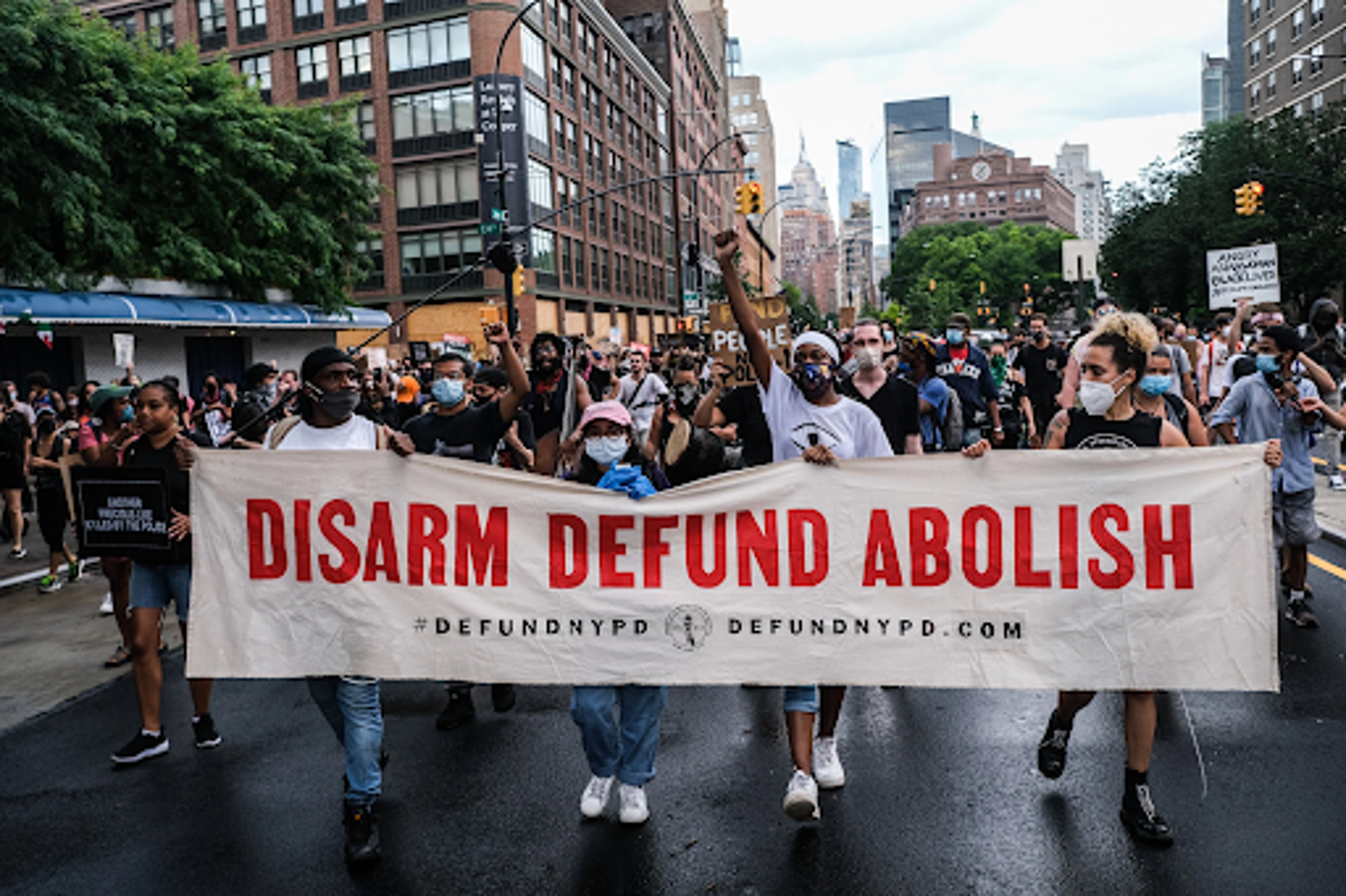
That is what makes the conversation unfolding in New York City today different from the discourse in 2020. Six years after George Floyd’s murder and the subsequent uprising, the national conversation about policing has now shifted. The city now has an Office of Community Safety with responsibility for coordinating violence prevention, victim services, mental health programs, hate crime prevention, and other forms of public support intended to address crimes before they happen in non-carceral ways. At the same time, racial disparities in policing remain pronounced, civilian crisis response remains incomplete, and the question raised during the Defund era—the 2020–2021 push to reduce police budgets and redirect those funds to social services—about alternatives to systems of punitive punishment has never fully disappeared.
What would it mean to build safety through institutions designed around prevention, care, accountability, and public investment rather than expecting police to respond to nearly every form of social crisis?
What Defund Put on the Table
NYC-DSA was deeply involved in asking that question during the Defund era. The NYC-DSA Racial Justice Working Group’s campaign called for major reductions in the NYPD budget and for resources to be redirected toward housing, health care, education, social services, and other institutions that shape whether communities are safe in the first place. The chapter’s broader policy platform proposed reducing the NYPD expense budget by at least $3 billion, removing police from areas such as schools and mental health response, and investing those resources in community-based alternatives.
The political significance of that campaign was larger than a single budget number. Defund challenged the assumption that public safety and policing were interchangeable. It connected the enormous resources devoted to law enforcement with decisions about what the city did not adequately fund elsewhere. In working-class communities, those tradeoffs are not theoretical. They appear when mental health services are difficult to access, when young people lack stable programs and employment, when housing instability becomes a recurring source of crisis, or when people experiencing homelessness encounter enforcement before assistance.
What happened afterward was more complicated than either victory or defeat. The fiscal year 2021 budget was publicly described by City Council as removing $1 billion from NYPD spending, but that total combined direct cuts, transfers of responsibilities, and associated costs. Later Council budget documents separated those categories and recorded a smaller amount of direct NYPD savings. The dispute became part of the political legacy of Defund itself. A headline budget figure could not answer whether the size and role of policing had fundamentally changed, whether promised alternatives had been built at sufficient scale, or whether communities were experiencing safety differently.
That experience offers important context for the current campaign. Political moments can move quickly. Institutions move much more slowly. A demand can command enormous public attention without producing durable organizations capable of following implementation for years afterward. NYC-DSA’s current proposal describes an effort to renew sustained work on policing and community safety while connecting it to civilian crisis response and the longer-term possibility of a Department of Community Safety.
A New Opening for Community Safety
The governing landscape for community safety in New York City changed extensively when, on March 19, 2026, Mayor Zohran Mamdani signed Executive Order 15 establishing the Mayor’s Office of Community Safety. The order gave the new office responsibility for developing citywide community safety strategies and coordinating several existing offices dealing with gun violence prevention, crime victims, mental health, hate crimes, and domestic and gender-based violence. It also gave the office authority to review programs, collect information, coordinate mental health crisis response, and make recommendations about funding priorities.
The order represents an institutional recognition that safety involves more than law enforcement and that violence prevention, mental health, victim support, and community services can be treated as interconnected responsibilities of government. The administration has since begun building out that structure, including appointing a commissioner and developing a summer strategy focused on violence prevention, young people, and community support. The Office of Community Safety therefore represents more than a campaign promise sitting on paper. It is now part of the city government.
At the same time, creating an office is different from building an entirely new system of public safety. Many of the programs under the office already existed, often with longstanding capacity problems. Executive Order 15 coordinates those programs, but coordination by itself does not guarantee that every person experiencing a crisis receives a civilian response, that services have enough workers, or that police practices outside the office’s control change. A new structure can create the conditions for transformation without automatically producing it.
B-HEARD shows why that distinction matters. The program was created to send teams that include emergency medical workers and a mental health professional to certain mental health emergencies instead of relying exclusively on a traditional police response. Yet a 2025 Comptroller audit found that 13,042 of the 37,113 calls determined eligible for B-HEARD between fiscal years 2022 and 2024 did not receive a B-HEARD response. That represented 35 percent of eligible calls. The audit also found that officials were not adequately tracking why many eligible calls went unanswered. Today, the city reports that B-HEARD operates sixteen hours a day across 31 of the city’s 78 police precincts.
Those gaps are not an argument that civilian response has failed as an idea. They show the distance between creating an alternative and building one at the scale required to make it effective. Staffing, geography, hours of operation, follow-up care, and budget decisions all determine whether the program actually works. A family calling for help does not experience a policy commitment. They experience whether somebody appropriate actually arrives.
Policing itself presents another unfinished part of this picture. NYCLU’s compilation of NYPD data shows that 25,386 stops were recorded in 2024. Of those, 17,610, or nearly 70% of stops, resulted in neither an arrest nor a summons. The records identify 14,662 stops involving Black New Yorkers and 7,662 involving Latino New Yorkers, together accounting for roughly 88 percent of recorded stops. Those figures predate the Mamdani administration and should not be attributed to it, but they describe the dire institutional conditions the current administration inherited.
Recent court monitoring also shows why police accountability remains a separate issue from expanding civilian programs. The court-appointed NYPD monitor found that specialized units failed to meet required constitutional compliance benchmarks in late 2025. During the fourth quarter, the monitor found 83 percent of reviewed stops, 66 percent of frisks, and 57 percent of searches by those units to be lawful. These findings concern reviewed encounters by specialized units rather than every police encounter in the city, but they demonstrate that unlawful stops and searches remain a documented oversight concern.
There are other indicators worth watching as well. NYPD recorded a dramatic 76% increase in use-of-force incidents: 12,066 in 2024 compared with 6,862 in 2021. Recorded uses of force are not the same thing as substantiated excessive force. Still, the increase is part of the broader record that makes police conduct, oversight, and accountability relevant to any serious discussion of community safety.
The opportunity created by the Office of Community Safety therefore requires us to think about what this opening makes possible. New York City now has an institution explicitly charged with thinking holistically about safety and security through violence prevention, mental health, victim services, public health, and community engagement. That creates a concrete setting in which residents, service workers, organizers, researchers, and public officials can evaluate what prevention actually requires and whether the resources behind these programs match their stated ambitions.
Building Mass Politics for Community Safety
A racial justice perspective is essential to that conversation because policing has never been experienced equally across New York City. Black and Latino communities continue to experience disproportionate exposure to stops and enforcement. Working-class communities also frequently encounter the failures of underfunded public systems. A person can experience aggressive enforcement while simultaneously struggling to access mental health care, housing support, youth programming, violence interruption services, or other forms of assistance.
That is why the campaign’s broader proposed framing reaches beyond a debate about whether police budgets should rise or fall. It raises questions about what infrastructure society builds to prevent harm before an emergency occurs. Mental health workers, violence interrupters, social workers, youth workers, health care providers, survivors, families, and residents all encounter different pieces of the safety system. A working-class approach to community safety examines whether those systems have enough workers, money, authority, and public accountability to function reliably.
A mass political approach adds another dimension. It treats communities not simply as an audience receiving a finished program, but as people capable of shaping what safety and security look like. That requires making room for reality. Working-class New Yorkers do not hold one uniform position on crime, police, mental health, or public disorder. People can simultaneously fear violence, want immediate responses when something goes wrong, distrust police misconduct, and support greater investment in services outside law enforcement. Organizing around community safety has to take those concerns seriously rather than assuming people must already speak the language of a particular political tendency before their experiences count.
A political opening can vanish. A durable political base is something you build, and it outlasts the moment that created it. Sustained organizing requires relationships that remain after demonstrations end and news cycles move elsewhere. It requires developing new leaders, creating opportunities for ordinary people to participate in decision-making, and connecting large questions about public power to experiences people already understand. The current campaign proposal identifies community participation, education, and leadership development alongside its policy goals, reflecting an ambition to connect institutional change with longer-term organizing.
For a socialist movement, the distinction is important because the purpose of political organization is not only to assemble the people who already agree with one another. It is also to develop institutions through which working people can understand their shared conditions, debate what should change, and gain experience acting together. Community safety touches housing, health care, employment, education, race, gender, disability, public space, and the distribution of government resources. Few issues reveal more clearly how decisions that appear administrative are ultimately decisions about whose needs receive public investment and whose problems are addressed through violent enforcement.
Seizing the Promise of Defund to Build Real Community Safety
The Office of Community Safety gives New York something that did not exist during the height of the 2020 Defund movement. There is now an institution inside city government whose mandate explicitly recognizes prevention, mental health, victim services, violence intervention, and community engagement as elements of safety. That is a significant change in the city’s governing architecture. It also gives advocates and the public something concrete to evaluate as the office grows.
But institutions should ultimately be measured through the lives of the people they serve. Does a person experiencing a mental health crisis reliably receive an appropriate response? Are communities most affected by violence receiving sustained resources before tragedy happens? Are Black and Latino New Yorkers experiencing fewer unnecessary or unlawful police encounters? Are the workers responsible for delivering alternatives given enough staffing and support to make those systems credible? Are residents themselves meaningfully involved in shaping what comes next?
Those questions connect the Defund era to the present more clearly than any single slogan can. The movement of 2020 forced New York City to confront what it spends on policing and what it leaves underfunded elsewhere. The creation of the Office of Community Safety gives that unfinished debate a new institutional setting. The campaign around community safety enters that space not because the last six years produced no change, but because change has created new terrain and new questions.
The challenge now is understanding what it would mean for community safety to become something people can see, use, evaluate, and shape in their everyday lives. That is where questions of policing, racial justice, public investment, and mass political participation meet. It is also where the legacy of Defund becomes less about returning to a past political moment and more about understanding what that moment left unfinished.
That is what makes this campaign worth paying attention to now. The possibility before New York City is not simply a different administrative structure or another round of debate about the size of the police budget. It is the chance to test, in practice, what happens when prevention, care, public investment, civilian crisis response, and democratic participation are treated as the infrastructure of safety itself. The unfinished work of Defund lives in that possibility. Building alternatives strong enough to earn public trust, creating institutions that working-class communities can actually shape, and turning an opening inside government into a broader conversation about what we expect from one another and from the city we share.
Whether the Office of Community Safety ultimately represents a modest coordination effort or the beginning of something much more transformative will depend on what is built around it, what communities demand from it, and whether New Yorkers are given a meaningful role in deciding what safety can become