
Sep 7, 2026
The Proposed Privatization of Public Housing in New York is Not a Good Deal
New York wants to demolish the Fulton and Elliott-Chelsea public housing complexes and rebuild them mostly as market-rate housing. Layla Law-Gisiko shows why it is a bad deal for NYCHA residents.
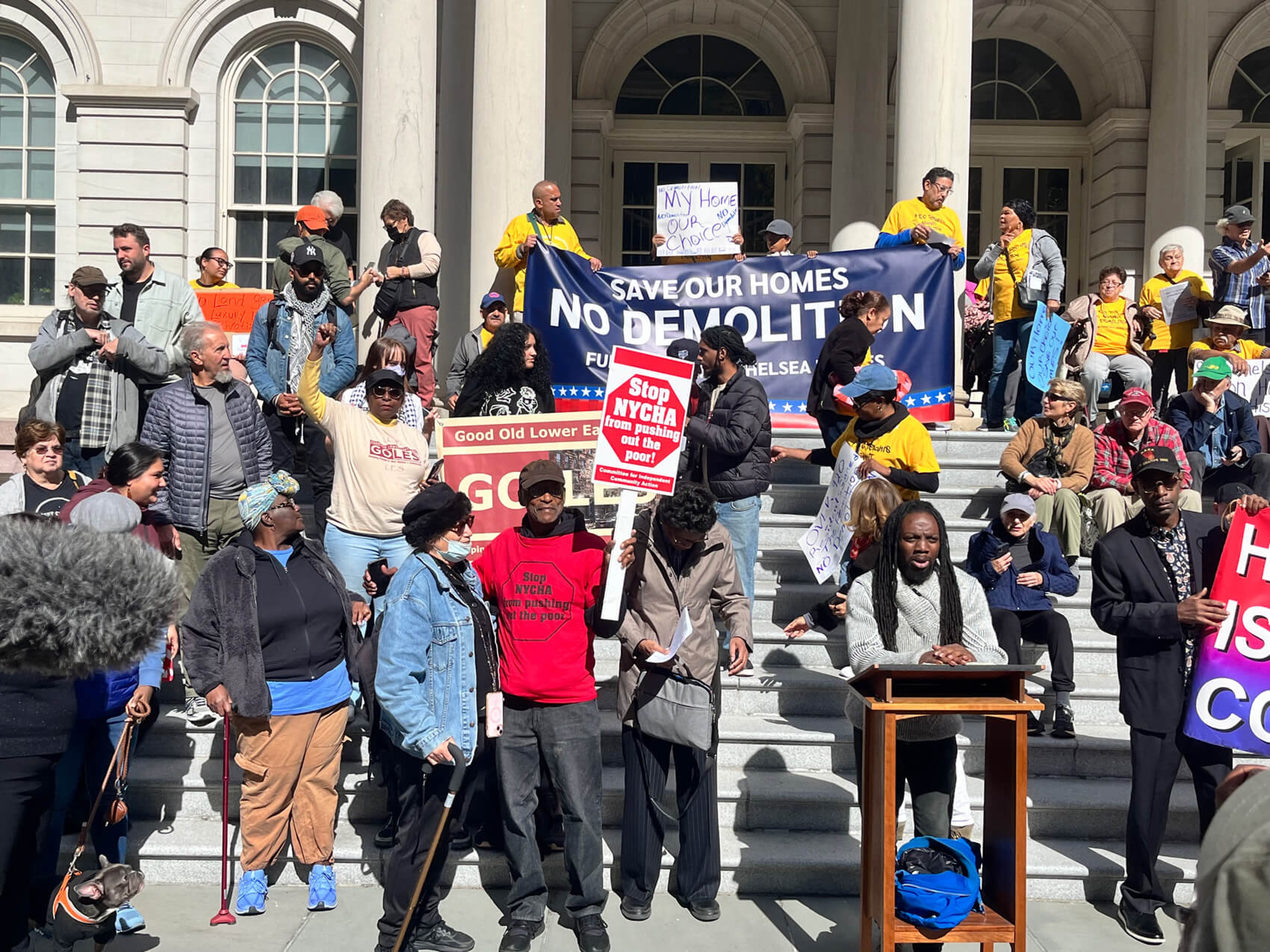
At Fulton 11, the first public-housing building slated for demolition in Chelsea, a wealthier neighborhood in New York City, there has lately been a procession of visitors: senior NYCHA officials, executives from the development team, people with titles and assurances. Their message is remarkably consistent. Leave your apartment. Agree to relocate voluntarily. Everything will be fine.
And if you don't, eventually, we will evict you.
Fulton 11 is only the beginning. Once emptied, it will be demolished, followed eventually by the rest of the Fulton and Elliott-Chelsea campuses: 18 residential buildings over seven acres, housing thousands of low-income residents.
Tenants have been promised that they will be allowed to come back.
But come back to what? The building will not exist anymore. And the legal structure of their residency will change dramatically, making their ability to stay in the units they grew up in an open question.
From its stairwells, Chelsea presents itself in layers: brick warehouses from an earlier city, the High Line, glass towers, condominiums, the polished bulk of Hudson Yards farther north. Climb to the 23rd floor of any Fulton Houses, and you can enjoy fantastic views of the Empire State Building and the Hudson River.
Seven acres of extraordinarily valuable Manhattan land have been occupied for generations by people whose incomes bear no relation to the value of the ground beneath them. For a long time, as a matter of policy, the land was permitted to remain indifferent to the fortune it represented.
The buildings aged.
Some elevators reached the end of their useful lives. Heating became unreliable. Pipes, façades, and mechanical systems needed work. But the federally mandated environmental review produced as part of the proposal found the buildings structurally sound and identified no systemic mold. Fulton’s roofs were replaced in 2018. A new community center was completed. A million-dollar playground was built.
The neglect was real. So was the possibility of fixing it.
In 2019, NYCHA proposed demolishing part of the Fulton Houses. Residents strongly objected. Elected officials balked. A working group followed, along with meetings, consultants, studies, and presentations. Eventually, a plan emerged carrying one rather important assurance:
No demolition. The buildings would be rehabilitated.
To finance those repairs, NYCHA proposed PACT (Permanent Affordability Commitment Together), New York City’s implementation of the federal Rental Assistance Demonstration program, or RAD. In 2021, a resident committee selected Related Companies and Essence Development to carry out that rehabilitation.
Then silently, the diagnosis changed.
Historically, Section 18 demolition for physical obsolescence required showing that rehabilitation was not cost-effective; for elevator buildings, HUD’s threshold is generally 62.5 percent of the Total Development Cost. NYCHA says that analysis was unnecessary here, despite the project Request For Proposal contemplating one.
Instead, Related and Essence, the team with the most to gain from demolition, declared the buildings beyond repair. When their assessments were requested under FOIL, the answer was remarkable: they did not exist. No assessment. No rehabilitation. Yet, demolition became the plan.
All existing residential buildings at Fulton and Elliott-Chelsea are now slated, in phases, to disappear. The 2,056 apartments are supposed to be replaced, although the replacement apartments would be configured differently and hundreds of bedrooms would disappear. Residents are promised a right to return, but past examples have shown this promise to be tenuously enforced. Thousands of additional apartments would rise around them, a majority of them market-rate, and with those apartments, new opportunities for new renters.
How did the original residents consent to such a transformation? That story, too, requires some translation.
3,388 adults were eligible to answer the survey prepared by NYCHA to assess tenants’ opinions. Only 966 submitted valid responses, barely 29%. Of those, 57 percent preferred new construction to rehabilitation.
But here’s the catch: the word demolition was not used. Instead, residents encountered the more soothing word decanting, a technical construction term that entirely obscured what would actually happen. The language was so misleading that many believed they were selecting repairs, not bulldozing their entire campuses.
29% participation became a mandate from “the residents.” A preference for a new apartment became consent to demolition, redevelopment, Section 8 conversion, and an entirely different institutional arrangement. And finally, what started as an informal survey, poorly written and poorly administered, was upgraded: the broader public, it was presented as a “vote”.
This is how bureaucratic language matures. It begins life as a poorly-administered questionnaire and retires by claiming it is democracy.
The Number that Changes Everything
Public housing is sometimes described as merely a system for making apartments inexpensive.
Traditional Section 9 public housing is built and owned by the government, operated through a public housing authority, and supported directly through the federal public-housing system.
Inside that arrangement was a genuinely radical proposition: the government could simply provide housing. The apartment did not need an investor. The rent did not need to service private debt. The land did not need to achieve its highest possible return. Housing a person could be the purpose rather than the revenue model.
But PACT changes that arrangement. Financially, it flips the incentives at play.
But financially, the distinction is enormous.
And here is the catch. The Section 8 subsidy fills the pocket of the private developer or building manager. But where HUD decides to give $1 subsidy for public housing under Section 9, it will willingly give $3 for the same unit under Section 8. Why, you may ask, is Section 8 so much pricier than Section 9, and why does the Federal government want to spend more today, rather than less as yesterday? Because the private sector has convinced HUD,with the help of skilled lobbyists, to give the private developer the fair market rent through Project Based Voucher Section 8 for the same unit, to give the private developer the fair market rent. For our Fulton buildings, that is a little over $5,000 for a one-bedroom apartment. This is what Related is guaranteed to receive from the federal government if this project moves forward. The annual rent roll for FEC is estimated to be around $115 million annually, with a 3% annual increase and a possibility to revalue it from time to time. Guaranteed by the Feds, i.e., the best possible tenant.
So why is the Fed so eager to pay so much more?. The answer is political. Section 8 is the asshole of federal housing policy: every congressional district has one. Whereas Section 9 housing is concentrated in large, dense, mostly blue congressional districts such as New York, Chicago, Boston, San Francisco.
Project-based Section 8 produces a contractual stream of federal rental-assistance payments attached to apartments. A stream of federal payments is predictable. Predictable revenue can support borrowing. Borrowing permits bonds. Bonds attract lenders. Private capital can enter. Long-term interests in the property can be financed, using mostly public finance streams, but for the mostly exclusive benefit of the private sector.
The same apartment that the government struggled to maintain as Section 9 housing becomes considerably more interesting once it has a revenue stream that a bank can model. In other words, the incentives are literally financial.
The same apartment that the government struggled to maintain under Section 9 becomes considerably more interesting once its subsidy can be modeled as income. Lawyer Elizabeth Gyori, writing in the N.Y.U. Review of Law & Social Change, calls this the commodification of public housing.
The word is useful precisely because no crude sale needs to occur.
NYCHA can keep the deed. Everything around the deed can change.
The subsidy changes. Management changes. Property interests change. Financing changes. Long-term leases are created. Debt enters. Private entities acquire contractual interests in the housing. All of a sudden, the housing acquires a new economic life.
Residents acquire different legal rights as well. The conversion reduces their transfer and tenant organizing rights, as well as the statutory structure governing their housing. And unlike traditional public housing, the new arrangement is built around contracts, subsidy terms, and financing periods that expire. Related may have acquired a 99 year lease, but is only contractually mandated to provide housing under the scheme for 15 years at FEC.
And Then There Was Money
Rehabilitation was promised. Then demolition and redevelopment entered the picture. And the financial drought ended.
Now, there are bonds. There are mortgages. There are public loans and private loans. There are Section 8 Housing Assistance Payments. There are project companies. There are long-term ground leases. There is construction financing and permanent financing. There are development rights. There is market-rate housing, a lot of it. There is Related Companies, with its $66 billion under management. There is Essence, a company formed mere weeks before the RFP went out. There is HDC, the NYC Housing Development Corporation, that issues bonds for housing projects. There is HUD, whose goal is to support all housing authorities throughout the country in privatizing. There is NYCHA, which loudly states at open-mic events that large-scale demolitions are the model for the city’s public housing portfolio. There are lenders and their demands for a 12% return on their investment banks.
There is even a Subordinate Market Rate Revolving Term Loan, or SMRRT, proving that the financial sector has retained a sense of whimsy.
The first phases alone involve financing measured in hundreds of millions of dollars.
Much of the principal and subordinate capital is public. The land is public. The federal rental subsidy is public. The authority to redevelop the land is public. The obligation to house the residents is public.
The transaction, however, is presented as evidence of what becomes possible when private capital is finally allowed to insert itself.
One begins to wonder which party is rescuing which.
The essential logic is not difficult.
Section 8 payments create predictable project income. Income supports debt. The debt helps finance construction. Additional development produces value.
The tenant remains a tenant, albeit with fewer rights. He or she is now associated with a dependable federal revenue stream. But only if the private sector wants to, and they have much discretion.
One begins to wonder which party is rescuing which.
No sinister meeting was required. No one had to declare that tenants were financial instruments. The structure of the deal took care of that.
The Value Beneath Their Feet
The most interesting asset at Fulton and Elliott-Chelsea is not the buildings.
It is Chelsea.
The campuses sit in a neighborhood where almost every square foot has, at one time or another, attracted somebody's attention.
The private market has been extraordinarily attentive.
Public housing was different.
For decades, Fulton and Elliott-Chelsea occupied Manhattan land of enormous value without making any serious effort to realize that value.
Families lived there. Children played there. People grew old there.
From the standpoint of modern capitalistic real-estate economics, the land was behaving irresponsibly. Its high market-value was being ‘wasted’ on housing low-income residents. But “use” and “value” have acquired rather specialized meanings in New York.
Public ownership once allowed those meanings to diverge.
A parcel worth a fortune could house a family earning very little, and the mismatch between land value and household income was the social achievement–it meant that housing mattered more than profits.
The market could look at the property and calculate what it might be worth.
Government could answer: irrelevant, we are worried about people having homes.
Now the calculation has returned.
The redevelopment would allow thousands of additional mostly market-rate apartments to be built. This is generally described by neo-liberals as unlocking value.
The phrase is revealing because the value of that land was not locked, it was deliberately unclaimed for the sake of social use.
For most of the twentieth century, governments did that on purpose.
What Survives
Residents deserve fully modernized, safe, high-quality public housing. That requires comprehensive modernization.
Instead, the city chose demolition and redevelopment.
The plan would add 3,454 apartments, 2,416 of them market rate, making it the majority housing typology. Existing public-housing residents may return, but they would return as a minority in a place built around them.
That is displacement too–not necessarily expulsion, but demographic displacement.
And the externalities of creating that new neighborhood will fall overwhelmingly on the people who live there now. Current residents will endure years of demolition, excavation, noise, dust, construction traffic, and the disturbance of contaminated soil. Some of them will be forced to move and live in suboptimal situations, carrying their possessions and family members with them. To return home, they will have to wait in this limbo–and if the construction is delayed, which it almost undoubtedly will be, they will be trapped in that limbo indefinitely. The future market-rate residents will arrive after much of it is over.
But the greater loss may come later.
Section 9 public housing was designed around permanence: public land, public responsibility, housing deliberately removed from ordinary speculative pressure.
Once that housing is converted, leased, financed and commodified, there is no easy route back. It is easier to privatize something than make it public.
The replacement apartments may continue to be called (wrongly) public housing. But their future will be tied to subsidies, contracts, financing cycles, debt, and private interests.
They acquire something traditional public housing was never supposed to have: an economic end-of-life. That is the irreversible part: Once public housing becomes an asset, it begins answering to the logic of assets.
And it is difficult to imagine it ever returning to the civic proposition associated with Fiorello La Guardia and Eleanor Roosevelt: that the government could take valuable land out of the market, build decent homes on it, and keep them there for people who needed them.
Once commodified, that function is not merely altered.
It is gone.