
Sep 2, 2026
Nithya Raman Wins DSA-LA Endorsement: Now, Only Socialist Unity Around The Permanent Campaign Can Defeat The Establishment
Nithya Raman has won the official endorsement of DSA-LA. J. Ryder argues that the entire chapter should now mobilize and unite under a permanent campaign to build a socialist pole in LA and defeat Karen Bass.
by J. Ryder
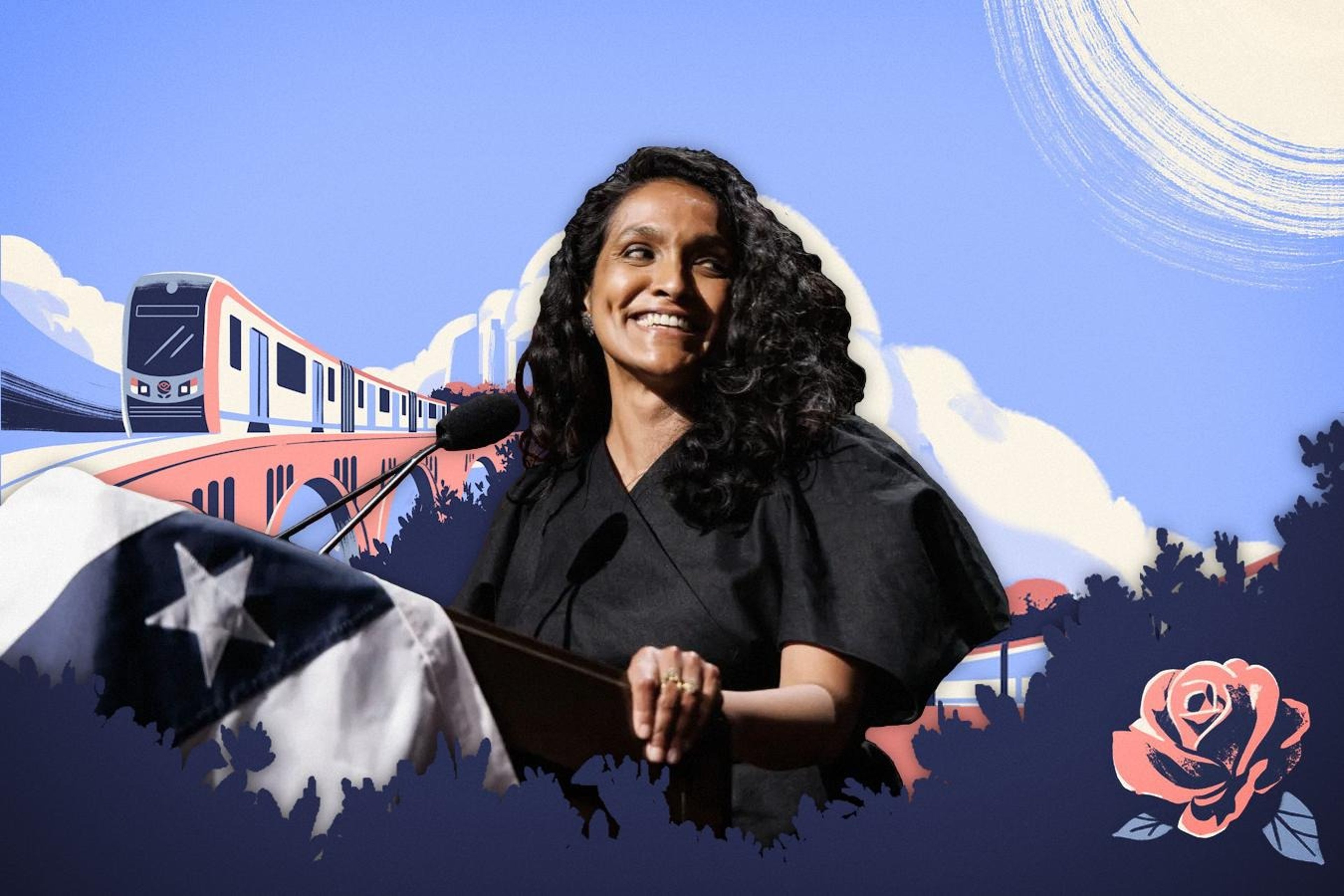
As of Wednesday, September 2nd, Los Angeles mayoral candidate Nithya Raman has received the required 60% of the DSA-LA vote necessary to win the organization's endorsement. According to sources within DSA, Nithya won 65.9% of the vote with over 1,400 votes being counted.
The decision, made after a week-long voting process, follows several weeks of intense discussion among DSA members over whether the organization should throw its full weight behind Nithya. The debate exposed genuine disagreements over socialist strategy and represented a microcosm of DSA’s broader struggle to define its relationship to electoral politics, and the spectrum of candidates now emerging within the insurgent Democratic pole. The debate culminated with a surprising but decisive endorsement for Nithya by UNITE HERE Local 11, along with city councillors and union organizers making the plea to DSA-LA specifically to endorse in the pages of Geese Magazine.
In a mass deliberative process in which members on both sides of the endorsement debate wrote in Geese to make their voices heard and their positions legible en masse (with the debate even being registered by the mainstream media), the organization has now rendered its verdict decisively.
The potential significance of this decision, however, lies less in the decision alone and more in what the organization actually does with it. There is a natural temptation, especially after a contentious endorsement debate, to continue fighting this fight indefinitely. Those who opposed Nithya may remain unconvinced, and understandably so. Those who supported her may be tempted to treat the vote as vindication of everything they argued during the campaign—using that vindication to alienate those who disagreed, or to understand the tasks of the chapter as purely assisting Nithya Raman's campaign rather than using it to build a socialist political pole in LA.
What we must realize, though, is that the purpose of democratic deliberation is not merely to determine which faction has won an argument. It is to produce a political decision around which collective action can subsequently be organized. That moment has arrived; the debate is over, and now the permanent campaign, one involving omnipresent mass-participation and intervention into the electoral sphere, must begin to take shape in Los Angeles.
What Constitutes Organic Unity?
The vitality of discussion within DSA throughout this endorsement debate cannot be understated. For weeks, members generated substantive long-form arguments about Raman’s record, political trajectory, and the potential of her campaign in contributing to socialism. Critics raised concerns about her record, her political commitments, and whether she represents the kind of transformative politics that socialists should seek to advance. Supporters then made the case for her capacity to build a broader constituency for socialist politics in Los Angeles that is larger than her individually, and at times sought to defend her record from narratives they didn’t feel were substantiated by the political reality.
Although consensus has now been reached, such a fact does not render previous disagreements meaningless. Nor should we now seek to entirely erase the history of those differences after the vote; we just cannot let it become an excuse for political paralysis. One of the most important principles of democratic organization is that disagreement and unity are not mutually exclusive; in fact, without an open deliberative process, organic unity becomes impossible.
As Italian Marxist Antonio Gramsci once wisely said:
Unity and discipline cannot be mechanical and coercive; they must be loyal and the result of conviction, and not those of an enemy unit imprisoned or besieged—thinking all the time of how to escape or make an unexpected counter-attack…[we must struggle] for the unity of the party, and not merely for external unity but for the rather more profound kind which involves there not being inside the party two political lines which diverge on every question.
A serious political organization does not require its members to reach identical conclusions before they can act together. It requires them to develop mechanisms through which disagreement can be transformed into a collective decision—and then, once that decision has been made, into collective action.
That is precisely what makes the outcome of the DSA-LA endorsement significant. The weeks of debate have produced not merely a winning position, but what can reasonably be described as a resounding organic consensus: a unity that emerged through the process of open disagreement itself. Many Nithya dissenters became convinced of the campaign’s utility for DSA and socialism as the weeks of discourse went on; even those who continued to oppose now appreciated the basis of the argument, and vice versa. The task now is to preserve this deliberative achievement and consolidate its resultant endorsement into political victory for socialism in this city, and this country.
Raman represents the means—not the ends—to Democratic Socialism
There is an obvious danger in treating a candidate endorsement, or even their eventual incumbency, as an end in itself. Socialists should not approach electoral politics as though the election of one individual, by itself, constitutes the consolidation of socialism. A socialist movement cannot outsource the independence of its politics to electeds. An elected official cannot substitute for the organized power of the people; it can only reflect that power and develop a reciprocal relationship with it.
The relevant question thus requires a paradigm shift. It’s not about whether Raman represents a 1:1 reflection of DSA’s image, but rather whether her candidacy can become a vehicle through which a broader political project can organize, expand, and universalize itself. DSA-LA has decided that the answer is a resounding yes.
This is where the Zohran Mamdani comparison gains utility. Zohran’s political significance has never been reducible to the policies contained in a campaign platform, the deliverism that some have decided is the end-all, be-all of Zohran’s mayoralty and socialism in New York.
The importance of Zohran lies little in the individual policies he’s been able to pass through the gauntlet of capitalism, but, rather, his ability to translate socialist politics into a language that ordinary people can recognize as their own and to transform otherwise dispersed questions of housing, wages, public goods, the cost of living, etc. into a larger argument about who the city, and the country belongs to. Zohran's socialism represents his principled commitment to the people of New York and his opposition to the old mode of politics, not to a specific policy set. This is the content of democratic socialism in the current period: working-class political power.
That is the opportunity now before Los Angeles. Nithya Raman has had bad moments, and Socialists should be neither embarrassed nor afraid to acknowledge them. But political movements are not built by waiting for candidates who perfectly embody the movement’s entire program. They are built by identifying opportunities to lay foundations upon which the future of struggle can become tangible and seizing them without hesitation. The task is not to cringe from Nithya's mistakes, but to soberly take advantage of Nithya's actions.
Nithya can become a political vehicle through which the socialist movement in Los Angeles reaches constituencies far beyond the people who already identify with socialism. The choice facing DSA is therefore not between Raman as she currently exists and some hypothetical candidate who perfectly represents the organization’s politics. It is between using the political opening created by her candidacy or allowing that opening to close.
Defeating Karen Bass and the Establishment
Raman’s opponent represents a political establishment with enormous institutional advantages, resources, relationships, and legitimacy accumulated over decades. The incumbent Karen Bass represents the existing political order that DSA is already in conflict with nationwide—one that has demonstrated repeatedly how effectively it can absorb progressive rhetoric while leaving the fundamental structures of urban political power intact, and has actively sought to suppress the rise of socialism in the Democratic Party. Bass' anti-socialist corporatism is no abstraction. She is using the same donor funds to defeat Nithya that are also being used to sink DSA-LA's endorsed candidate for Council District 9, Estuardo Mazariegos. Bass is the personification of everything the current mass insurgency has set out to destroy, and with Nithya, we can now take the fight directly to the enemy in the largest city on the West Coast.
DSA-LA backing Nithya is an extension of the struggle we’ve seen from New York to D.C., Philadelphia to Colorado, Michigan to Florida, not a break with that struggle. Socialism in Los Angeles has not yet found roots outside its rather isolated contingent of city councilmembers. An embattled minority on the council, they are living proof of the difficulties faced even by DSA's own cadre candidates; in the primaries, weighing their options, they made the somber political calculation to endorse Bass (whose establishment bona fides have been well-documented in the pages of this magazine and elsewhere). Seizing the mayoralty would change the equation; it would provide an unprecedented opportunity to pack not only the executive office, but all that remains downstream of it. Zohran has shown that playing an active role in not only city governance but also bolstering the campaigns of others using the mayor’s platform is a vital function for socialism that the left can push Nithya to follow.
But defeating that establishment in LA will require more than the support of Nithya’s backers; it will require it of even those who voted against her endorsement. Some will have serious reservations about her personal politics. Some may believe another candidate's policies would have been preferable, such as those embodied in the admirable campaign run by Rae Huang. They should nevertheless campaign for her.
Not because their criticisms have magically become invalid, but precisely because their criticisms are valid, they must not leave it solely up to any individual leader to wage the Democratic Revolution.
With a socialist in office for mayor, and as an essential constituency of her victorious coalition, we will fight boldly with her campaign, criticize her when necessary, and do our part to bring all of Los Angeles into a socialist-run City Hall. Accountability—a contentious term within the organization—can only have meaning if we are willing to engage difficult struggles alongside our representatives, through which we broaden our relationship with the masses and show elected leaders the power of a mobilized city that is prepared to fight for democracy and socialism. Our shared enemy is the present authoritarian government, and our shared obstacle is the regime's decrepit establishment opposition. These realities have proven sufficient to throw DSA and the Nithya campaign into the same coalition, for now.
This sort of accountability can only be won through engaging these struggles and their respective bases in real time, not leaving them out to dry. It is located in the work we do to distinguish ourselves and build a mass pole, not in the work we don't do, such as a lack of endorsement.
Building socialist dual power starts with leading people on the frontier of struggle, a frontier that is increasingly defined through the ongoing electoral confrontation with establishment forces. Once DSA and democratic socialism become symbiotic with this frontier, further refining its features to become fluent in the logic of the masses fighting for it, the organization will be able to use its leverage to generate real accountability—one that can elevate Nithya to achieve high standards in office—as a core constituency and strategic ally.
With change, comes many problems. But with problems come solutions, and it is questing for solutions, building the independent organization and political pole, that is the real potential to be gained from the left's involvement in the Nithya Raman campaign for Mayor.
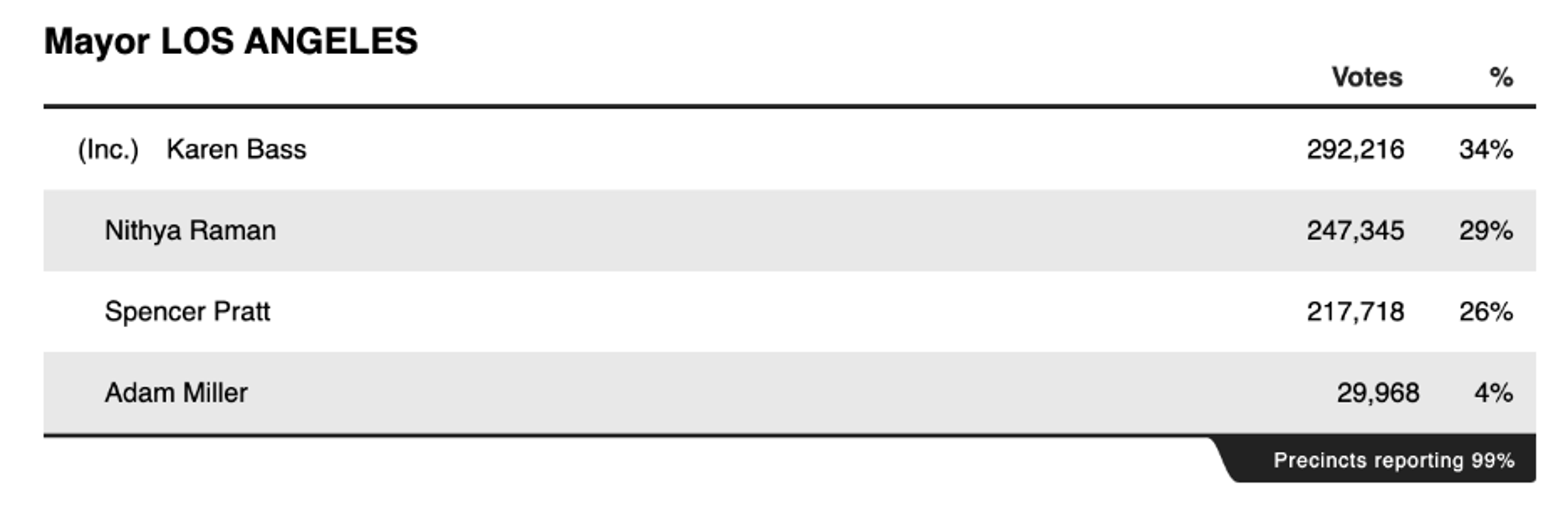
Nithya lost the vote to Bass in the Jungle Primary by a small yet tangible margin. She needs the support of DSA to get her over the line; playing such a crucial role would undoubtedly provide great future leverage for the organization as kingmakers, not only in NYC but in LA.
Building Socialism for The 2028 Moment
Perhaps most essentially, Nithya represents the opportunity not just to aid the growth of socialism in Los Angeles, but to also move toward a national consolidation in the lead-up to the crucial 2028 moment. With an AOC presidential candidacy now looming large over the prospects of socialism in the United States, it is crucial that we recruit and elect a vast breadth of people all over the nation who can aid in creating a robust political pole for socialism.
To hold the mayor’s offices in the two biggest cities in the country, along with the congressional surrogate growing with additions such as Chris Rabb, Darializa Avila Chevalier, Claire Valdez, Melat Kiros, and potentially more on the way, provides a foundation through which an AOC candidacy would not be so easily isolated on the national mainstage; a fact that played to the detriment of both of Bernie Sanders’ presidential runs. We can no longer fly solo against a nefarious political establishment that will seek to coordinate and outmaneuver us at every turn.
Electing Nithya now means AOC 2028 will have nationwide allies, both in office and at the grassroots level, that can endorse her, and mobilize their base both for her, and against the establishment Democrats and MAGA fascist threat in the most important presidential elections yet.
We must not falter now. The debate has ended, and the permanent campaign must now begin in Los Angeles. And if socialists in Los Angeles are serious about defeating the establishment, there is only one direction left to move: together.