
Jul 9, 2026
Towards Active Revolution: Where to Begin? The Permanent Campaign
In the conclusion of this essay, we argue for a concrete orientation to 2028 in the face of a potential AOC ‘28 run and our opportunities.
II. Populism and The Proletarian Revolution
III. The Permanent Revolution and the Tactics of the Communists
IV. Where to Begin? The Permanent Campaign
Every question “runs in a vicious circle” because political life as a whole is an endless chain consisting of an infinite number of links. The whole art of politics lies in finding and taking as firm a grip as we can of the link that is least likely to be struck from our hands, the one that is most important at the given moment, the one that most of all guarantees its possessor the possession of the whole chain.
V. I. Lenin, 1912
At the close of the “socialist moment” (yes, the close) that began roughly in 2016 with the Sanders run, we are able to more clearly identify its features.
I originally discovered this concept as a product of the CPUSA, which led me to appreciate their focus on historical specificity. The “socialist moment” can be schematically defined by three factors: 1) the rise of political militancy among the masses, embodied in the increased participation in voting, political discussion, and, most importantly, in the various forms of worker organization both permanent and temporary, ranging from the left-organizations themselves to marches such as BlackLivesMatter, 2) the ideological return of socialism and liberal-critical ideologies more generally, such as Trumpism alongside the general and successful consensus around liberal humanism, of which the current wave of right-wing reaction is reacting to, 3) the loss of faith in the traditional liberal political formation, a disaffection inaugurated by Obama, asserted by Hilary Clinton, and historically confirmed (and concluded) by the 2024 fiasco surrounding Biden and Harris.
To the degree that this can be described as populism it is because the form that these three factors take is a return to political polarization and mass participation in politics, along with the rise of extreme contempt and dismissal for non-political means of conflict resolution within politics (such as technocracy).
Each moment is not defined by its qualities, but by the dominant problems of the moment. So, consequently, we say that the socialist moment is concluding because practical solutions are being discovered for each of these problems—always the step before the discovery of new problems. Firstly, the massive explosion in political activity of the masses has been resolved into the realization of the permanent campaign—the constant participation of the masses in formal politics and the State (i.e., not just cultural or proxy issues) is becoming a structural feature of American society. This has not been concluded, but is in the process of concluding. Voters are no longer mobilized at elections, but constantly mobilized by forces in society in general. The shining example of this is the MAGA movement—and the relative strength and vitality of the MAGA movement can somewhat be attributed to its ability to solve the problems of the populist era so thoroughly that Trump is often identified with the origin of the era itself.
MAGA is not a voting decision, but a culture that turns politics into an identity. It is held together not by the party-form but by the web of interpersonal connections (each man turning into a political center unto himself), extensive media infrastructure, and, of course, its ‘populist’ ideology as a cohesive social glue. It persists both extensionally and intensively: every possible issue, from China to video games, is placed within a framework and given essential significance in the world of MAGA politics; any particular issue, too, can be infinitely litigated and muddled–a constant set of ‘bad faith’ verbal tricks and dismissals–often described as a commitment to ‘post-truth’.
What was innovatory here has finally reached across the aisle and is quickly becoming the main mode of politics more generally. This, more than anything, signifies the closing of a period. The permanent campaign is, actually, the implicit strategy of the left that has reached its fullest potential in the DSA. The DSA and the left more broadly, due to historical attachment to socialist organizational forms, has successfully developed a permanent campaign of its own: one perhaps even bolstered by its political aversion to electoral politics. The Democratic Party elite, more than anything else, fears this element of the rise of socialism as the condition of their extinction—that they will, because of their inability to transition to a new mode of politics, be permanently evicted from leadership of its social groups.
So, Jordan Weissmann, Editorial Director at the Progressive Policy Institute, writes: “The left basically has a permanent campaign, while libs have none. That may have been tenable for us in cities when demographics and the national mood are in our favor, but it isn’t anymore.” Recognizing the era has changed, Weissmann recognizes the appropriate mode of organization must also change (although, of course, he fails to understand this meaningfully, as a relation and development of society and of the relation between classes).
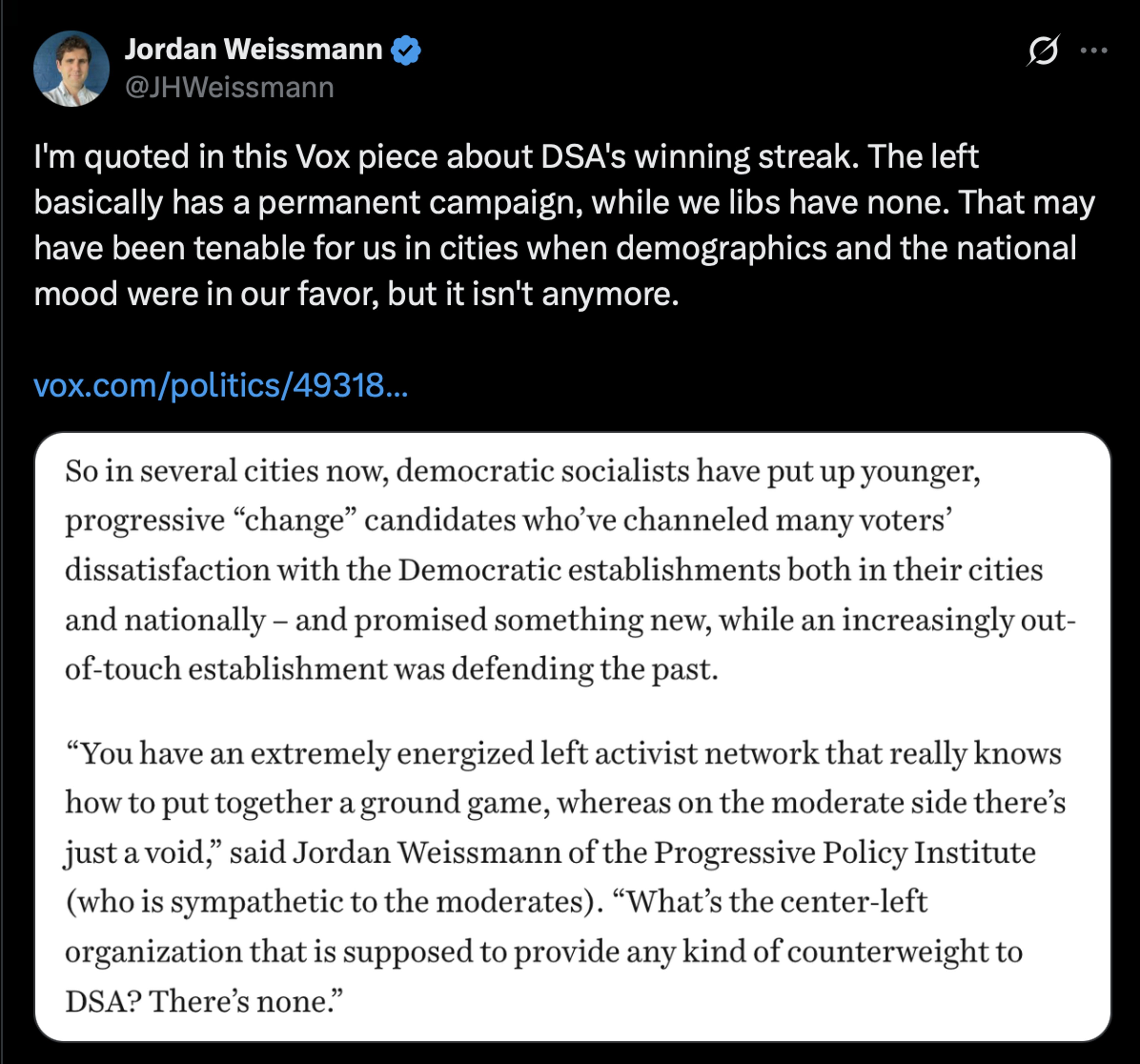
Screenshot taken July 8, 2026.
The basic elements of this permanent campaign are uncontroversial, vis-à-vis, the formal independence of DSA as an organization (hence a ‘pole’) , its robust internal democracy (or large set of serious and committed cadre), and its practical basis in mass struggle. As might be expected from the preceding analysis, it is the third of these factors that is decisive. As such, to understand the permanent campaign in our current juncture, we must look for not merely the formal or physical bases of the permanent campaign but the political tactics appropriate to it–those that will facilitate its most extensive development and achieve its ultimate aim.
What is this ultimate aim? This model is presented most clearly in J. Ryder’s analysis of the first 100 days of Zohran’s administration in New York City, which we will quote somewhat at length. He writes:
“Rather than treating the first 100 days of his administration as a milestone to be interpreted by journalists and filtered through mainstream media, Zohran presented it as a collective checkpoint: a moment where the administration accounts for itself before the people it represents. This reflects a governing strategy that Zohran has consistently followed from the beginning, and that is at odds with traditional Democratic governance. Instead of resting on his laurels and treating legitimacy as something periodically conferred through elections, Zohran treats political legitimacy and agency as something that can and must also be built in governance.
In the weeks leading up to the address, this approach was already visible. Zohran has made a habit of issuing near-daily updates via platforms like TikTok, narrating policy decisions, legislative fights, and administrative hurdles in real time for a mass audience. These updates are not polished press releases; they are deliberately legible, often informal, and oriented toward explanation rather than the standard mystification we see from traditional establishment politicians. The effect is evident: Mamdani’s governance appears to the average person not as a distant bureaucratic apparatus, but as an interactive democratic process through which the people themselves are invited to participate in, contribute to, and identify with. This is left-populism in action.” [My emphases—PKG]
Although Ryder is analyzing the Mamdani administration inpower, what he identifies here is surprisingly also a cogent analysis of what makes DSA effective as a political force more broadly. DSA has largely not succeeded by tamping down its radicalism—but by effectively representing this mass entry of progressive workers into politics. In doing so, they have created parallel and oppositional ideological and political narratives (challenging the narrative of socialism “to be interpreted by journalists and filtered through mainstream media”), treated political action as something to develop and as defined by worker agency, and, by making their politics both legible and by basing the concrete elements of their program on existing workers’ demands, ensuring it was genuinely interactive in content and not just in form. As the recent election cycle showed, DSA can still win even without moderating on some of its most radical demands—demands are won, in other words, by making those demands meaningful and politically salient to everyday people, not necessarily through moderation. Although radicalism can be an obstacle, it is not insurmountable–and, in the modern day, it can often be explosively useful.
More importantly, we see here the contours of the development of the class struggle of the proletariat. For, contained in this formula, is also contained the principles of its exhaustion. The proletariat must form its independent narrative and politics, it must become an organized agent, it must have a clear and legible political program grounded in the struggles of the current day—but once it has these things, its tasks will be different. Ryder continues:
What his 100-day address revealed is that populism, when executed at a high level, is not opposed to organization but can serve as its most effective elaboration in practice. The constant public updates, the mass address, the commitment to framing of governance as a shared project—all of these function to create and expand a critical, working-class base. They transform passive supporters who may have voted for Zohran because they felt vaguely engaged by his resonant messaging into an attentive audience–and perhaps an attentive audience into a potential socialist political force. Populism here is not a substitute for organization; it is a method of organizing, and functions as one with great efficacy.
In this sense, DSA’s success should be attributed to its historical insight and understanding, explicit or not, of the current stage of development of class struggle. To take a living attitude to communist tactics is not to dismiss this out of hand, but to understand this work as a phase of development and, again, work to advance it as much as possible.
But what are the conditions of possibility for this? To ascribe this to “the DSA” as an organization is to engage in organizational chauvinism, and to mistake the symbol for the meaning. “DSA” is nothing; the people involved and the activity they engage in, in relation to society as a whole, is everything. Accepting that the above are the theoretical lessons derivable from the practice of socialism over the last decade, our orientation must be towards understanding these elements and engaging in a type of practice that most effectively develops our ultimate goals, viz., the proletarian revolution.
The first key is that our struggle must be political. In a concrete sense, this means that we must run candidates. We must win elections. And we must run as many candidates and win as many elections as possible. The electoral arena is the primary field of political struggle in the current day, and, consequently, the primary field of class struggle as well. The vast majority of the American proletariat understands politics as a question of elections and candidates and, as a general rule, the further one gets from electoral politics, the less rather than more politically mobilized a given individual is. The most fundamental difference between the DSA and its peers has been the willingness of the DSA to use the electoral struggle pragmatically—to cohere and construct a progressive political subject, to energize that subject, and then to actually politically represent it.
Elections are sites of struggle: where two (or more) political individualities struggle for victory, to discredit the other, to win over ‘the people.’ It is here that the political demands of Marxism are brought to the forefront and made visible for everyone. It is here that Socialism wins its authority and prestige as a political ideology that has the ability to serve the working class as a weapon. It is here that the socialist line on the issues of the day—the campaign necessarily being structured around ‘the issue of the day’—can be made clear, legible, and spread effectively.
It is often stated that elections demobilize or deradicalize the proletariat. Nothing could be further from the truth. The demobilized proletariat does not participate in the electoral struggle, is less involved in the politics of general society, and is less engaged in the task of cohering a revolutionary subject. The campaign is precisely where the issues, around which the proletariat relates, generally, from a reactionary perspective, are intensified; this is the most effective place where oppositional perspectives can be directly challenged, and the issues that remain silent in periods of complacency are paraded in front of the world.
The various leftists who chase the proletariat in their capacity as non-political actors—such as, as a recent distorter of Mao presented it to me, by going to people as individuals or as economic units—are doomed to remain at the level of individual consciousness or economic reform. To build a political proletariat, one must participate in the politics of an era. Here, we might read Lenin:
Can one think of any other institution in which all classes participate to the same extent that they do in parliament? That cannot be created artificially. If all classes are drawn to participate in the parliamentary struggle, then it is because class interests and conflicts have their reflection in parliament. If it were possible everywhere to stage, let us say, immediately decisive general strikes to make a clean sweep all at one go, then the revolution would already have taken place in various countries. One must, however, take account of the facts, and parliament represents the arena of the class struggle.
It is difficult to be any clearer, despite the million attempts to the contrary. The issues facing the working class are explicitized and given significance in the electoral campaign: the radical left must do whatever it can to maximize this process and the tension around these embodied demands, rather than, as is the normal mode of the political campaign, relate to them exclusively as a means to win the election. The end result of the classic campaign is closed at the time of voting. Our campaign, on the other hand, must never end.
Between now and 2028, then, the task is for the left: identify and prepare to run candidates for the next cycle. In a period where the masses are entering politics, where they are interested in socialism, and where they are fed up with the old—it is dereliction of duty to fail to provide a genuinely Socialist politician to fight for them. It is dereliction of duty because, if even a single possible front is lost to the enemy when the conditions are so propitious for us, we will have missed the opportunity to swell the ranks of our movement, to build the proletariat into a fighter—and we will have surrendered to liberalism; lost political initiative and capital, in the crisis that belongs to us, to liberalism.
Is this not already happening? The infamous “Democratic tea party” is not an appropriate term for the DSA’s work. It includes, necessarily, the entire strata of “middle” politicians, such as Graham Platner, Abdul El-Sayed or even Brad Lander, who do not identify with socialism or the DSA but who are identified by the masses as being part of the same tendency, the same wave of “left-populism”—whether or not they are formally endorsed or recommended. What these people represent is the real future of the Democratic Party: not managers like Pelosi or Biden, but good social democrats, good leaders of the people, good fighters. In doing so, however, they are ensuring that the leadership of the movement is once again captured by liberalism, and left out of socialism. They do not do this maliciously or intentionally, but they do it nonetheless; it is the objective significance of their campaigns.
The dangers of ceding the terrain here are not limited to the purely political. As the case example of Graham Platner has shown, our weakness in the midst of what is a mass upsurge leads to vexing contradictions. Platner was a progressive ‘fighter’ candidate put forward by the Democrat voters of Maine–someone who was defended despite his checkered past, not because of it. Ultimately, his vile crimes were too much for even them to swallow. But the energy behind his campaign was real–and if we are not there to channel, organize, and structure it, people like Graham Platner or his equivalents will. The masses are hungry for something different. If we do not provide a political representative, they will find someone—anyone—to do it for them. DSA, and the organized left, have a structure that allows for serious vetting and the raising of candidates who have histories of organizing. If they play their cards right, they will be the ‘elite’ of the upcoming progressive wave.
In 2028, AOC must run for President. If she does not, the crisis of American politics will be resolved by 2032—and it will be resolved by a new Democratic Party leadership that is able to authentically present itself as a radical break from that which came before, but which is still invested in the bourgeois mode of politics. Socialism will not die, but it will have lost a historic opportunity and will be significantly weakened. The old, the Democratic Party, has lost legitimacy. The new, the Trump-Republicans, is universally reviled. 2028 is the moment that the future of the United States will be decided: if the socialists are absent, that will only signify to the masses that we are untrustworthy, that we are not the real fighters of their class–that we claim to have the boldness to revolutionize society but really lack the strength to even present our vision of leadership publicly. We will be charged with: dereliction of duty.
An AOC run, on the other hand, would light the fuse for the bomb that has been ticking since 2016. The objective conditions for it are finally here. If Sanders represented the opening of Socialism, the exhaustion of the Democrats under Biden and the venality of Trump represent Socialism’s potential maturity. The BlackLivesMatter movement, Uncommitted, and the various smaller protest movements all represent this in miniature. Their radical energy and mobility were not false starts or superficial discontent—they were the prefigurations of the seething mass that only requires the correct moment and sufficient organization to burst onto the scene.
This organization can only be provided by a fleet of radical candidates who systematize, organize, and direct this energy into collective political action. The conditions for such an intervention exist in 2028; failing to do so is, simply, a failure, a loss, and that energy will be either demobilized or redirected towards more dangerous ends. We will have failed in our task of creating a “critical, working class base.”
This is, also, necessary for the radical left to properly orient to a successful AOC presidential run. We kill two birds with one stone: the DSA (and not just its left) fear that AOC is too moderate, too managerial in her approach to her relations with the Democratic establishment. AOC, on the other hand, seems to be worried about her relations with those figures as a matter of mass politics—she wants to push the bounds of the acceptable, but in a relatively passive, minimal fashion.
This is fine. The radical candidates will be the mouthpiece of radical socialism. They will, even without any intention, use AOC and her open socialism—her mass support and energy—as a platform, as a tool to maximize the efficacy of our own line. These candidates will run left and, in their oppositional program, represent the real views of Socialists without adulteration or moderation. They will establish an independent pole from AOC, likely with a similar dynamic to her and the new social-democratic establishment that figures like AOC currently have to the center of the Democratic Party. For AOC, on the other hand, it will be immensely useful politically if she is not the furthest left candidate to be running or that will win that cycle. The left flank will create the space for her to both more effectively maneuver within the Democratic Party and pressure her to adopt our political stances.
This is the first time in American history, too, that an open Communist may be able to run on the Democratic Party ballot line, use their campaign to agitate for Communism and make clear the tasks of the moment, and potentially win, acting as a genuinely militant “tribune of the people” in Congress or other levels of government. If this opportunity for Communist candidates is not seized, we will not only lose the opportunity to assert ourselves in American national life. We will also have failed to bring forward the mass struggle of history past the limits of Socialism so far, past the limits of AOC–asserting the demands of public ownership, prison abolitionism, and the serious reconstruction of the American state described in picture in ‘Project 2029.’
This is the only path through which the Communists can retain true independence and radicalism while also participating vigorously in the mass struggle and the organization of the proletariat. To break left, and refuse to participate—is the isolation of the Socialists from the active and militant section of the working class. To break right, and refuse to assert the militant program and the radical left flank—is the collapse of the opportunity to forge an independent subject, a failure to ensure that the struggle develops beyond AOC rather than, as it currently will, reach its terminus in her administration.
There is a corollary to this dictum. 2028 will be the powder keg. AOC will run, and the farce of the January 6th coup threatens to resolve, in 2028, after the growth of strength and radicalism of the far-right, into a veritable tragedy. We must be there. We must stop them. We must lead the working class, as the working class bursts into American political life.
The debate around replacing AOC is flawed for this reason. Encouraging AOC to run is in our interests at this stage—not replacing her with our own candidate, unless the situation changes dramatically. Our resources and intentions should not go towards getting in the way of an AOC run, but ensuring we can retain our political independence and our own set of radical politicians independent from AOC—ensuring that we relate to the moment correctly.
In general, one of our biggest sources of strength and our real home is in the mass movements. For decades, now, the mass movements have been building up—from the New Left to the protests against police brutality to even the liberal-guided ones for democracy and the current-day mass wave of anti-Zionism. These cannot be disconnected. The individuals that received lessons in political radicalism and socialist values in 2020 are the ones who are driving the radicalism behind the modern opposition to the genocide in Gaza. Without these mass movements—without continuous, active, and organized involvement in the mass movements—we are nothing.
But here another contradiction within DSA’s activism reveals itself to be an important signal of what needs to be done. Zohran’s charm as Mayor of NYC is not replicable individually. But it is replicable as a social function, viz., the social function of communicating to the masses the ideas of Socialism and developing their organization as a collective subject. To do this, not only our politicians, not only our platforms, but our political movement itself must become “deliberately legible, often informal, and oriented toward explanation.”
The answer is the Socialist press. Currently, this exists in minimal and often amateurish forms. In a sense, it can be soundly argued that the relative success of Geese Magazine is itself only possible because there has been a lack of other media effectively fulfilling this social function. We are animals who have found an evolutionary niche. The media currently existing largely either fall into a sort of passive reformism, where the events of the day are commented on with little interest or flair, or hyper-radicalism, useless tracts of theory that serve to affirm the shibboleths of dead Marxism rather than to agitate or mobilize people. Geese Magazine is itself the product of an extremely small splinter from a larger organization, composed mostly of organizers and workers (i.e., not professionals, not academics, and, surprisingly, not even many people who went to college!). Our opponents have often resorted to accusing us of being funded, appearing “suddenly,” etc. That this accusation is possible at all is a remarkable condemnation of the current sorry state of the socialist press, which should have vastly more resources and accolades than our humble magazine.
The flaws are largely obvious. Most of the socialist left is afraid of writing and propagandizing, and even those that are more confident take a completely insular attitude and isolate themselves from mass struggle. They refuse to follow Lenin’s dictum to convert all injustices—including the ‘liberal’ or ‘secondary’ ones, such as elections, trans rights, etc.—into sparks for the revolutionary movement. They are afraid to write things that people want to read.
But you possess the talent. I know you possess the talent. I have seen it. I have seen Communists and Socialists who have spent years—decades, sometimes!—in our movement, but who refuse to believe that their experience needs to be objectified and converted into the collective knowledge of the Communists. I have seen Communists and Socialists devote hundreds if not thousands of hours poring over old texts or researching extremely specific topics. I have seen branches send weekly, extensive internal emails summarizing events in local politics, who believe that they do not have anything to say to the masses. This is absurd. I have seen all sorts of brilliant articles and newsletters, often by organized political formations, that are not publicly accessible—let alone made accessible, actively distributed wherever possible. I have seen trainings on union organizing run by people who seem to believe they could never write down their insight and share what they know. People who have such varied experiences in organizing that would put anything currently published to shame.
Many of you are proud of being more intelligent than we are, and better writers than we are. I agree. You are—you just need to start putting it down on paper and making an effort to influence people.
All information must “be interpreted by journalists and filtered through mainstream media,” but through our journalists, through our political leaders—filtered through our intelligentsia, with our imprint. But who else will do it?
It is hard to write. It is hard to publish. But there is no amount of labor or experience that will prepare you to strike out and make your mark on the world, except for first-hand experience. Lenin says: “Revolutionary experience and organisational skill are things that can be acquired, provided the desire is there to acquire them.” It is only after striving to make your voice heard among the masses that one can identify the means by which one can make your voice heard; only then can you discover what to say to the masses, how to say it.
You will need first-hand experience: first-hand experience working and organizing with others who are interested in the same work, first-hand experience responding quickly to political events with meaningful analysis, first-hand experience drawing the connections between every phenomenon of capitalist society and uniting it into a comprehensive, Marxist critique. You will need to learn how to post the articles onto social media regularly; you will learn how to title things and what cover images to use to attract clicks—you will learn what note to strike to cause the maximum effect in your audience and to bring them into the struggle, what missile to next fling at the heads of the bourgeoisie to most effectively challenge their hegemony.
This is not optional: it is necessary. The frequent complaint I hear about the DSA elected project is that, absent means to ‘discipline’ electeds largely lacking in our current situation, the project of socialism becomes identified with these individual leaders who are wont to balk, compromise, and even betray. The answer for the activists to this dilemma is to conjure up all sorts of tricks of pseudo-discipline, to the point of abandoning any serious analysis of tactics and class alliances in favor of obsession with control, formalism, and the internal organization. This is astounding to me, and it is astounding even more to me that these elements do not seek to assert their own political leadership over any section of people. They lack their own voice and their own social base—and see the solution in bemoaning that others possess a voice and a social base. It may be abstractly correct that the DSA elected ‘should’ ‘listen to the member, but it is not an actual solution.
The elected will never fulfill this function for our movement, and it never has, historically. The Party (with its program) does, and the press does. The Party is the heart and soul, the press is its tongue. In our case, the cacophony of media is our many-forked tongue. The tongue is vastly more powerful and vastly more important than the hand or the foot. This is not self-praise—if what is needed is a powerful tongue, Geese Magazine is a sputtering throat. A total and comprehensive and pluralistic coverage of all politically important events, issues, and debates is the full tongue, and it is needed if the collective subject, the revolutionary proletariat, is to really exist. Because this press—which, hopefully it is clear, includes not only the article-form but all types of social media and agitation—articulates the significance of all political events, it becomes one with the consciousness of the revolutionary proletariat. As the consciousness of the proletariat, the Socialist press becomes its real sinews, the threads that hold the body of the subject together.
The contradiction of our period is that the movement to socialism within the proletariat has largely been implicit. But with the exhaustion of traditional liberalism and the repulsion of far-right Trumpism, there is no option but an explosion in 2028. The question is the character and dynamics of that explosion: will it be a mass explosion, of the millions of workers entering politics and defining themselves in antagonism to the old? Or will we fail to intervene, and allow the movement to be swallowed by the placidity of liberalism–or even crushed by the guns of fascism?
The masses are already turning to the socialists for guidance and leadership. They are already sizing us up, and asking us what we have to offer. To succeed, we must recreate the world in our image. We must redefine and re-narrativize every political event, without exception or excuse, from a socialist perspective. The entire world upon which capitalism rests must be disarticulated and rearticulated through the vehicle of the thinking of the revolutionary proletariat. We only need to step forward and fulfill the role that is being thrust onto us: we must be bold enough to try.
When 2028 arrives, the attention on our movement will be multiplied a thousandfold. The potshots at the DSA currently presented by places like The Atlantic are pebbles compared to the coming avalanche. That mass of people will need to be organized, thematized, and educated. But our task is to ensure that we do this as widely and as deeply as possible. To do so, we must master the press. We must learn to write exciting articles, to write stimulating articles, to present a full tapestry of an alternative world to the working class. Does this mean that the other work of our organization is not important? Of course not. But just as we must understand the necessity for all types of work, so too must we understand political work, and be aware of impending tasks.
But we cannot wait until 2028. We cannot begin practicing posting on social media consistently in 2028. We cannot start learning how to set up websites in 2028. We cannot start learning how to write with regularity and furor in 2028. We must start now, so we can practice.
To the degree that we are able to develop these two objectives to the maximum is precisely the degree to which 2028 will be an advance and a rousing victory for our movement. To the degree that we do not, is the degree to which we will fail to convert the rising proletariat into our political pole, and bring them into our struggle.
The theoretical principles of this type of media have already been made clear. It must be focused on the life of the American proletarian, her daily events and her recurring problems. It must be the paper of the socialist people—not just the socialist, but also the people, not just the people, but also, without qualification or compromise, radically socialist. There is no need to hunt elsewhere for grand ideas or ‘pure’ forms of struggle. Write about elections, the State, the news, the mass movements. Once you have written something that can be consumed by the masses, spread it everywhere. Become a center of political education. Write not for the communists of tomorrow nor the proletariat of yesterday, but for the incipient and struggling people, the mass yearning to break through, today.
If an article does not succeed, write a different one. Open the NewYorkTimes or even Fox News and see what they are talking about. Find other, like-minded comrades: to help each other edit and write, to subdivide tasks such as social media posting, and to create a formation that is self-sufficient and able too regularly and meaningfully criticize the current state of affairs.
The final element of the trifecta that will define the short-term struggle is the mobilization against the impending coup by the Trump administration. The far-right will attempt to capture the State, just as they did in 2020. They will not accept a loss of power. We must be there. We must turn the coup into a people’s January 6th–a democratic mobilization to stop the far-right in its tracks. This will embed Socialism into the history of the United States, and show the people we are the most stalwart defenders of democracy.
It will, even more importantly, assert the leadership of socialism in a non-electoral, but genuinely democratic, form. The sum of our work will show that our movement is more than the candidates we elect—it is the entire historical motion for progress, it is the long arc towards justice made manifest.
This is where to begin.