
Jul 8, 2026
Towards Active Revolution: The Permanent Revolution and the Tactics of the Communists
In Part III, we ask what the proletariat ‘is’ from a historical perspective and how the concept of the proletariat is inseparable from our theory of revolution.
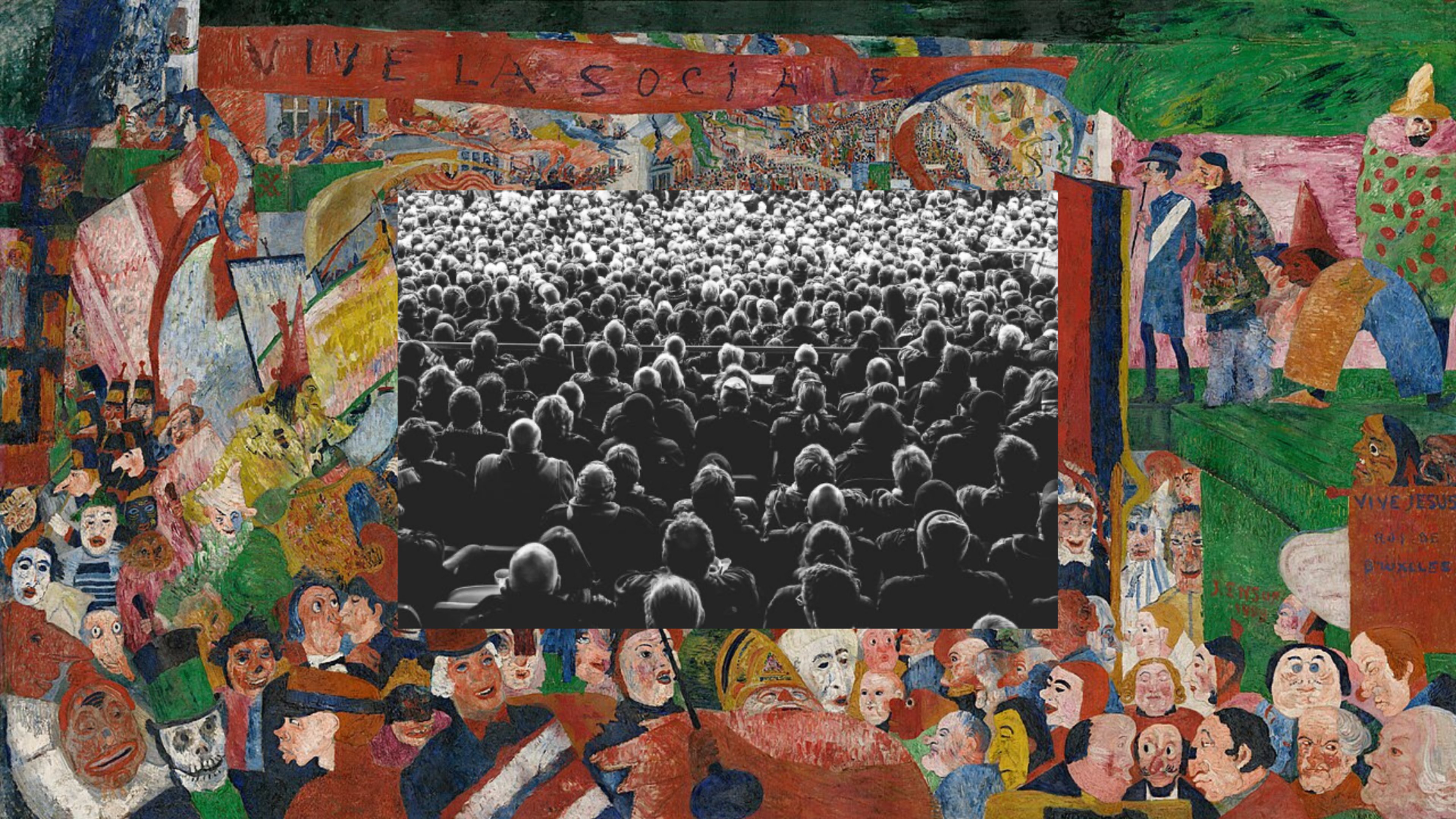
Christ’s Entry into Brussels in 1889, James Ensor (1888)
II. Populism and The Proletarian Revolution
III. The Permanent Revolution and the Tactics of the Communists
IV. Where to Begin? The Permanent Campaign
What is the task of the communist party? It is the organization, education, and agitation of the proletariat. For the vast majority of the history of the proletariat, the proletariat qua revolutionary working class only exists implicitly, as an idea. The proletariat as a revolutionary class can only materially exist in a revolutionary moment; rather, the existence of a revolutionary moment is defined by the rise of the revolutionary proletariat as a political force (a mass) rather than as an idea or interest or economic relation.
This is not idealist: it is a careful tracing of the structure of capitalist society. The proletariat qua wage-laborer or qua variable capital is itself internal to the capitalist system and the capitalist logic of production; literally, the proletarian is another form of capital, he is capital. The proletariat is internal to the system, but also impossible to contain; it is a ‘ghost in the machine’ or, as Marx puts it, not a class in society but the class upon which capitalist society in general rests. The task of the Communist Party is to agitate, educate, and organize. Its aim is the dictatorship of the proletariat, the victory of the working-class republic. But for the proletariat to seize the state, it first must become a collective subject, a real social body that acts consciously and reflectively. In Two Tactics of Social Democracy in the Democratic Revolution, Lenin writes:
“For the first time [the democratic revolution] will give the various classes their real political baptism. These classes will emerge from the revolution with a definite political physiognomy, for they will have revealed themselves, not only in the programs and tactical slogans of their ideologists but also in the open political action of the masses.”
In other words, Lenin provides us here with an example of understanding the historical proletariat as conjecturally specific: in periods where the organization or consciousness of the class is weak, the proletariat is structurally denied the ability to express itself as a mass, and only finds outlet in an ideological trend. We are certainly in this period, in 2026, where the proletariat is in the process of being born and explicitizing itself as a mass, as a political actor.
The proletariat can only learn through experience. This is another way of saying: the proletariat develops in history. There is no effective work that can be done that will cohere the proletariat that is not based on the self-activity of the class itself. Further, the self-activity of the class must be conceived according to its historical limits: if the proletariat is weak as a class, their self-activity necessarily takes the form of bourgeois politics; its political participation in a liberal democracy is limited to electoral politics, and its formal organization (the organization by which it organizes itself as a mass) remains economic-corporate in character (demands for economic reform, labor organizing, etc.). Consequently, the communist approach must be situated within this “spontaneous” activity of the masses. The approach cannot be directed towards extending these activities quantitatively (i.e., increasing their scope, “lending the economic struggle a political character,” etc.), but by advancing them qualitatively—by identifying the essential and practical elements of self-activity that belie the forms of that activity, and energizing them so that they develop into their opposite, viz., so that they move beyond the current dominant phase of bourgeois politics towards revolutionary politics and organization as a mass.
Because this struggle must be based on the relation of the communist partisan to the self-activity of the proletariat, and because the self-activity of the proletariat is always historically specific, this means that the tasks of the communist partisan in the struggle must also always be historically specific. In reaction to the debates of the 20th century, the specificity of the stakes have largely fallen to the wayside. We learn that the popular front or the united front or democratic centralism or organic centralism were “right” and the other “wrong.” This is dangerous because it is both over-general and over-specific. It is over-general, in that a notion such as “popular front” is completely meaningless without being granted a specific set of slogans and tactics;, i.e, there are popular fronts, and there are popular fronts. It is over-specific, because it relates to strategies as ideas that are fully detailed and must be evaluated according to their merits and not as generalizations for attitudes that the Communist Party in practice must dynamically pick up and drop, mix and match, and otherwise implement ambiguously in each concrete situation. The evaluating question directed towards these strategies has been objectivist, defined by a ‘What’: What is this? What is true? What is the correct strategy? This must be replaced by the historicist ‘When’: When is this strategy effective, when is it not?
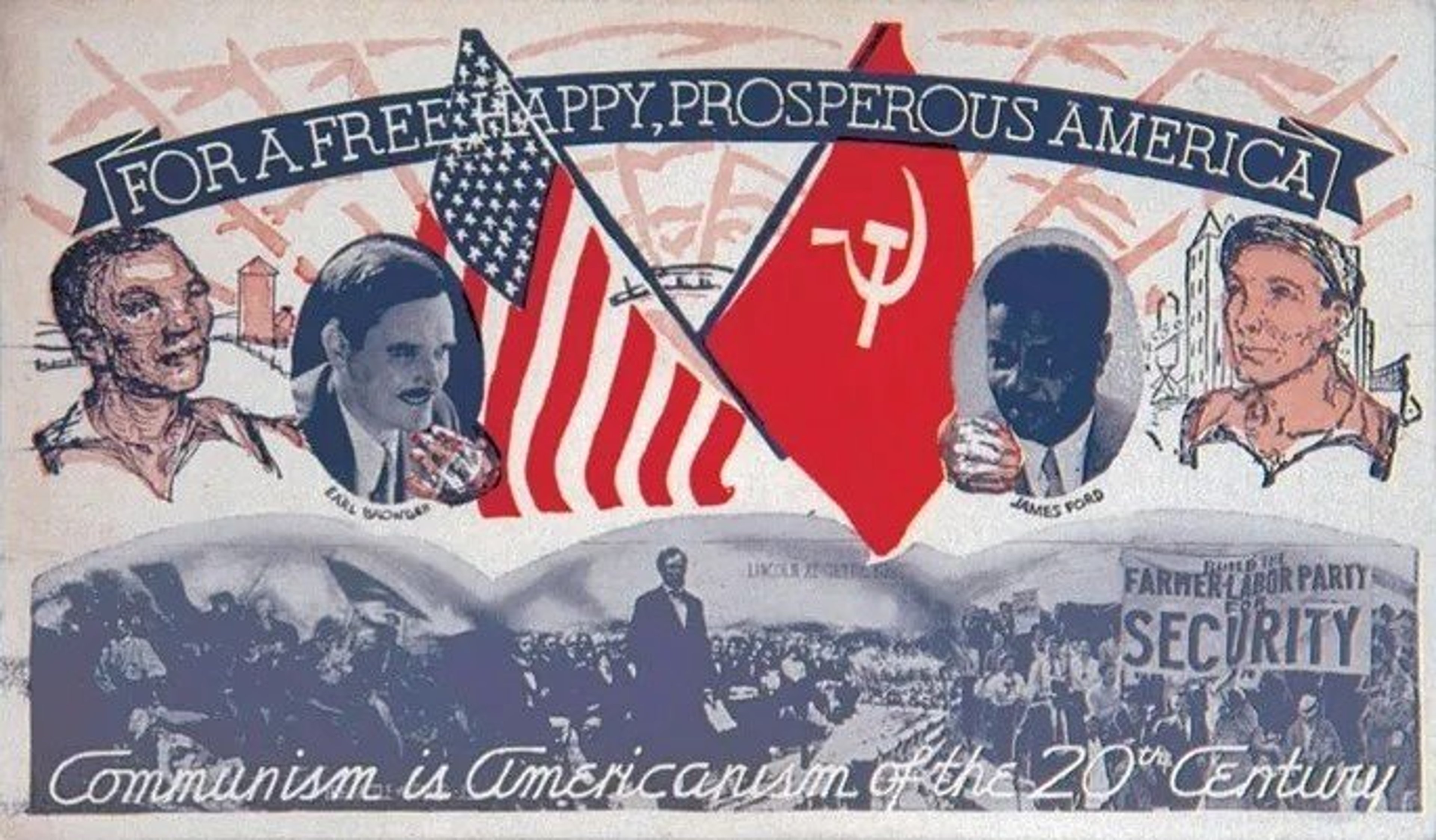
Propaganda from the CPUSA’s “Democratic front” era—a unique American theory mutated from the concept of the Popular Front and which is oft understudied.
This is the other reason that the communist partisan must be linked to a sober and even pessimistic concept of the self-activity of the proletariat: without doing so, tactics can only be evaluated on the basis of abstract historical criteria or according to theoretical principles. But tactics do not matter whatsoever at the level of principle or historical criteria: they are means of solving short-term problems in the struggle of the proletariat. Hence, we can see even the most ardent revolutionary, Lenin, shift between defending the reformist project of Legal Marxism to defending the need for a proletarian revolution to defending the possibility of a peaceful proletarian revolution in Russia to insisting on the need for a violent seizure of power—not because he changed his mind in each case, but because certain slogans and tactics were appropriate for certain phases of the struggle of the Russian working class, and inappropriate for others. To, then, have rejected the slogan of peaceful revolution as advocated by Lenin in favor of theoretical fidelity to a concept of violent revolution is to treat both types of revolution as objective tactics that can be evaluated rather than historically specific means of mobilizing the proletariat. In other words, it does not matter if a theory or strategy is abstractly true—the question is whether or not the tactic advances the interests, organization, and consciousness of our class. When Lenin advocates for one type of revolution over the other, then, he is not erring in attempting to understand Marxism but trying to achieve a ‘real’ revolution–the strategy is not an idea but a tool.
Within this narrative, the communist is a “fish in water.” She is a “permanent revolutionary,” not in the sense of the Soviet debate over the possibilities of global revolution but in the traditional meaning: that the revolution never ends, it is carried through from the most minimal demand of our current moment to the most extensive and radical demand of communist revolution. Permanent revolution is the understanding that the small revolutions in our day-to-day—wins in the workplace, or for democratic goals—are the real seeds of the ultimate revolution, that the ultimate revolution is only the final and most fleshed-out conclusion of the struggle for democracy and progress today. It also clarifies our attitude: we are negative, we see each victory as one step in a long journey, we do not aim at any set of affairs in particular but fight for everything that can be used to develop the self-organization and consciousness of the revolutionary class. But it is precisely this negativity that allows us, as Marx demanded, to “fight for the attainment of the immediate aims, for the enforcement of the momentary interests of the working class; but[…] also represent and take care of the future of that movement.”
This provides the framework for a materialist analysis of tactics: what tactic or slogan best coheres the existing struggle for progress and advances it outside of its own demands towards more radical action and thinking? The line for historical communism is not the line of anarchism or ‘true’ communism, which understands the line as the most correct assessment of the current situation. The Communist line is the line that is the most organizing assessment of the current situation;, the line is that which can bring the maximum possible of proletarian militants into direct antagonism with the bourgeoisie at any level or any level of consciousness, and which by that process brings them to a higher level of consciousness. The historical communists, for example, did not compromise with the progressive strata of non-proletarian classes because it was abstractly correct to do so, as the “stage-ist” interpretation of revolution posits. Instead, the need for general democratic slogans (such as “Peace, Land and Bread” or “New Democracy”) arose out of a need to organize a proletariat that saw real historical problems at the level of general society for which these slogans were the only solution. So, Lenin is very careful to insist: the interests of the proletariat are not the interests of the proletariat as a narrow-minded class, but of the class in its relations to the other classes of society, i.e., the most direct and genuine interest of the proletariat is to take the standpoint of the force that can cohere all vacillating, questioning, or otherwise intermediate strata into its mass, into a combined people.
Essential to the concept of the permanent revolution and what we might call the mass line is the element of historical motion and creativity. It is oft-remarked that Marx has a surprisingly general understanding of capitalism as the mode of production which, for example, successfully destroys the illusions and structure of domination of feudalism, while massively expanding the scope of human activity, freedom, and production. This needs to be understood and internalized theoretically: the shifts in the mode of production, even when completely outside the power of the left or the proletariat as a formal class, are real shifts in the world. Consequently, the world is always shifting and always changing;, the conditions of revolution and political strategy change every year, every month, every moment. The fatalistic and economistic version of Marxism that predominates in the West sees this standpoint as a moral failing: Trump, they say, is only another imperialist and racist President; Obama was just a new face to an old exploitation; Bush was stupid and evil—but the system remains the same.
This is completely incorrect. No matter what Trump, Obama, or Bush did, they changed the world (or, in another register, they represented real political periods with qualitatively different political tasks). The system in the general sense (capitalism, imperialism) is of course the same. But the system in a specific sense, in terms of What is to be Done?, changes irrevocably.
The movement of the proletariat, then, cannot be tied to the model of revolutionary organization within Marxism that conceives of the proletariat only in relation to the series of steps before its revolution. Everyone individually will deny they fall prey to this error, so it will be useful to explicitize it. The economistic model of Marxism tends to follow what is best embodied in György Lukacs in conceiving of the proletariat as a hidden thing that, in its development across various stages of consciousness, ultimately arrives at the proletarian revolution. But the proletariat does not exist as a concept for Marxism. The proletariat is already in the midst of development—significant development, centuries of development—which places it in a concrete relation to the ultimate goal of proletarian revolution, not an abstract one. In practice, the model of the proletariat in its steps of consciousness only serves to reinforce the abstract and idealist model of the development of the revolutionary proletariat, which is the basis for abstentionism and refusal to cognize the proletariat as a concrete historical class. It draws a path from the economic class to the political class intheory, and theory alone–and so falls into idealism.
Take, for example, the debate over populism. The main thrust of the critique of the phenomenon of left-populism, embodied in even the brighter and more heterodox Marxist minds of our age, such as Prometheus Magazine or the recent book The People Are Not One by Daniel Tutt & Derick Varn, treats populism as an objective tactic or decision that is being taken by the party of the proletariat. This tendency warns the proletariat: you are not building lasting organization, you are not engaging in the necessary tactics, you are chasing shortcuts. This is all true, but it does not change anything. Populism is not the strategy of a rational actor; it is the historical form of politics in the immediate era. It is the historical form of politics in the immediate era because the history of the development of the proletariat led it to this situation—not because the proletariat has adopted the wrong tactic, but because it has been fighting all this time, and its fight has led it here.
The critique of left-populism thus serves here, functionally, to divorce the Marxist intelligentsia from the actual struggle of the proletariat. The reason the proletariat is struggling in the form of populism in the current period is because populism is a specific reaction to neoliberalism and technocracy and the infamous “death of politics” at the end of the 20th century. Marxism, when devising its approach, does not have a proletariat it needs to bring into the struggle—it has a fighting proletariat before it that is unaware of the truth of its struggle or its ultimate result, and which cares little to follow the abstract model of identity we ascribe to it. The communist partisan, then, cannot tell them to “Cease your sorrows”—she must dive in, headfirst, and show that the end result of everything the proletariat fights for today is embodied in the permanent revolution for communism.
In this context, where do the negative elements of populism stand? To identify populism with its negative elements is precisely the same objectivist error that treats the term like a real, independent object instead of a historical phase. The negative elements of populism are the product of the weakness of the proletariat and the party. Where there is no revolutionary movement, all political actions, regardless of their intrinsic merit, cannot be revolutionary. The failures of left-populism are failures not of the populist mode of politics but of the organization of the proletariat and the power of historical communism during the period of populism.
Populism is not something we can accept or reject. We cannot reject it, because it is not the voluntary action of a rational subject but the product of a historical conjuncture. We cannot accept it, however, for the same reasons. We have to map its development and its ultimate conclusion. Populism will not be used by the proletariat any more than the election is a “tool” of the proletariat—both are actually means of social practice, the real content of politics from a historical materialist sense. Even if we were to throw our hearts and souls into populism, declare ourselves populists, study populism till our eyes bleed—we will have only devised a new orthodoxy, a new sham of principles, that will be swept away in the next moment of proletarian revolution, when the struggle of the day is no longer to react to the failures of neoliberalism but to the failures of populism.
This is the law of society, man, and history. In The Poverty of Philosophy, Marx writes:
There is a continual movement of growth in productive forces, of destruction in social relations, of formation in ideas; the only immutable thing is the abstraction of movement—mors immortalis.
Within a concrete social formation, all social identities are interpellated; as we have seen, however, they are only thoroughly and totally singular if we conceive society abstractly. In the course of motion, however, these identities evolve. Their characteristic vagueness provides them with a significant range of motion. In a broad sense, the New Deal order, for example, was exactly the same in terms of the correspondent social formation at the end and the beginning. But each of the identities that belonged to it, during that long period, faced with both internal and external obstacles, subtly shifts. In addition to its reactions to the various obstacles it faces, superimposed on top of any social order, by virtue of a society that changes without changing, is a series of problems that are left unresolved and further disfigure these social identities. This historical weight means that fundamentally no identity, even if we keep all else equal, is unchanged over time. (Even the memory of constancy is a new element introduced into a social identity that, prior to that sense of constancy, was simply constant.) But the accumulation of these changes stack on top of each other until—suddenly, the paradigm collapses; the identities, conceptions, and social order of before is no longer compatible with these identities that through their own development have negated the conditions of their own existence.
Consequently, no one wins in history; the defeat of a rival is always the heralding of the abolition of both winner and loser, who, in the new social order, are newly re-interpellated and newly set at odds. The Jeffersonian yeoman ideal triumphs over the aristocratic attitudes of the gentry-led Federalists—but at his ascension immediately the Jeffersonians fracture into new factions once more, factions who have aims and issues that are comparable to the ones of old only metaphorically.
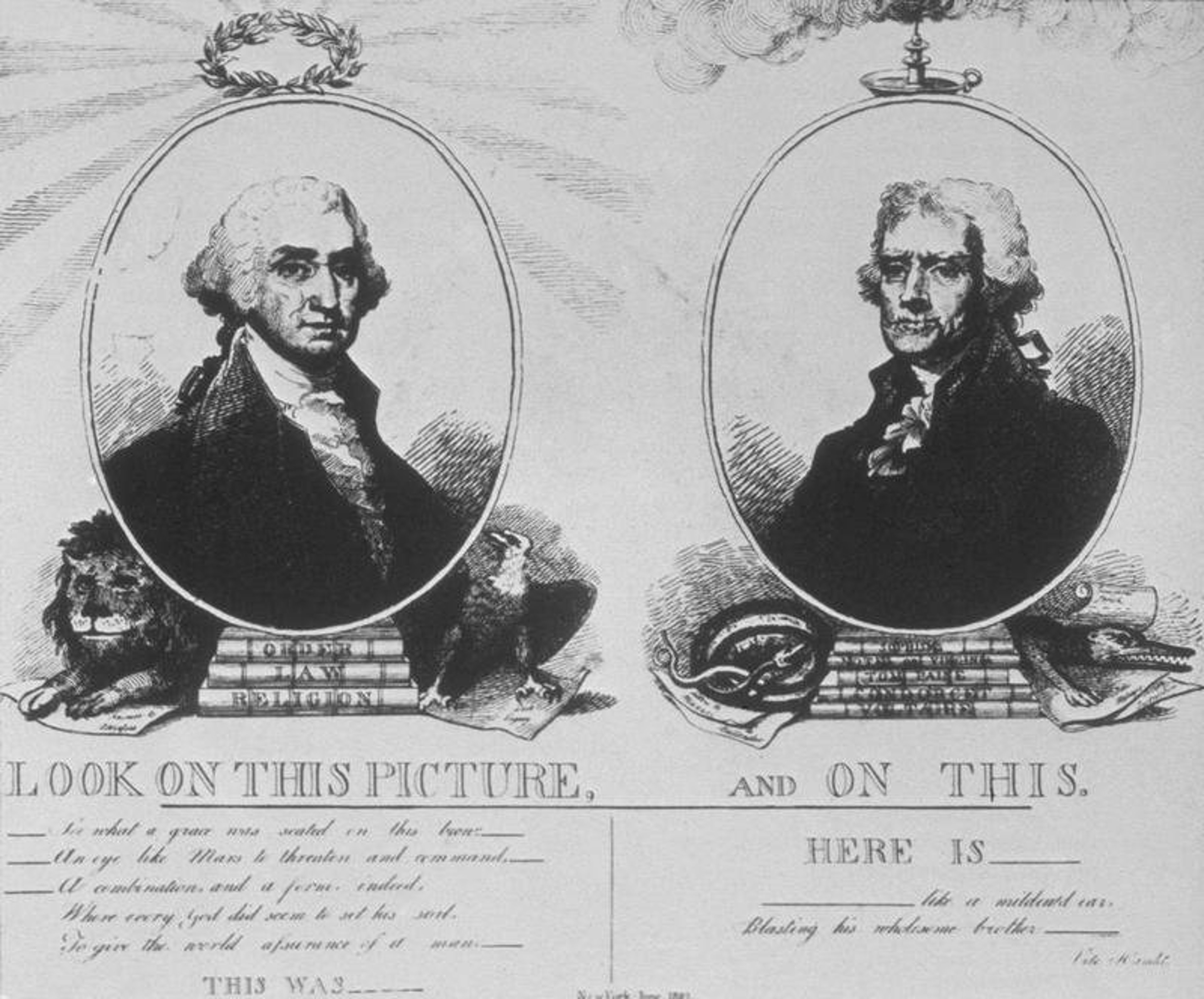
Anti-Jefferson political cartoon in the style of the currently popular “Virgin vs. Chad” meme, describing Jefferson (right) unfavorably in comparison with his predecessor George Washington (left).
Similarly, Marx writes in The German Ideology that, before capitalism can establish itself, the capitalists appear (and in a sense, genuinely are) as simply fractions of the feudal landlord system. But once they triumph and establish their legitimacy, what is established is not the dominance of one fraction of feudal society over another, but of a wholly new category, the bourgeoisie; and every other subject finds themselves, willingly or not, consciously or not, also re-interpellated and re-articulated—without a single subjective act of articulation in sight.
The permanent revolution knows that it can never rest on its laurels. It knows that it will never be presented with the convenient formula of, on one side, all of the proletariat standing behind the red flag, and, on the other, the whole of the bourgeoisie rallied behind capital. History is always uneven, and it is always specific. The form of the revolution will be a series of tasks, problems, and crises which the proletariat will have to raise its own level of independence, consciousness, and organization to answer decisively. A proletariat that has achieved this—that has achieved self-consciousness of its historical position along with its historical tasks—is a revolutionary proletariat, the proletariat as a mass, the proletariat that will storm the State. But this proletariat can only be developed historically, through experience—never through theory, never by jumping outside or over history, but always in it.