
In response to a recent string of victories by socialist candidates across the country, from Pennsylvania to New York to Colorado to Washington, DC, and with the specter of more socialists haunting the horizon, a chorus of voices has risen to disparage, discredit, and sow distrust about the political organization responsible for these insurgent victories, the Democratic Socialists of America (DSA). The general MO of these attacks has been predictable and uninspired: DSA represents a narrow but motivated interest group of young city-dwellers, DSA hates the Democrats and cost Kamala Harris the 2024 election, DSA only pretends to be moderate and reasonable socialists and in actuality is comprised of radical communists.
Jonathan Chait is among the latest to hop on this bandwagon, offering a different, if not entirely original spin on the last of these allegations in his article for the The Atlantic, There’s Nothing Democratic About These Socialists. He posits that DSA was a reasonable, democratic organization (during the forty or so years in which it did nothing) but has since been taken over by dogmatic, undemocratic communists (during the ten or so years in which it has won multiple House seats, municipal and county executive positions governing millions of people, and dozens of state and local legislative positions).
It is not surprising that someone who self-identifies as “Liberal (not leftist, not centrist)” would prefer socialist organizations to be ineffectual book clubs disconnected from the demands of the millions. However, the notion that the Democratic Socialists of America lacks a “democratic” character, especially in relation to the eponymous establishment political party, still deserves refutation. If socialism is to be the movement of the workers for themselves, socialist organizations must make themselves accountable to the working class. To refute Chait’s assertions, we will need to examine the histories of the Democratic Party and DSA and how they have reacted to changing political conditions over the past decade.
The Road So Far
During the long, cold winter of the American Left, between the collapse of the Soviet Union and the birth of our current left-populist moment in 2016, the lights were kept on by a ragtag scattering of anarchist groups, deeply flawed sects like the International Socialist Organization and the Party for Socialism and Liberation, and diminished Old Left formations including the Communist Party USA and, of course, DSA. Most left activity was centered around protests against the World Trade Organization meetings and ‘forever wars’ that came to define the most formative years of everyone under the age of forty. The 2008 recession cut the early careers of many young Americans off at the knees, and things never seemed to get better.
In the face of economic, environmental, and international precarity, Americans began to polarize. Those polarizing to the right found their articulation in the Tea Party. Those on a leftward journey found it first with Occupy Wall Street, and eventually with Bernie Sanders’ 2016 presidential campaign. Tea Party Republicans, on the other hand, became MAGA. After Bernie’s defeat in the democratic primary, most of his supporters voted for Hillary Clinton, who lost the presidential election to Donald Trump.
To many, this defeat signaled a death knell for the strain of politics which envisioned itself as standing above the rest of society, its decisions informed by looking down upon the masses. While Donald Trump and Hillary Clinton ran in the same elite circles and served the same capitalist interests, Trump was able to transform right-wing populist resentment into an electoral victory despite losing the popular vote. At the same time, Clinton was unable to turn out an adequate number of voters in key states. The left pole, energized and more experienced from the Sanders campaign, began looking for ways to resist Trump and soon found it in DSA.
While Bernie Sanders had long identified as a Democratic Socialist, this alone would not have been sufficient to allow DSA to capture the growing ranks of left populists. This was a necessary condition, but DSA was successful because it had an open and accessible structure in which new members found that their voices mattered—when they organized to change something in the organization, they could.
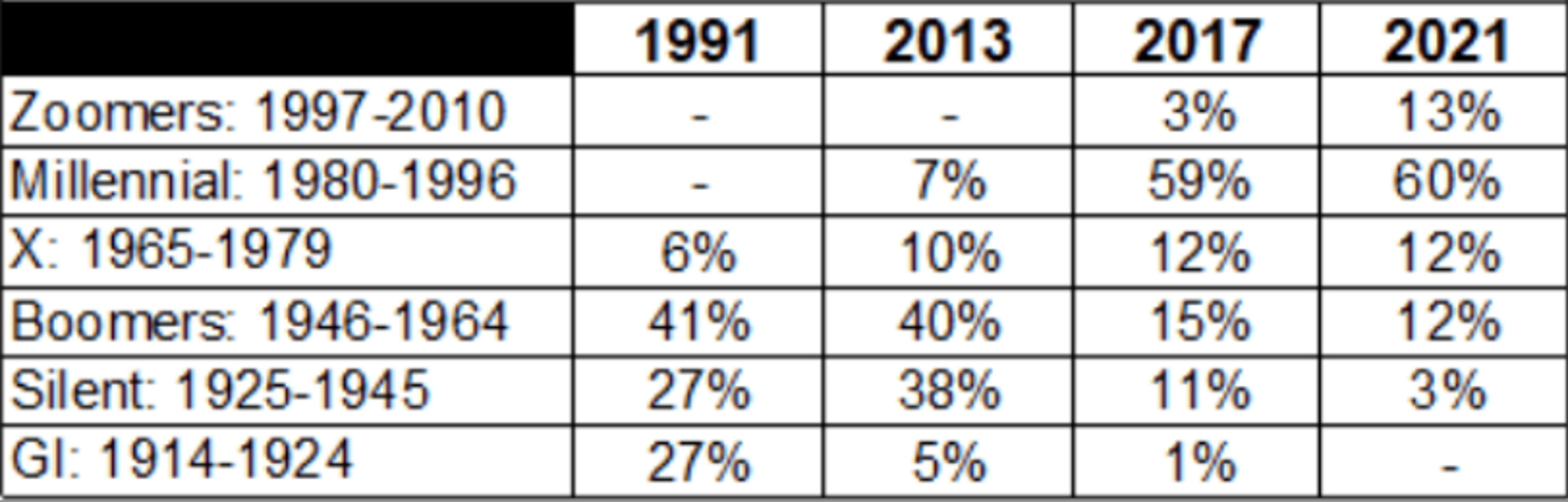
Part of what Chait asserts is true here: the DSA of Michael Harrington vanished almost overnight. The median age of membership dropped from 68 in 2013 to 33 in 2017. Political attitudes shifted rapidly, especially around foreign policy, policing, and relationship to the Democratic Party. The most important shift was in the organization’s political horizon.
DSA Member Survey Report, 2021.
Gone was Harrington’s contentment with “the left wing of the possible.” The DSA of 2016 was no longer going to passively watch a politically adrift working class succumb to right-wing propaganda or detached, ironic indifference. Instead, this DSA would start working to expand the definition of the possible. Instead of a DSA that served a self-selected group of elderly intellectuals and labor bureaucrats, there was a DSA that sought to articulate the demands of a furious working-class that would no longer accept politics as usual.
Over the next four years, DSA would grow and develop as an organization. Members of scant experience with politics before 2016 began to protagonize themselves and their comrades: to experiment with what kinds of political interventions the burgeoning organization could make, to build infrastructure to support their efforts, and to write about what worked and what didn’t, helping guide the work of members in other chapters.
Over the same period, voters saw the Democrats brandish performative resistance without effectively challenging the core demands of the right-wing. Trump placed his choice of justices onto the bench of the Supreme Court, and his legislative agenda was impeded more by his own incompetence and that of his cronies than anything that came out of Democrats in office.
As DSA continued to rack up congressional, state legislative, and local wins, Bernie Sanders ran for President once again in 2020. Bernie’s campaign capitalized on COVID-era economic woes, finding an energized core of experienced supporters in DSA who ran a well-organized and independent expenditure campaign in his favor. Then, like clockwork, the centrists in the Democratic Party coalesced around Joe Biden to stop the populist upsurge.
That summer, longstanding anger over police violence and societal indifference to the murder of Black Americans boiled over when Derek Chauvin and other Minneapolis police officers murdered George Floyd. As protests (which DSA often took a role in) shook the nation, the Democratic establishment feigned support for the Black Lives Matter movement, echoing calls to defund and demilitarize the police while consistently voting to expand them. Democrats would eventually come to blame this rhetoric for losses to Republicans, while the basic relationship of the police to the communities they surveil, disrupt, and oppress remains fundamentally unchanged.
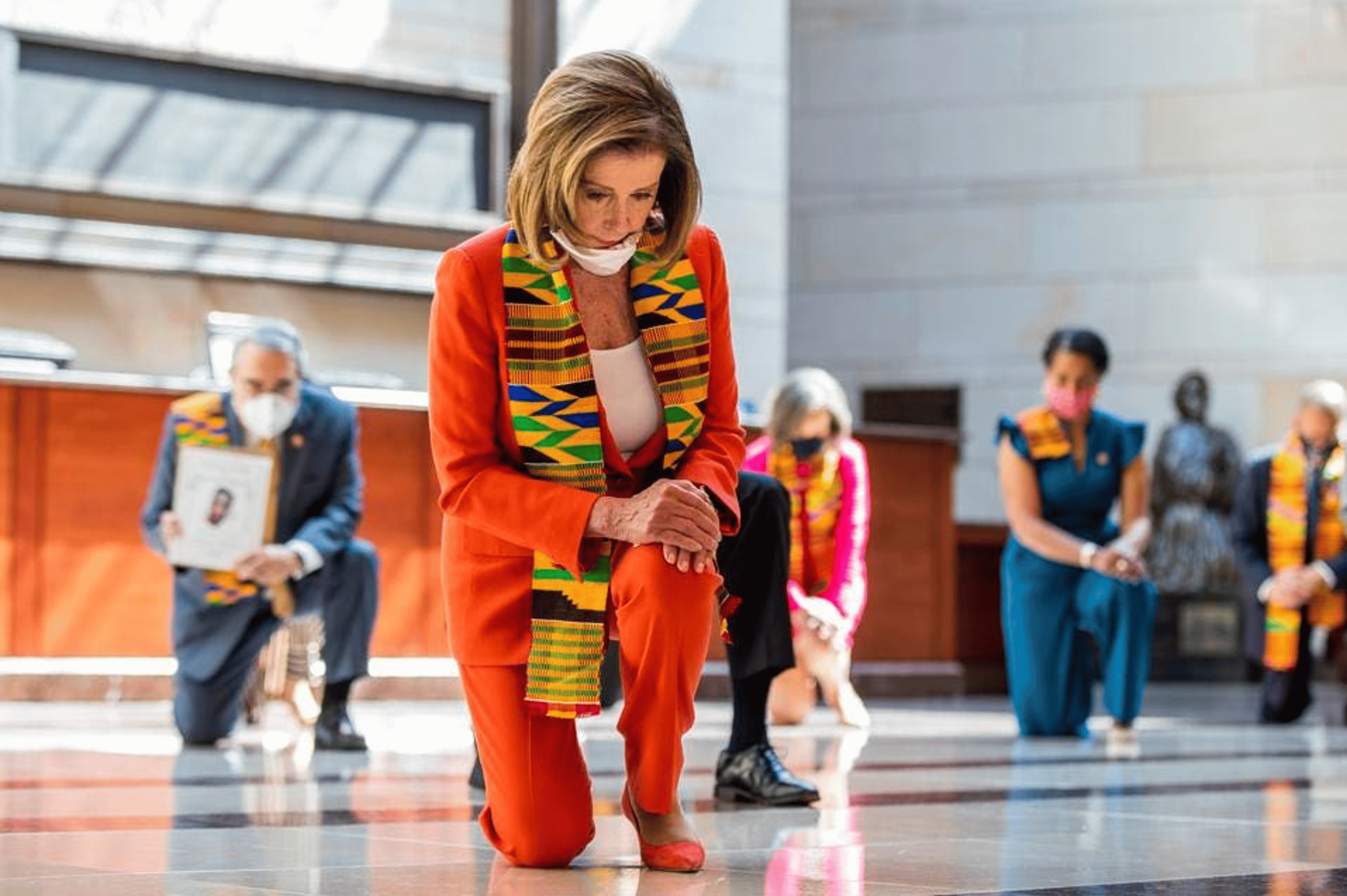
House Speaker Nancy Pelosi and other members of Congress kneel in a moment of silence at the Capitol's Emancipation Hall.
Biden would go on to win the 2020 Presidential election. His victory, however, was marred when protestors directed by Donald Trump and aided by Republican congresspeople attempted to disrupt the certification of the election results on January 6th. The coup was defeated when Trump saw the military and general public were against him and called off his angry mob.
While there would be some prosecutions of those who had physically entered the Capitol building, most of those involved never faced any legal penalties. Trump would be charged, but the courts moved so slowly that he would be able to get the charges dropped after trouncing Kamala Harris in the 2024 election, and none of the Republican congresspeople who aided in the coup would ever be charged or even seriously investigated.
A Democratic Party that truly cared about “democracy” would have seen the Republicans for what they were—a fascist party that had repeatedly overridden democratic processes to get the results they wanted. They would have used January 6th as an opportunity to politically decapitate the GOP and legislatively dismantle its anti-constitutional interlopers. Party leaders in and out of Congress would have had their homes and offices searched, internal records would have been subpoenaed and published, and key donors would have been placed under intensified scrutiny by the IRS. Instead of Merrick Garland, Biden would have appointed an attack dog who made it their mission in office to imprison everyone even tangentially connected to the coup attempt.
By this time, DSA had swelled to nearly 100,000 members. Many socialists in organizations like the International Socialist Organization and Socialist Alternative began to see DSA as the most energetic and vibrant articulation of socialist politics available—the vanguard of the proletariat, if you will—and joined. Others joined from the “progressive” or “Berniecrat” spheres, as they saw the continued failure of the Democratic Party to accommodate left-populist views.
DSA Member Survey Report, 2021.
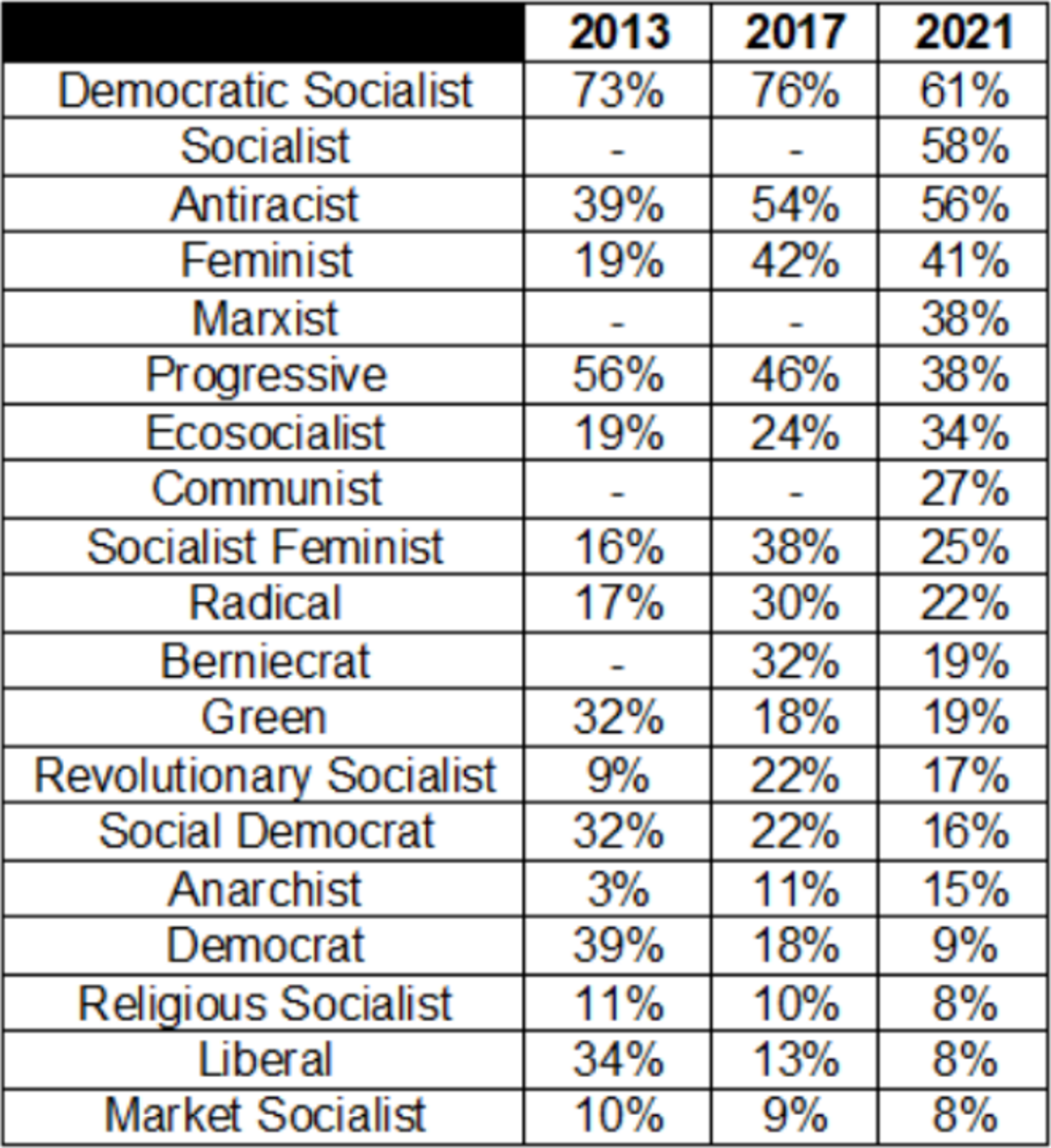
Chait assesses one point semi-accurately: in 2021, DSA’s internal member survey added two new options to the question about ideological identification: “Marxist” and “Communist.” These new options were selected non-exclusively by 38% and 27% of respondents, respectively, while the share identifying as “Democratic Socialist” experienced a modest decline from 76% in 2017 to a still commanding 61%.
What Chait does not want you to realize about the shift from the “good” DSA of Harrington to the “bad” DSA of Mamdani, Chevalier, and the >120,000 people who have found a new political home in the largest socialist organization in U.S. history is that in 2013, only 19% of members actively self-identified as feminists and only 39% as anti-racist, compared to 41% and 56% respectively in 2021. Simultaneously, the share of self-identified liberals and social democrats has decreased significantly, as ordinary people within and without DSA have come to correlate these ideologies with failures and empty promises to enact progressive policy.
As each year passes, millions of everyday people associate the positive elements of what the Democratic establishment professes to uphold less and less; not due to some nonsensical horseshoe theory of authoritarian alignment, but rather the inability and ineptitude of Democrats to politically maneuver these ideas into effectively unifying, popular rhetoric against a growing fascist menace at home and abroad.
Starting in 2023, the official Democratic Party position was somewhere between blithe denial of or enthusiastic support for Israel’s genocide in Gaza. As masses of students and workers protested the war, the Democrats finally found the will to use their “authority” against them in a way that they never thought necessary for Republican putschists. Any support for Gaza and opposition to Israel’s war crimes was dismissed with the bludgeon of “antisemitism.” Students at encampments across the country were beaten, detained, and had their careers dashed against the rocks.
This abject and complete moral failure has been compounded by the Democrats’ failure to defeat Trump in the 2024 election, and failure to offer sustained and meaningful resistance since then. In August of 2024, Nancy Pelosi said that, “the country needs a strong Republican Party.” She said this at a time when they—with help from Vichy Democrats like Joe Manchin—had successfully undercut large portions of Biden’s legislative agenda, and were poised to take back the White House. Now and then, there was a strong Republican Party, and a weak Democratic Party, because the Republican Party has always been willing to use its strength to act on the grievances they have stirred up amongst their base, while the Democrats see strength itself as “undemocratic” and would prefer their base stop making demands and go back to brunch.
Democrats have continued to make clear that there is no real plan to stop Donald Trump. Most Democrats’ objection to Trump’s illegal war in Iran, which has shaken even some of his staunchest supporters, is that he hadn’t asked them first, and they’d gladly hand him billions of dollars to set on fire if only he would respect the proper checks and balances. Still, Democratic insiders and establishment politicians tear down young, motivating, energetic candidates because they support Palestinian resistance.
If Trump runs for an illegal third term, we can count on Democrats to continue their charade of shouting until they’re blue in the face that it is illegal, while failing to mobilize the masses of people who want to do something about it in any real way. This is why millions of voters from across the political spectrum are now looking to DSA and proximate socialist candidates like Abdul El-Sayed to fight against the rising tide of fascism, guarantee healthcare and an affordable and dignified life, and embrace a foreign policy of peace and cooperation. It is why thousands are joining DSA and getting involved in the movement themselves.
Every new member of the organization shapes DSA and is shaped by it in turn. Both communists and progressive left-populists find their preconceptions and political biases challenged as they struggle together, just as any democratically minded organization would—a sharp contrast from the DNC, where lobbyist money speaks the loudest! Yet, if neoliberal Democrats wish for this upward trend of membership to cease, the only option left for them is to arrange the affairs of their own house into order.
Democracy For Whom?
As the title of his article implies, Chait primarily posits that the DSA harbors a nefarious secret hidden in plain sight—the organization is plagued by a daemon of anti-democratic authoritarianism.
He spells out a list of the DSA’s dirty laundry, from accusations that it has now become opposed to its own founding principles, to comments shared over social media by Chevalier where she expressed her distaste for Joe Biden and Kamala Harris (we reiterate: a democratically elected House nominee!).
He concludes by explaining the dirty break/clean break strategies, suggests that the DSA intends to split the votes of the Democratic base to exploit frustrated voters for the sake of improving their own political position, and then finally deduces that by not drawing clear moral lines against ‘illiberalism’, the Democrats are likely to suffer the same fate of the GOP and bow to an enemy who is seemingly no different from the authoritarianism of MAGA.
All this, he alludes, is antithetical to any true form of democratic expression. Yet what is written here is merely a vapid string of ad hominem complaints as a means of shirking the responsibility that political parties must bear for the sake of adapting to their constituents’ demands. It would seem all that our neoliberal friends are capable of comprehending is that successful politics means blaming other people for the products of their own flaws and shortcomings, be it the Republicans or the Socialists.
Consistent with the themes of the liberalism he clings to, he invokes the ghost of McCarthyism to punch left—inadvertently blaming the 36.55% percent of the national electorate who sat out in 2024, blaming those who could not bring themselves to vote for a coalition who was a day late and a dollar short against a modern Holocaust of the Palestinian people, blaming the DSA for having a more exciting message than the standard Democratic incumbent, blaming those who in their alienation from government voted for Trump out of anger and rejected the very same pomposity of “business as usual” which the author nonchalantly espouses in his article.
He cleverly obfuscates these self-inflicted deficits with whining allegations of scheming communists disguising themselves as alluring social democrats, waiting in the wings for their opportunity to seize power and enact a totalitarian regime—a self-conjured fantasy which could only be found in Red Scare propaganda films of the mid-20th century. He facetiously alleges that socialist thinkers define “true democracy” as simply their political party assembled as the governing body empowered by the people—as if he nobly rejects an otherwise identical demand with a blue coat of paint and far more billionaire Super PACs!
The truth of the matter is that this fantasy is a projection of Chait’s own thoughts, demonstrating a profound lack of self-awareness. He and his ilk would much rather see the rise of the Neoconfederate bloc instead of a multiethnic coalition which seizes the reins of our country’s fate in a fashion he does not fancy. He ignores the sovereign demands of the people and their clear thirst for a reforged politics, but is too cowardly to reject the outcome of democratic elections like the fascists he supposedly opposes, choosing instead to cross his arms and petulantly grumble about needing to emphasize the distinctions of our respective moralities.
Despite this, Chait still feels that the top-heavy section of the wealthy political aisle they belong to is the sole arbiter of what democracy truly means. If these so-called “clear moral lines” were convincing enough to rally a majority of the American people and decisively defeat fascism, we would gladly be making the same prostrations. But the people chose Trump—and the real blame only resides in those who refuse to unplug their ears in response to the cries of a tired, weary country. The evidence shows that it is no longer enough to say “we are the better alternative to MAGA”, then enact the same alienating tone and mode of politics which has only continued to prove itself a crumbling failure.
The audacity of this takedown only worsens upon further inspection; the author insists these socialists may be democratic in name, but are indeed undemocratic, providing yet again another prime example of the self-defeating neoliberal hypocrisy we have come to know so well. In a manner not so different from the far-right election deniers, Chait contradicts himself—should the DSA tactically position itself to win power and defeat both factions of the two-party system in carefully crafted races as he accuses, is that not how democracy is supposed to function? Is that not how American political parties have shifted over the course of 250 years; where one party’s failures lead to the rise of another? How nefarious! The socialists are winning in free and fair elections!
It would appear that the “undemocratic” socialists possess a far greater understanding of what democracy means in practice. Chait conveniently overlooks the fact that the opulent cliques who effectively run the political establishment are almost entirely insulated from the authentic, democratic demands of the millions. In nearly any given election, the vast majority of candidates backed by the Democratic Party come with the preemptive support of deep-pocketed lobbyist networks who mutually enrich themselves by running cover for this hegemonic model of governance, pushing an illusion of ‘choice’ between individuals with effectively identical politics. When any populist figure or organization who challenges the status quo makes significant headway, the elites circle the wagons to collaborate toward their destruction by any “liberal” means necessary—be it through slanderous media jobs, purchasing journal hit pieces (similar to the one addressed here!), or egregious campaign donations to fellow capital-defending “opponents” on the other side of the aisle.
As Lenin did years ago, we echo his voice to ask Jonathan Chait: democracy for whom? The answer is self-evident through those he defends—democracy for the few, and especially for those who can afford it! In our rejection of this neoliberal arrogance and lack of self-criticism, we reply to The Atlantic: democracy is the unity of the masses who make history. Without this unity, no authentic democracy can ever be expressed. And what greater divisiveness exists than the separation of collective human will by socioeconomic class?
Just a few short years before the outbreak of the Civil War, as the struggle against slavery came to a head, Abraham Lincoln—whom Karl Marx once fondly referred to as a “son of the working-class”—forewarned of the dangers that would arise from the irreconcilable differences burgeoning to the front of the political theater. In his famous words,
A house divided against itself cannot stand.
Upon the 250th anniversary of our country’s founding, it is a regrettable state of affairs when those who ignorantly defend a dying order insist upon driving yet another wedge between the millions, deepening the divide in a house which once again finds itself struggling to stand. With or without the consent of the elite, it will be those millions who repair its foundation.