
Jul 29
Our Audacity: Where Should Socialists Stand on Obama?
Zohran Mamdani invoked the legacy of Barack Obama in a speech, bringing the complex realities of the Obama years back into discussion. How ought the Left orient itself to the legacy of Obama?
by Ant L
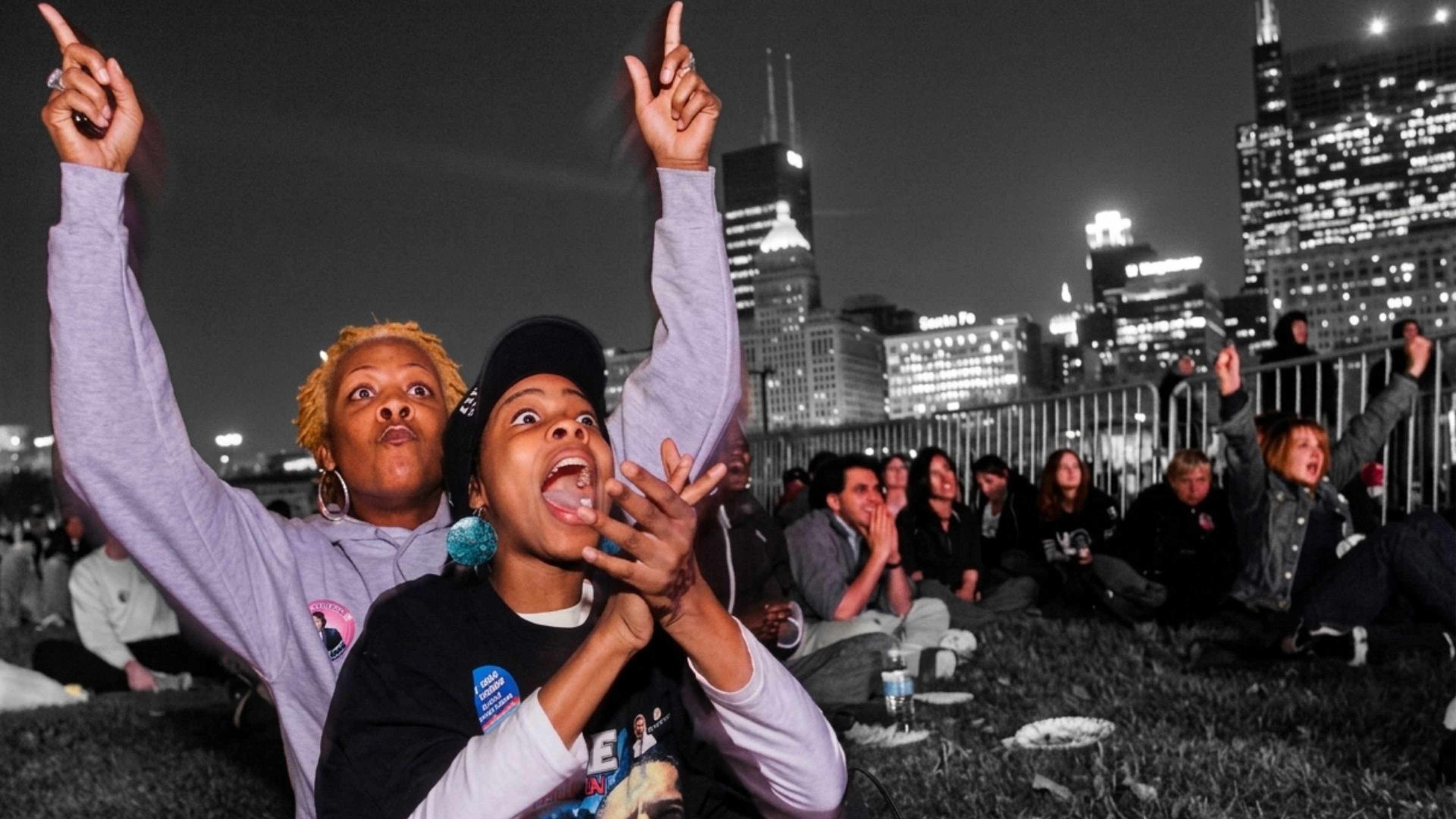
Block Party Celebrates Barack Obama's 2008 Election Victory
Everything was alive. Music blasted from every window, bottles of André were popped, sound systems and DJs somehow manifested from thin air. Every passerby was a handshake or a high five. It wasn’t obvious what exactly about Obama’s victory was deserving of celebration, but a few key themes emerged from the night’s conversations: our nation’s first Black president, an end to the Iraq and Afghanistan wars, LGBT equality, a peaceful resolution to the “Israel-Palestine conflict”, and a serious reckoning with America’s runaway economic and racial inequality. The lone dissenters were a few frat guys in cowboy hats burning American flags in the street, an effigy of “our country up in smoke”. Every party that night was hype as hell. Somehow, several different houses settled on “Juicy” as the theme song for 2008’s triumph.
At this time I had been some kind of Fanonian Marxist for several years already, horrified by the War on Terror, Katrina, the 2006 Lebanon War and blockade of Gaza, and further pushed into radicalism by the economic devastation of the Rust Belt. Rationally, I understood that the purpose of a system is what it does–and that Obama’s role in the executive branch was not the kind of power that could abolish American militarism or neoliberal capitalism in a decisive way.
And yet….
”we used to fuss when the landlord dissed us no heat wonder why Christmas missed us/birthdays was the worst daaaaays now we sip champagne when we thirstaaay”
Every blunt was passed to everyone in the room; a college town that was generally very segregated seemed, to me at least, united for a few hours. It almost felt like America was gonna be alright. We were in the White House.
Of course, I don’t need to remind the reader of how things actually played out. Bank bailouts, several new wars, police murders of unarmed Black men and women caught on video, Operation Cast Lead and Operation Protective Edge. New authorizations of mass surveillance, drone killings of US citizens abroad (and untold innocents who lack that status), worsening economic immiseration. A lot of us knew this would happen, and sprung into action as Occupy, BLM, and other social movements either arose or returned. Others had bought into Obama’s promise on a more intellectual level and turned to the rising left as an outlet for their disillusionment.
This process existed in an uneasy friction with the other hallmark of the Obama years: an intense right-wing backlash to the Obama administration’s rhetoric and genuine policy achievements. My peers and I had to square our own despair at Obama’s betrayals of his campaign promises with the recognition that, whatever was being said about Obama, was also being said about us. Over and over we made the same rebuttal “Obama’s not a socialist. I, however, am a socialist and therefore…”
What we didn’t understand at the time was that this wasn’t about logic at all. The backlash was not only against Obama’s policies but also his administration’s success at achieving a sort of left-liberal hegemony which marked right-wing political views as outside the realm of political common sense. It wasn’t what Obama did or even believed—one man can hardly be expected to overturn the entire system—but who and what he represented.
The Tea Party, a Republican organization preceding MAGA, arose primarily as a refutation of left-liberal hegemony. Over the latter half of Obama’s administration, critiques of his administration’s extension of the War on Terror began to make their way into right-wing rhetoric and the paleoconservative position which, slumbering through the Bush years, began to stretch its legs and reawaken. Then came Trump and Bernie.
Bernie Sanders and Donald Trump, two white men in their 70s, represented two populist responses to Obama’s administration. Sanders promised to deliver the policy objectives that Obama failed to actualize and address the problems that Obama worsened. In so doing, he relied on the left-liberal hegemony Obama’s campaigns and administrations created, offering to recuperate its legacy and close the circle. This is to say, the promise of Sanders was a correction to the cognitive dissonance that Obama’s betrayals produced in a generation–genuine frustration at the failure of liberalism–and this is why he was able to succeed in mass politics in a way that leftists hadn’t in several decades.
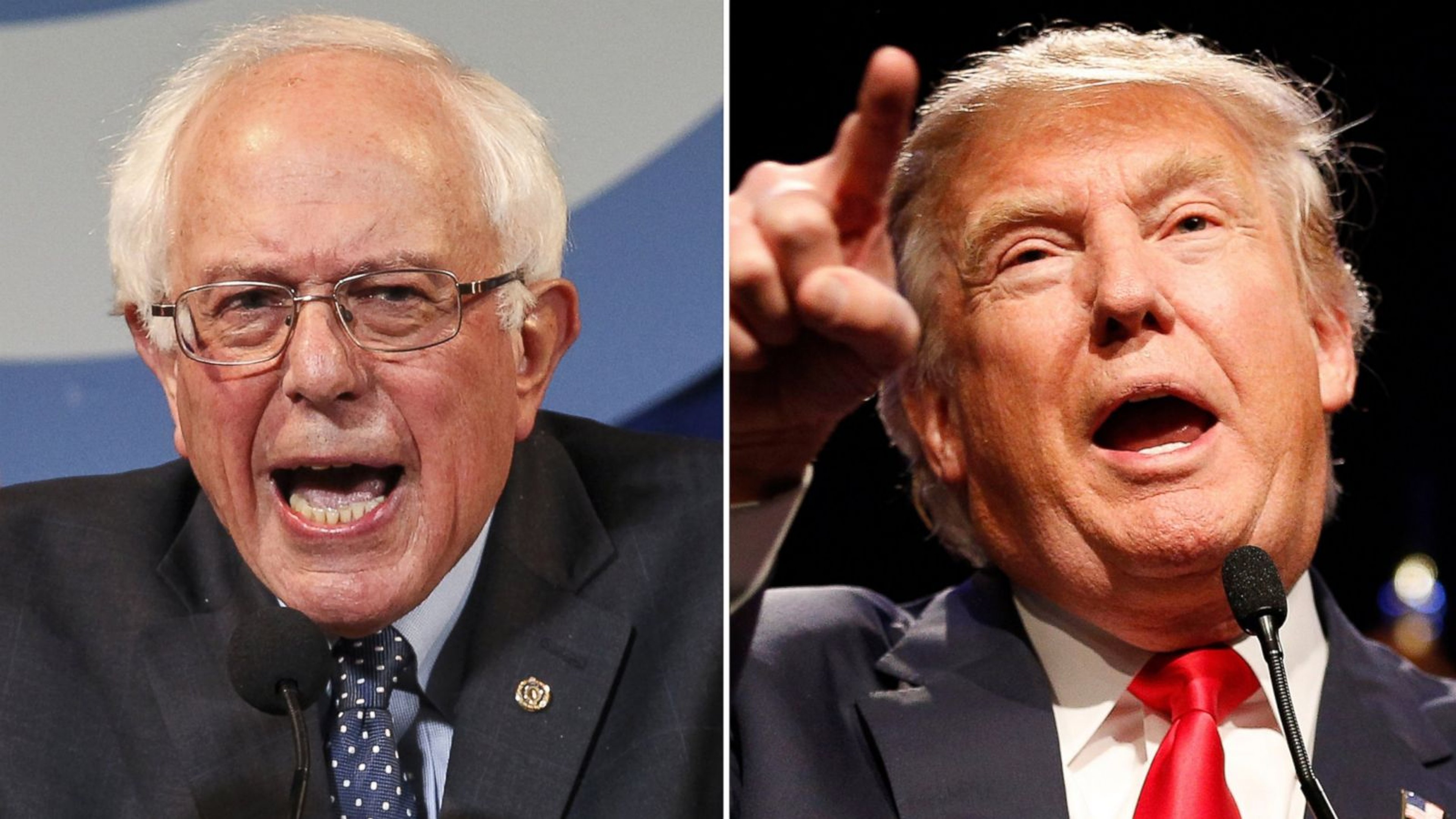
2016 election's leading populists. Bernie Sanders (Left) / Donald Trump (Right)
Indeed, Obama’s election and his legacy created the conditions for Sanders to exist. Sanders mobilized the energy of Occupy directly into mass politics, channeling its critique of American militarism and economic inequality into a groundbreaking left populist campaign. On the other hand, he floundered on BLM, unable to directly address the Black issues Obama couldn’t touch, racialized wealth inequality and militarized policing. Even more difficult for Sanders and his supporters was the Black political establishment’s embrace of Clinton and their refusal to grant Sanders the mantle of his past involvement in the Civil Rights movement. Ultimately, many critiques of Sanders’ 2015 campaign’s shortcomings on race collapse the two: thus “neoliberal multiculturalism” is conflated with left populism’s continued inability to metabolize the abolitionist movement. In 2026, “defund the police” posts have been scrubbed from candidates’ social media profiles, seemingly an admittance that left populists cannot adequately form coalitions with the Black left. And of course, Sanders is a Zionist. With that being said, his critique of Israel’s actions in Gaza during a debate with Hillary Clinton contrasted strongly with her unqualified defense of Israel. One can imagine the roots of Uncommitted in this moment, where Sanders’ position on Israel, as bankrupt as it is in absolute terms, created a moral wedge between the left populist appetites of the Democrat base and its leadership’s inhuman deference to Zionist brutality. This is all to say that both Sanders’ successes as well as failures both hinge on how well his campaign responded to the qualitative shifts Obama brought to American politics.
Conversely, Trump combined rejection of left-liberal hegemony with a critique of Obama’s failures on economic issues and war. Cultural backlash to the Obama consensus amongst aggrieved and downwardly mobile whites blended with the impacts of neoliberalism and the War on Terror on their social worlds, creating a ‘stab in the back’ mythology that enabled Trump’s right populism to acquire a rhetorical force that hard right politics had not achieved in America before and will likely never achieve again. Often, we forget that Obama’s More Perfect Union speech very directly reached out to the people who would become Trump’s base and legitimized their grievances. Whatever we think of this, clearly nobody can deny that his administration’s policy achievements were unable to overcome the grievances that downwardly mobile whites accrued during his administration. Is this due to their inherent racism? Maybe so, but these are the Obama-Trump voters. No assessment of mass politics in America can ignore them.
Years later, Zohran Mamdani invokes the legacy of Obama in a speech.
“Democrats have been branded as socialists for longer than I can remember. I remember President Obama being called a socialist almost every single day by Republicans and it didn’t stop him from delivering not just on his first term but his second term. People are hungry for a vision of the Democratic Party that has more to do with the New Deal than the raw deal that so many Americans have been forced to accept”
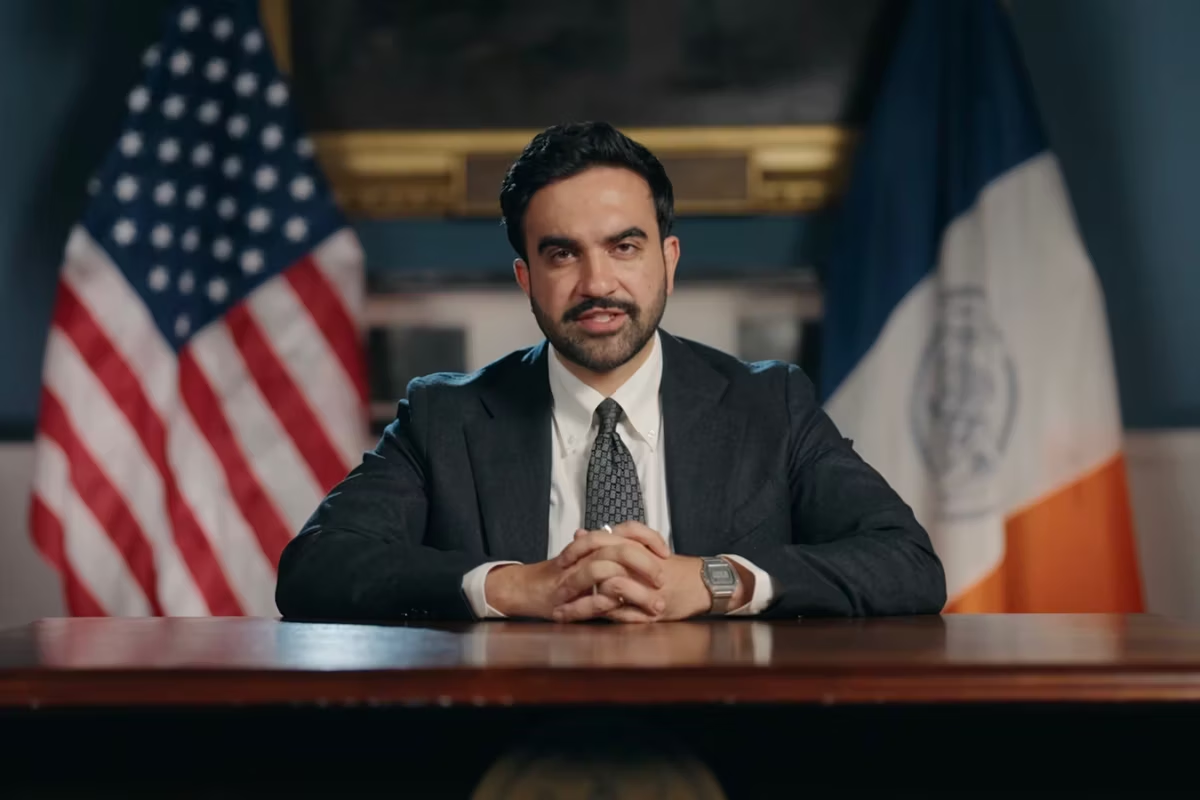
Zohran Mamdani delivers a speech.
As is often the case, fierce controversy ensued on the Left over Zohran’s comments, bringing the complex realities of the Obama years back into discussion. Criticism of Mamdani’s statement hinged on a feeling that he was downplaying or ignoring Obama’s policy failures and his expansion of neoliberal capitalism and militarism. Of course, no leftist with basic knowledge of 21st century history needs to be reminded of Obama’s various betrayals. Furthermore, none of us would seriously deny that Mamdani’s public addresses are primarily noteworthy in terms of the messages and symbolism they put into circulation more-so than their policy implications. At its heart, Mamdani was touching on something explosive: the legacy of Obama in a movement that is starkly riven internally on the question of how to relate to its past.
Given that we agree on the facts, what remains is how we ought to orient ourselves to the legacy of Obama’s left-liberal political common sense. Are we a rejection of that common sense, or the guarantors of its legacy? Is a rupture with Obama’s moral universe necessary to create a coherent leftist consensus at scale - the way Trump’s rupture created, for a short time, a coherent MAGA consensus? Or, should leftist mass politics fundamentally root itself in the powerful feeling of the first couple hours after the 2008 results were announced, taking that energy and radicalizing that? The historical experience of defeating the right and building genuine policy victories like the ACA was never about Obama himself or even his campaign, but the belief that the world can and must be changed with our own hands, and that we can do it together.
Debate over whether left populist success ruptures with Obama’s legacy on the one hand or extends it on the other is a false dichotomy: what Mamdani’s campaign and early administration has revealed is that the energy of Obama’s success was always ours, and the game is to harness it for our own ends. Voting for Mamdani felt like the sequel of voting for Obama, and last month’s New York primary returns felt like a continuation of both. This, then, is the horizon of leftist mass politics. Obama built his moral authority from the wreckage of the War on Terror.
The left has returned to mass politics in a similar way: by building and conserving its moral authority on the genocide in Gaza and the larger issue of Palestine. No single political figure can say the same, the left’s moral authority belongs to all of us and has propelled us to political victories unforeseen in our lifetimes. Thus far we have accomplished only this: the performance of a human reaction to unimaginable horrors. The situation on the ground in Gaza remains unchanged, just as Obama failed to bring peace or stability to Afghanistan and Iraq. Some have taken Mamdani’s citation of Obama as a repetition of Obama’s broken promises, especially in light of Mamdani’s reversal on Netanyahu’s arrest. This essentially misses the point. It is up to us to learn the lessons of the past and continue walking the long road to freedom.
The audacity has always been ours.