
Jul 30
Everything Chapter Meeting Got Wrong: The Theatre of the Absurd Has Gone Too Far!
As DSA moves quickly into the popular zeitgeist, millions of people are realizing everything is political and a better world is possible.
by Ally M.
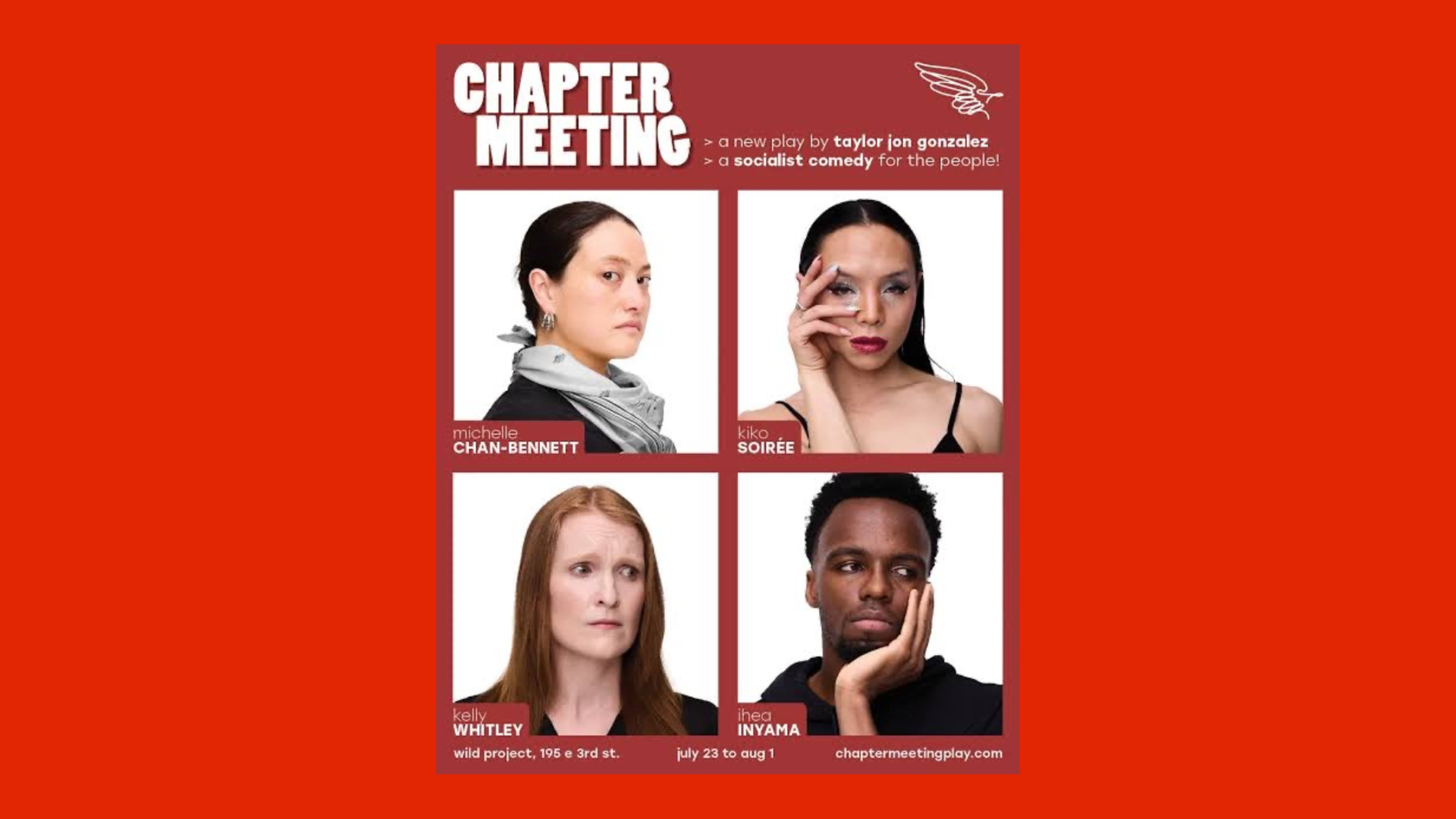
Chapter Meeting is a "socialist comedy" play by Taylor Jon Gonzalez centering around an all-night DSA chapter meeting set in Brooklyn that takes a turn when a participant reveals that he got a job.
Note: The writer of this review may or may not be a leader in NYC-DSA and may be biased against this play for that reason.
I‘m thrilled that DSA is culturally relevant enough to receive a satirical theatrical response. Maybe soon we will be big enough to deserve a good one. Worse than any single joke in Chapter Meeting, the play is referred to as “the DSA” throughout. This satire just doesn’t quite understand its subject.
That is unforgivable.
A self-deprecating joke is one of the most valuable art forms known to humans: it shows humility, self-awareness, and graciousness. Chapter Meeting could have done that had it consulted any active DSA member. The jokes made were hyperbolic symbols of 'wokeness' instead of reality—when the reality of the Democratic Socialists of America is much funnier.
We’ve had canvassers tumble down flights of stairs in New York City. We’ve had doors slammed in our faces with the line, “your candidate isn’t in the community.” We’ve had journalists infiltrate DSA meetings like they’re staking out Watergate. These are real things that have happened to us.
Humor is tricky, and, in the current zeitgeist, humor often relies on the “cringe” to make others laugh while the absurd and surreal fade away into the 2000s (see: Flight of the Conchords or The Mighty Boosh). Chapter Meeting used every socialist trope in the conservative playbook: rich students whose parents pay their rent, land acknowledgements, and an intense fixation on operational security. As the (albeit fantastic) cast leaned into these Internet clichés, a volunteer for DSA tabled outside the small Wild Project Theater, offering QR codes to those who wanted the real thing.
Cringe humor has a place in culture: to recognize when a joke has been exhausted, or to make the viewer uncomfortable or aware of how ridiculous a concept is. The problem is that a social movement focused on bringing actionable change for the working class is not a cringe concept—or at least not the one that actually exists. The tropes of Chapter Meeting rely on an outdated stereotype of a marginal, subcultural DSA, of an organization that hasn't broken containment. But the movement is growing in popularity throughout the city, the country, and the world. Congresswoman Alexandria Ocasio-Cortez was quizzed about the prevalence of communism just a few days ago by the press; a sign that the movement has become too big to ignore, and the old frames haven't caught up.
The result is that the writers of Chapter Meeting seem out of touch with the left, using memes from Tumblr in 2016 to explain away their fears of the left truly building momentum and becoming something new. The sheer irony of this play is encapsulated in the premise: that a chapter meeting for the New York City DSA (15 thousand members strong and counting) could even occur in a three-bedroom apartment in Williamsburg. There’s a desire throughout the play to minimize the left through this kind of humor, and its inability to really identify the object of satire leads the humor to ultimately fall flat.
As the play progresses, the characters show their various privileges in different ways: one character thinks winning at the cost of hurting some is validating, one character’s parents pay her rent, one character’s OnlyFans followers pay her rent, and one character is getting a job at Goldman Sachs. All characters seem to want to win socialism, but their so-called flaws seem to keep them from agreeing on anything—or even getting through the meeting with next steps.
The issue the play seeks to address is one many try to in DSA all the time: purity politics, or the tension between our principles and the compromises needed to make change. We live under capitalism, and until the means of production truly are seized by the working class—both white collar and blue—we exist in contradiction. That’s not to say becoming a vegetarian won’t make a difference, or that donating $5 to a candidate won’t either. The grassroots at its smallest is just as powerful at scale as an arms embargo. The key word is scale. A mass political movement starts perhaps in a Williamsburg apartment on Kent Avenue by the water, but it continues deep into the night in group chats, on Zoom calls the next week, in the streets the following month, and up on Capitol Hill for years to come.
The audience laughed so much at the jokes, but the cast were really the stars, making the cartoonish writing come alive. Despite the melodrama, despite the clichés of “woke one,” the cast received a standing ovation, and they deserved every second of it. They endured: having to make jokes about a 40-foot “Globalize the Antifada” banner over the Brooklyn Bridge, stealing an archival map from the New York Public Library, defining what is and isn’t sex work, hand-crafted pieces of furniture curated from global artisans, and many more zingers that felt aimed at the left—climaxing with one of the characters beating up a cop and stealing their gun.
But a 'cringe' joke about chaining emergency exits open on the subway so everyone can ride for free misses the point of the organizing that DSA does every day: not me, us. One person feeling smug about chaining open an emergency exit door, beating up a cop, stealing their gun, and bragging about it to their friends isn’t an organizing strategy; it’s a hazard to the movement. Characters read outdated descriptions of organizing work plucked directly from dsausa.org, added impromptu items to their meeting agenda without any motion from Robert’s Rules, and argued over whether or not to salt the roads before a protest in the snow (that could actually happen).
Are there DSA members who engage in purity politics, white guilt, unconscious bias of all kinds, and girlbossing too close to the sun? Without a doubt. Are there DSA members who also work tirelessly to organize for a socialist movement that mobilizes and grows the power of the working class? Definitely. The problem of the left is not that woke one was crazy, but that liberals still perceive the left as stuck indefinitely in woke one, and they use it to cudgel the left at every turn. An audience full of liberals laughing at these tropes is just another point of proof of this. Not a recognizable DSA member in sight.
Gone are the days of KeyWiki and small book clubs (although both still exist). Here are the days of large-scale legislative campaigns, electoral sweeps, and fundraisers that would make a development worker on the Hill suspicious (Canary Mission continues to seek monolithic power, unfortunately). The rich are getting richer as they always have been, but the 99% are noticing, and no longer think they are powerless.
It is time for the rest of us to catch up.