
Aug 19, 2026
Taking Back Our Time: The Struggle for a Shorter Workweek
As the left continues to grow throughout the country, questions of strategy and goals are becoming increasingly salient. T. Joad argues that the struggle for a shorter workweek is a central political demand of the working class.
by T. Joad
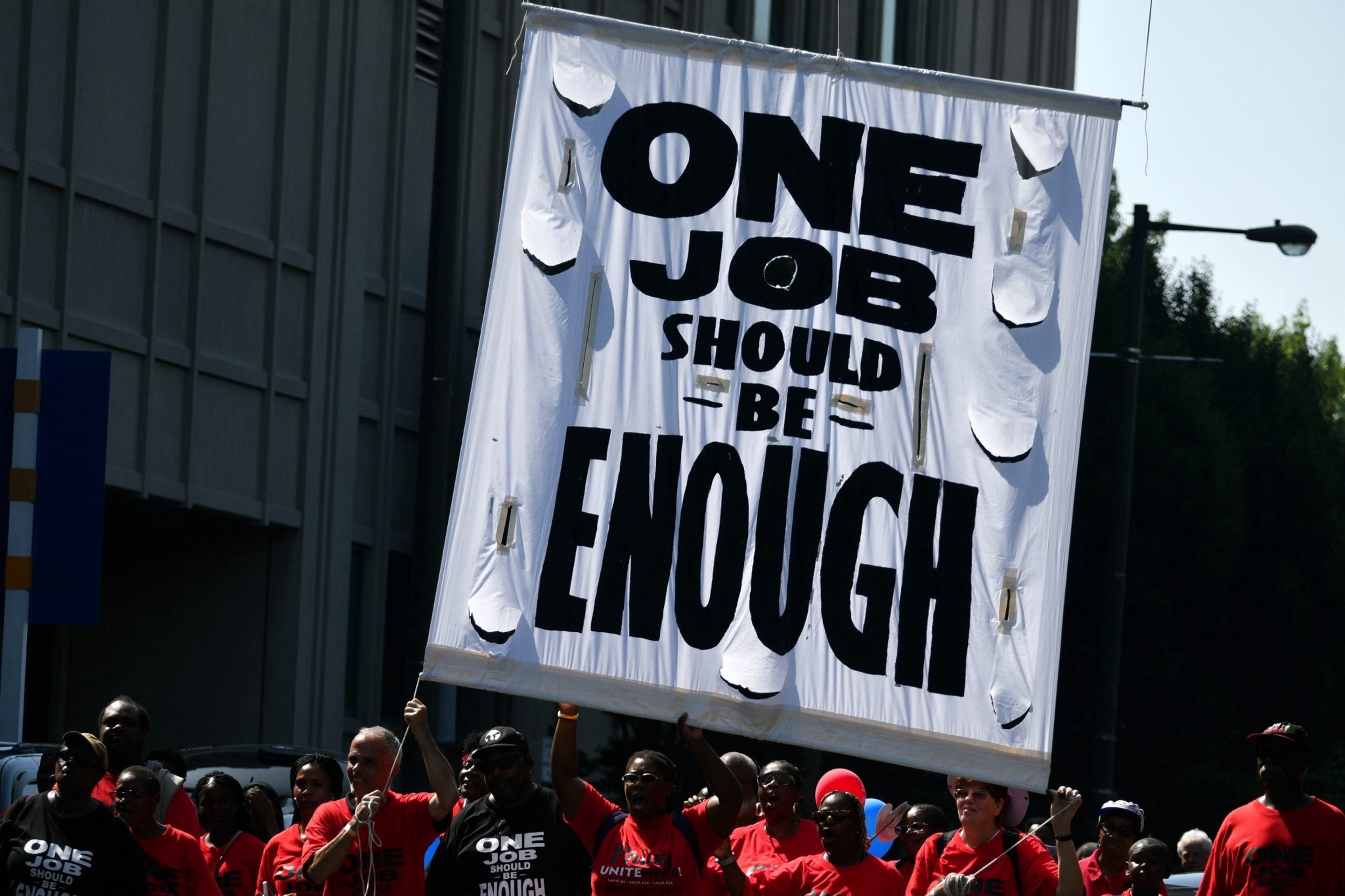
The Left is beginning to converge on a clearer strategic question: how should working-class power be built under current conditions?
After decades of union decline, the defeat of militant formations, workplace fragmentation, and the absorption of much of the left into electoral vehicles, advanced elements of the class are again seeking coherent forms of organization. The shared objective—rebuilding independent proletarian power—is increasingly recognized. The path, however, remains contested. The Left has an opportunity to rebuild that power by organizing around shortening the workweek and coordinated strike preparation, rather than centering high-profile electoral campaigns.
The current dominant political strategy concentrates energy on candidacies inside the Democratic Party, treating a presidential or major state-level electoral campaign as the primary vehicle for a breakthrough of socialist politics. Alexandria Ocasio-Cortez and related discussions of a “Socialist Project 2029” are the clearest current example of this approach. While it may be useful to strategize a pre-emptive orientation around this potential future, which may serve as another vehicle for bringing many into the fight much as the 2016 campaign of Bernie Sanders did, this orientation leaves much up to chance and only provides a limited space for organization, especially in terms of worker self-activity.
What proposals like a Socialist Project 2029 do exemplify is a real desire for decisive political gains. In this context, electoral campaigns can serve limited tactical purposes: they can popularize demands, test organizational capacity, or temporarily shift the terrain of struggle. Yet the strategy contains a structural limit. Campaign calendars, donor logic, vote-count metrics, messaging discipline, and short electoral horizons reshape working-class organizations around external objectives. Success is measured in doors knocked, funds raised, and ballots cast. These metrics register passive support more readily than active power. They do little to expand initiative at the point of production, increase strike capacity, or build durable rank-and-file institutions that outlast any single election cycle. The ultimate result is a subordination of the fighting organizations of the working class to the methods and rhythms of bourgeois electoral politics.
Electoralism may be useful instrumentally. In the event of a major candidacy, endorsement by organizations such as DSA can be weighed on its merits. But electoral campaigns cannot serve as the center of a socialist organization without deforming the very capacity that organization claims to advance. Opportunity costs are concrete: resources, time, and cadre energy devoted primarily to electoral machinery are resources not devoted to the construction of independent leverage. More crucially, it is debatable as to whether or not the organizational forms created through and used by campaigns such as these build lasting organs of independent class power in the first place.
There is another path. It has been neglected and displaced not only by supporters of electoral politics–but even militant and “revolutionary” organizations that advocate abstentionism have allowed the demand for a shortening of working hours to fall by the wayside.
Yet, it is the terrain on which the working class has historically forced real concessions and developed its own collective strength. This important field is the terrain of the working day, and Marx identified it as decisive. He writes:
“Between equal rights force decides. Hence is it that in the history of capitalist production, the determination of what is a working-day, presents itself as the result of a struggle, a struggle between collective capital, i.e., the class of capitalists, and collective labour, i.e., the working-class.” — Karl Marx, Capital, Volume I, Chapter 10 (“The Working Day”)
This path runs through the coordinated use of state-level popular referendums and the preparation of general or social strike action centered on the struggle over the length of the working day. Referendums allow the class to impose demands through direct democratic means where the legal form still exists; strike preparation builds the capacity to interrupt production and distribution. Together, they expand collective initiative, create material leverage independent of any single candidacy, and force the working class itself to exercise and develop its organizational power.
What is being proposed here is not meant to suggest a complete abandonment of electoralism or the contesting of state power, but a potential blueprint for the rejuvenation of a historic terrain of class struggle that proved an effective engine for spurring action among the proletariat and served as a unifying pole for the socialist left. Moreover, so much as it relates to a Socialist Project 2029, the activity put into motion by a campaign for a shorter workweek can at the same time build the kind of mass working class power and organization that can in turn exist to throw its weight behind a radical transformation of the state such as that mandated by SP2029.
Why it's Realistic Now
Roughly half of U.S states maintain some form of citizen-initiated ballot measure. Past progressive struggles have already demonstrated that real concessions can be won by these initiatives—such as minimum-wage increases, Medicaid expansion, and other measures—circumventing the hostile bourgeois legislative apparatus. A coordinated push doesn't require inventing a new weapon altogether, and provides an opportunity for nearly every organized expression of working class political power to engage in a shared nationwide legal campaign to win a historic victory for workers across the country.
Experiments with four-day weeks at no loss of pay in Iceland, the U.K, Spain, and Japan (among several others) have produced measurable gains in worker well-being without corresponding losses in output and productivity. In many cases, the experiments and pilot programs led to more widespread adoption of a shorter workweek.
At the same time, the horizon of coordinated strike action has become more concrete than at any other point in decades. The UAW and other unions’ decisions to align major contracts toward an April 30, 2028 expiration—just in time for May Day—have opened a discussion of multi-union, multi-industry coordination long dismissed as fantasy. The preparation for this kind of action is made easier also by the fact that many of the existing Left organizations in the country already have their own relationships with workers on the shop floor and are involved independently with different unions and unionization drives. It becomes a matter of concentrating the resources and energies of these disparate initiatives into a single, connected offensive centered around a clear objective.
The raw materials for a dual campaign therefore exist. What has been missing is the decision to treat the length of the working day—and with it the expansion of free time for human development—as a central field of struggle. That decision is made all the more urgent because of a structural feature of mature capitalism analyzed by Moishe Postone: the proliferation of superfluous labor. As the productive forces develop, less and less direct labor-time is required to produce material wealth; yet, capital continues to require the expenditure of labor-time for the production of value. The result is a growing mass of labor that is necessary for valorization but superfluous from the standpoint of social need and the potential of the existing forces of production.
The struggle to reduce the working day confronts this contradiction in the modern capitalist economy directly. It does not merely redistribute existing hours; it challenges the continued necessity of labor-time itself as the measure of wealth and opens the possibility of converting superfluous labor into disposable time.
In doing so, it strikes a decisive blow against the capitalist system and for the proletariat.
The Abandoned Field and Its Centrality to Marx
The struggle over the working day is not a secondary or purely “economist” demand. In Capital Vol. 1, Ch. 10, Marx shows that it is the direct terrain on which the two great classes confront each other as collective forces. To understand why, we must understand some basic elements of Marx’s critique of political economy.
Marx’s theory of capitalism centers around equivalent exchange: Capital purchases labor-power for a day; the worker sells only the capacity to work for a limited period. This is the source of all surplus created in society–all value and profit created and expropriated into the hands of the capitalists and private enterprise. What counts as a “normal” working day is not settled by any neutral law of exchange or via a benevolently mediating State apparatus that sits above society. It is determined by the struggle between classes – that of Labor against Capital. The history of capitalist production is therefore the history of this struggle: the progressive lengthening of the day in the early factory system, the counter-movement for the 10-hour and then 8-hour day, the bloody confrontations that produced, and are commemorated by, May Day itself.
The value of a given commodity is the embodiment of the socially necessary labor-time required to produce that commodity. Absolute surplus-value is produced by the simple extension of the working day beyond necessary labor, i.e., by making people work longer. Relative surplus-value is produced by intensifying labor or cheapening the means of subsistence so that necessary labor shrinks inside a given day, i.e., by making people work harder. In either case, the length and intensity of the working day remain decisive. A reduction of hours with no loss in real wages forces capital either to accept a lower rate of surplus-value, to intensify labor still further, or to accelerate the introduction of labor-saving technology under conditions more favorable to the workers. The struggle for a shorter workday is therefore a direct intervention in the valorization process.
In fact, the fight for free time has always been essential for Marx. In Capital, Vol. III, he writes that “the realm of freedom begins only where labor that is determined to be socially necessary ends… beyond it begins that development of human energy which is an end in itself,” stating in no uncertain terms that the real content of communism is determined by the amount by which real wealth is produced and measured in free time rather than valorized via exchange. The struggle for the reduction of the workweek is therefore a struggle which has the object of communism, free time, as its aim.
The forty-hour week, largely consolidated by the Fair Labor Standards Act of 1938 after a century of struggle, was never intended by capital as a permanent settlement. It was a compromise forced by mass unemployment and working-class power. Subsequent decades saw productivity rise dramatically while average hours stagnated or, for many, lengthened through overtime, multiple jobs, and the erosion of overtime protections. The further reduction of the working day was largely abandoned as a central demand of the labor movement.
That abandonment was not a technical necessity; it was and still is a void left by a political defeat. The field remains open, and the theoretical reasons for reopening it have not changed.
Reformism or Revolution?
A campaign for a shorter working week through state initiatives and strike preparation can be read two ways at once. This is a strength, not a weakness.
To reformists and the broader progressive left, the reduction of the workday appears as a quality-of-life improvement, a measurable reduction in burnout, and an expansion of free time. Ballot language can be drafted to appeal to precisely these concerns. To revolutionaries, it is an attack on the mass of surplus labor-time available for appropriation. Every hour no longer available for surplus-value production is an hour subtracted from Capital’s command and placed under the control of working people themselves. Victory would provide our class precious more time for development, actualization, and opportunity for further organization and political action. The same demand that looks like reform is, in its material effect, a compression of the domain in which value must appear as price and profit. Therefore, it functions as an increase in the real measure of emancipation.
This dual character is not a rhetorical trick; it is the actual structure of the demand under capitalism. The campaign therefore does not require the left to split into “reformist” and “revolutionary” camps before it begins. Different currents can participate for their own reasons while the objective effect remains the same: the working class imposes a limit on the length of the working day by its own organized force.
A key aspect of a campaign such as this is the potential for confrontation that it sets the stage for. Not only are the functioning organs of class power necessarily created during its preparation—and every minute wrested by Labor from Capital a minute more for further development and organization–this campaign can become the stepping stone to a directly revolutionary situation when Capital, having come under direct attack, reacts with its usual repression and attempts to sabotage the will of the working class and thus illuminates the bourgeois State and its institutions as unable to carry out and represent the so-called democratic mandate it supposedly is meant to embody and that it claims legitimacy from. This will undoubtedly have a disillusioning effect on those few who are left who still fall for the facade of democracy in this country and make clearer the need for a really revolutionary overcoming of the current social relations. When that moment comes, and the demands of working people are undercut even in the arena of perfectly legal struggle, the corresponding strike preparation and fighting worker organizations created during the campaign will be there to serve as the arsenal of the class to exert its power over Capital.
In contrast, an AOC-centered mobilization organizes people primarily around a candidate and electoral campaign apparatus. The skills exercised are canvassing, phone banking, and donor outreach under professional discipline. When the election ends, much of that organization is dissolved or absorbed into the ordinary machinery of the Democratic Party. The class gets activated, but largely as a support base.
Referendum signature drives, workplace committees preparing for coordinated action, legal defense networks, and mutual aid during disruptions require a different kind of organization. Workers must write demands, gather signatures themselves or through networks they control, form committees that survive beyond a campaign cycle, and flex their muscles in forcing disruptions in production. Even incomplete success would leave behind capacity that did not previously exist.
The importance of this struggle is that through it the working class experiences, in practice, that it can force laws onto the ballot, and withhold labor while imposing costs on Capital without waiting for permission from an elected official. That experience is vital and itself a revolutionary development.
It is the difference between substitutionism and self-emancipation.
Coalescence Beyond DSA and the Anti-Imperialist Link
Because the dual campaign doesn’t subordinate struggle to a Democratic Party timeline or to DSA’s internal endorsement process and official procedures, it is a project that can be a lightning rod for the whole of the Left and the working class’s fighting organizations to come together. It provides an opportunity for mobilization of even the smallest chapters and organizations to take part in and become involved in the larger campaign, whether focused on mutual aid, union, or community organizing. It is able to draw in currents outside of but also in tandem with DSA and the larger organized parties of the American Left, namely, independent socialists, trade union militants, anti-imperialist formations and communist organizations that reject participation in bourgeois electoral politics and the Democratic Party as a strategic terrain. Further, as a demand, the reduction of the workday is already deeply embedded in the left consciousness. Almost all of these organizations already tout a reduction of the workweek as part of their platform, one thing the entirety of the Left—and potentially beyond—seemingly can agree on.
The project now is to actually come together and force the issue, recentering the fight for the length of the working day in practice.
The anti-imperialist quality of such an action is also significant, and made more urgent by ongoing American aggression across the world in West Asia in Iran and across the Gulf, its collaboration with the Israeli apartheid regime in the genocide of Palestinians, the enabling of the imperial meat grinder in the Donbas, and the subjugation of Venezuela and the increased belligerence against and starvation of Cuba. Everywhere, the State is attempting to reassert and maintain hegemony and prospects for capital accumulation. Military spending, bases, and the projection of power overseas both militarily and economically are all funded by the surplus extracted from workers that is appropriated to the capitalist State as the manager of the national capital. A real reduction in the working week shrinks the total surplus available for appropriation and redirection to the imperialist system.
This does not abolish imperialism by itself, nor does it prevent the State from raising taxes or increasing exploitation elsewhere. It does, however, impose a concrete restraint that pure foreign policy agitation cannot. It is a method in which we starve the machine of the fuel it needs to run. Those who maintain anti-zionism and anti-imperialism more broadly as central to their political organizing therefore have a direct interest in the same domestic struggle over labor-time that workplace militants and referendum organizers are fighting.
Toward a Concrete Campaign
The Left does not need a complete blueprint before it begins. A short list of clear demands centered on a substantial reduction of the workweek with no loss of pay, linked to overtime protections, rights to refuse unsafe work, and measures that begin to decommodify basic needs can serve as both ballot language in initiative states and as strike demands. Existing unions, left organizations, and independent organizers can plug in at the level of signature gathering, workplace preparation, research, legal defense, or media work without dissolving their own existing formations.
Obstacles are real. Incomplete geographic coverage of initiative possibilities, laws surrounding strike action and solidarity strikes, costs, and the uncertainty of State and Capital response are all real impediments. Treating these as expected features of class struggle instead of fatal objections is the difference between a serious campaign and an empty gesture. In fact, it is to be expected that the representatives and managers of Capital will resist any way they feel they’re able to, and that is part of the point. This is a struggle that targets the functioning of the system directly and will apply immense pressure to the contradictions lying at the heart of the capitalist mode of production, and provides the working class the opportunity to realize its potential and organize itself for its overcoming once exposed.
The alternative to electoral and candidate-centered mobilization is not abstention. It is the deliberate construction of a terrain of struggle in which the working class acts as the subject of its own power, not passive observers. The length of the working day remains what Marx showed it to be: the terrain on which collective capital and collective labor confront each other most directly. Reopening that struggle through state referendums and the preparation of coordinated strike action is both realistic under present conditions and directly revolutionary in its implications. It is the task of the left as a whole to take up without waiting for any single candidacy to resolve the contradictions of American capitalism–relying on the workers and their organization instead.