
Oct 1
Stop the Spoilers: On the Resolution to Expel Spoiler Candidates in the DSA
The Democratic Socialists of America’s electoral project is ascendant. But as the organization grows, so does a strange problem: candidates within DSA running against other candidates endorsed by DSA. In her latest, Roxanne R. argues that to maintain electoral discipline and respect democratic deliberation, it is necessary to stop the spoilers.
by Roxanne R.
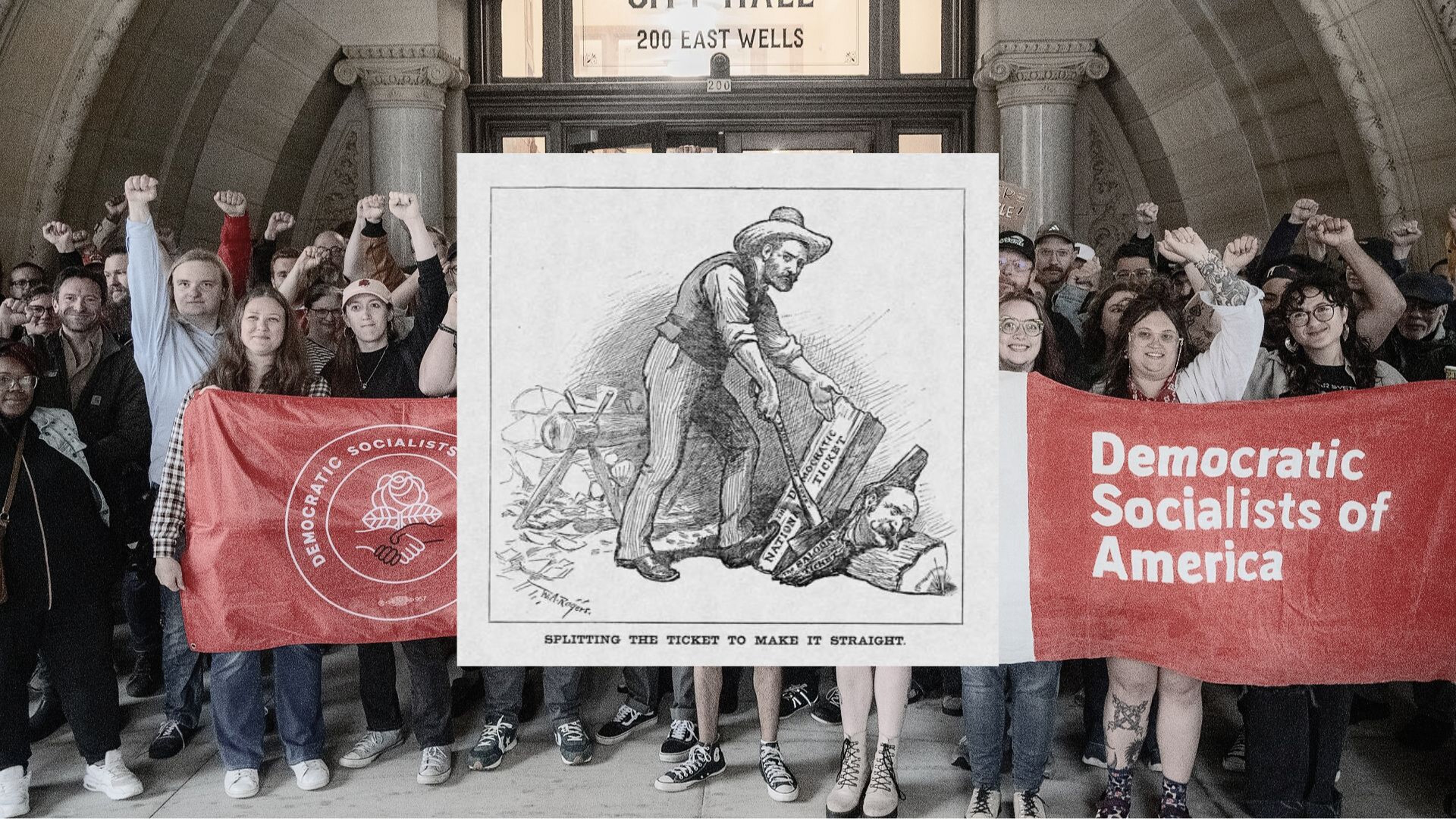
This article is written by a DSA member about the Stop the Spoilers resolution, which will be discussed by the DSA’s National Political Committee this Sunday. If you are a member of DSA, you can sign onto the resolution here.
Introduction
The Democratic Socialists of America (DSA) is ascendant. The 2026 election cycle features almost 240 DSA-endorsed candidates across dozens of chapters, the greatest number of DSA endorsees in the organization’s history, and there is good reason to assume half or more of these candidates will ultimately win their elections. With nearly 300 DSA electeds already in office, we stand to grow our socialists in office by a third in a single cycle.
It should not surprise any of us, then, that our organization now faces an influx of candidates joining DSA with the hope of using our name and resources to boost their own political careers. In many respects this is a positive development, reflecting the growing seriousness with which we are taken as a political power broker. But it also creates a novel problem: DSA-endorsed candidates getting spoiled in their races by non-endorsed, opportunistic members running at the same time for the same seat and splitting the left vote. Such a scenario has already transpired at least three times this year alone (most recently in the race for Wisconsin’s 76th Assembly district to replace DSA member Francesca Hong) and more examples are sure to follow in the years to come. We should not wait to do something about this.
For this reason, Rose Garden members Alyaza B., Roxanne R., and Sylus S. have drafted a resolution: “Stop the Spoilers: For the Expulsion of Spoiler Candidates.” This resolution makes it explicit that chapters can expel non-endorsed DSA members who run in an election against DSA-endorsed candidates, provided their running would also hinder the endorsee’s ability to win. In short: If a non-endorsed DSA member “spoils” a DSA endorsee in a competitive race, that member can be expelled. We believe candidacies of this nature should constitute “substantial disagreement with the principles or policies of the organization” and “undemocratic, disruptive behavior” as outlined by Article 1, Section 3 of the DSA bylaws.
This resolution is currently set to be voted on by the NPC at their October regular meeting, this upcoming Sunday. If you agree with this in principle, we encourage you to sign the resolution and to encourage your comrades and fellow caucus members to officially support it in advance of the vote.
We have already found much agreement with the principle of our resolution: Over 450 DSAers have signed in support, including members of a dozen caucuses. Three caucuses have even voted to officially support the resolution. But we have also encountered no shortage of skepticism—potentially including skepticism from you, the current reader. In the remainder of this piece we hope to lay out a case for our resolution that you can agree with.
Is This Really a Problem We Need to Solve?
The most common question we receive as resolution writers is this one: Is this really a problem we need to solve? Our answer is unequivocally yes, for three fundamental reasons:
- Spoilers undermine internal DSA democracy.
- Spoilers undermine DSA co-governance and party-building.
- Spoilers undermine DSA electoral work.
Spoilers undermine internal DSA democracy
We think it is of the utmost importance to respect and defend political interventions that are democratically decided by our membership. Once our organization has decided to endorse a candidate, it is imperative that other members avoid undermining the DSA-endorsed candidate by running against them and making it harder for the candidate to win their election. Our political interventions as an organization can only be effective when we actually care about upholding our internal, democratic deliberations, regardless of any other political disagreements members may have. This is especially true of endorsement votes. When respecting democratic outcomes comes second to placating individual political desires, it threatens to disorganize our membership and unravel our organization completely.
We think that it is also important to proactively create a mechanism through which prospective member-candidates are incentivized to adhere to the democratic will of their chapters; doubly so in light of the already-discussed growth of opportunistic politicians attempting to tie themselves to our organization.
Spoilers undermine DSA co-governance and party-building
When members run against DSA-endorsed candidates they are undermining our ability to implement co-governance. DSA is not like Our Revolution, Justice Democrats, or even the Working Families Party. Our goal is not merely to get the left-most candidate into office; it is to build socialism in the United States. This requires elected officials who can set aside their ego and ultimately act as vessels for a political project much greater than themselves. If a candidate cannot so much as dignify their chapter’s endorsement process (and the will of membership it expresses), how can we trust them to collaborate with us later on bigger issues—much less co-govern through them or expect them to serve as embodiments of socialist politics?
And if this behavior makes co-governance problematic, then it makes party-building in our current organizational form an outright impossibility. DSA wants to be a party, but a party where non-endorsed members can run against endorsed candidates without consequence is simply not a party at all. Typically, when we speak of becoming a “party,” we are seeking to emulate the strong, membership-based political parties of Europe. In parties of this type, expulsion of members who run against their own party is simply taken as a given and considered basic electoral discipline. If we are serious about building a party, then we should not be any different in recognizing this behavior as political sabotage and penalizing it accordingly.
Even in our own political system, where parties are weak and registration-based, both formal and informal mechanisms exist to preempt this form of undemocratic behavior. In many U.S. states, for example, sore-loser laws exist, meaning that primary election losers cannot ignore the will of their party’s electorate and render the primary moot by simply running in the general election anyways. Running as an independent against a party’s general election candidate is, additionally, often grounds to be, at minimum, blackballed by the party apparatuses. It is clear that this reform is a basic step towards DSA effectively operating as a party.
Spoilers undermine DSA electoral work
Some may argue that the actual effect of spoiler candidacies on our organization has been overstated. Strictly speaking, out of the three “spoiler” examples from this cycle, only one had a fully negative electoral outcome. So far, spoiler candidates have not been a danger to our electoral work. But we must emphasize that this was entirely a matter of good luck. It would be extremely foolish to assume that the electorally neutral outcomes of this year’s crop of spoiler candidacies will remain true in future election cycles.
In the case of New York Assembly District 34, for example, the situation of a spoiler running against a DSA endorsee was defused only by the fortuitous opening of the overlapping State Senate District 12. Before then, DSA-endorsee Aber Kawas was barreling towards a vicious primary against DSA member Brian Romero–one that she likely would have lost. Had this occurred, it is easy to imagine the narratives that would have sprung from such a loss: that DSA’s power is overstated; that our influence is marginal; and that our membership is out of touch with even the primary electorate.
The outcome in Wisconsin Assembly District 76, where member Dina Martinez-Rutherford emerged victorious over DSA-endorsed Julianna Bennett and fellow members Isaia Ben-Ami and Zoe Sullivan, was similarly a matter of luck for DSA. The reason a DSA member won the seat—even though the winner was not our endorsed candidate—is simply because four out of five candidates in this primary were DSA members, and we, as an organization, amassed a nearly insurmountable 84.5% of the vote as a result. This is hardly representative of a typical race where spoiling may come into play. We should, as a rule, expect splitting the vote between more than two DSA members in an election to cause all of them to lose.
Most spoiler races will instead look like the Utah State Senate District 13 primary, in which DSA member Evan Done ran against DSA endorsee Taylor Paden. The result? Silvia Catten, the candidate opposed by DSA, won with a plurality of 44.1% against Done and Paden’s combined 55.8%. This denied us any chance of picking up a seat we can clearly compete in.
But what about MY special blorbo???
The case of Evan Done is also useful for rebutting another refrain from skeptics, which we might somewhat dismissively characterize as: what about my special blorbo? Sure—this refrain often begins—running against a DSA-endorsed candidate might be undermining a chapter, but what if the chapter picked a really bad candidate? Or what if a chapter overlooked a member who really should be the candidate? Or what if there’s a candidate that has the possibility to unify the working class? Surely, then, it must be permissible for someone to run against my chapter’s endorsement?
We are somewhat dismissive of this refrain for what we hope are obvious reasons: to be an unorganized socialist is a contradiction in terms. Socialism is not advanced merely by individuals running for office and winning; it is advanced by the collective efforts and base-building of socialist organizers. Frankly, we must be willing to subsume our individual political interests in the service of something greater.
This is not to suggest chapters are infallible or incapable of mistakes in judgement (for example, one of the resolution’s coauthors has been intensely critical of Nithya Raman’s endorsement by DSA Los Angeles). But collective errors in judgement of this sort are not—and will never be, outside of the most exceptional circumstances—resolved by undermining a chapter’s work in favor of what an individual thinks is right and wrong. The solution to bad chapters is to organize within them. When you think your chapter has made a bad endorsement or failed to consider something politically pertinent, then you should voice this opinion at a general body meeting, organize fellow chapter members around your position, and join your chapter’s electoral body to have greater say over their future endorsement decisions. Even if a chapter makes the wrong choice, the only serious solution is to work to create a new democratic consensus rather than reject the necessities of organization entirely.
Your special blorbo cannot advance socialism alone. There is no getting around the fact that every candidate has to work with the chapter–and to do that most effectively, they have to swallow their pride and back the endorsed candidate for that election cycle.
A Personal Case Study
Personally, I’m not unsympathetic to the view that sometimes a chapter makes a bad decision and that it may be better to support a non-endorsed member. Let me tell you about my own special blorbo: Evan Done.
I met Evan Done at an unrelated campaign event in Salt Lake City and quickly became convinced Salt Lake DSA had made a mistake in endorsing Taylor Paden. This was Salt Lake DSA’s first major campaign and I was very frustrated by what I viewed as the weakness of the candidate they chose and their lack of interest in courting delegates for the state convention. At the time, it seemed like the Paden campaign would fall short in collecting the number of signatures they needed to make it to the primary ballot, and their lack of interest in convention meant that failure to get enough signatures would end his campaign entirely. Done, by contrast, felt like a significantly more serious candidate. He was much more connected to local politics and was confident he would get enough signatures to make it to the ballot. He also would go on to win at convention, and seemed to only be seriously challenged in the primary by Silvia Catten. To me, Done was Salt Lake DSA’s only real chance at getting a member in the SD-13 seat.
I was dead wrong, and made a complete fool of myself to Salt Lake DSA in the process. First, Taylor Paden ended up getting ballot access. In the last three weeks of the campaign Salt Lake DSA managed to get the 2,000 signatures required. For a chapter of their size this was incredibly impressive, particularly as a grassroots campaign with volunteer canvassers unlike Done and Catten’s. Then, Evan Done went on to betray the entire progressive flank in Salt Lake City by endorsing Blue Dog Democrat Ben McAdams for the UT-01 congressional seat over progressive (and now DSA member) Nate Blouin. As it turns out, the kind of socialist who’s willing to undermine their chapter to win also tends to be the kind of socialist who will sell out socialist values to win. My special blorbo ended up letting me down, while, by contrast, the chapter I thought was wrong built up their electoral capacity significantly and stands a good chance of picking up some seats in the 2027 election cycle.
Had I put my trust in chapters instead of candidates from the beginning, I would have saved myself the embarrassment. I implore you to do the same, and you can do that by supporting the Stop the Spoilers resolution.
Edge cases
Elections have many edge cases where “spoiling” and “violating internal democracy” get more complicated. We feel the resolution as written adequately addresses all of the substantial edge cases.
The resolution defines “spoiling” more narrowly in types of elections where a non-endorsed DSA member can run alongside a DSA endorsee without detriment. In ranked-choice elections, only candidates who refuse to cross-endorse or otherwise antagonize the endorsed candidate would be subject to potential expulsion. This is also the case for elections with multiple winners, where DSA has endorsed fewer candidates than the total number of seats available.
The resolution also makes clear that it only applies to non-endorsed DSA members running against DSA endorsees, so it simply wouldn’t apply if two chapters endorsed different candidates for a statewide or federal election. This has never happened before, and, as such, there is nothing close to political consensus on what DSA should do if chapters have competing endorsements.
If a member wanted to run in a third-party primary or as an independent to hedge against the possibility the DSA-endorsed candidate loses in the Democratic primary, then the resolution would only apply if both the non-endorsed member and the DSA-endorsed candidate made it to the general ballot, since before that point they would not be in the same election.
In any case, the political expulsion process in DSA already gives discretion to the NPC and we have confidence in their ability to exercise it in that eventuality. This resolution would not mandate any expulsions, but allow us to take action when these problems arise.
Conclusion
This is a fairly comprehensive overview of the sorts of objections we’ve heard. We’ve certainly heard more, and, while we’re more than happy to deliberate about edge cases, party structure, and blorbos ad infinitum, we must not miss the forest for the trees.
DSA’s electoral program is more successful than ever before. This has brought an influx of opportunistic members who use DSA’s brand while running against DSA endorsees. These spoilers undermine the power of our internal democratic process; they undermine our co-governance with SIOs and efforts to party-build; and they undermine our electoral work by splitting the socialist vote. We must address this problem now before it gets worse.
This Sunday, the NPC will vote on adopting the resolution. If you agree with our effort, then you can sign the resolution and circulate it among your chapter to show the NPC that there’s broad support for this measure. We also call upon caucuses to officially support this measure to ensure that their members on the NPC vote in favor of passing this resolution.
You can also adapt this resolution into a chapter resolution, as Salt Lake DSA has done, to make sure that at least in your chapter, there’s a mechanism to penalize members who spoil your campaigns. Together we can Stop the Spoilers and build a stronger DSA.