
Oct 12, 2026
What the Resistance to ICE Teaches Us About Mass Revolutionary Politics Part 1: Lessons from LA
As Zohran Mamdani struggles to address ICE violence in NYC, Los Angeles has seen mass deportations by ICE since last year. In the first of this two-part series, Matthew J. Hunter reviews the political lessons from the anti-ICE uprising in LA.
"The weapon of theory is as decisive as the theory of weapons. But while we must be ready to fight with arms, we must also fight with culture, education, and political mobilization. The enemy uses many forms of domination; we must respond with many forms of resistance." -Amilcar Cabral, "The Weapon of Theory" (1966)
On the fall morning of October 8, Immigration and Customs Enforcement (ICE) attempted to murder another immigrant, this time in New York City. Oscar Belgal was driving his five-year-old daughter when ICE agents dressed as construction workers surrounded him and his child and opened fire with the intent to murder them. This is at least the 43rd ICE shooting in less than two years. ICE claims they have broken record after record of kidnapping immigrants, migrants, and ‘citizens.’ There’s also the foreboding reality of thousands of people missing from ICE concentration camps.
We are facing exponentially increasing fascist violence on our communities, and this latest surge is already creating casualties in our class struggle. The anti-ICE efforts in New York City are not happening in a vacuum. We have almost two years of lessons now on how to build resistance to this type of fascist violence from Los Angeles to Minneapolis to Washington D.C.
NYC is also in a different dynamic. They have elected a socialist mayor with deep DSA roots. The Left has far more political power there than anywhere else. It's time to use these lessons from the anti-ICE uprisings from last year to win the struggles of today.
“Operation Return to Sender” began January 7, 2025, in Bakersfield, California, and throughout the Central Valley. This was the first wave of fascist DHS/ICE assaults on immigrant and migrant communities. Since that day, we have seen continued wave after wave of fascist violence and kidnappings by ICE and other affiliate agencies. It’s been almost 2 years of seeing families ripped apart, people disappeared, and others murdered in cold blood.
Military occupations of cities like Washington D.C., Minneapolis, and Los Angeles have shown the extreme to which the administration is willing to go. If ICE’s recent increasing violence in New York City and another round of surges in California show us anything, it is that we have to understand the lessons from this struggle for the last 2 years. This fascist danger is not going away, so we have to figure out how to make it go away. The essential lesson is clear: the struggle against capitalism, imperialism, and fascism requires a diversity of tactics. Police and fascist repression refuses to discriminate between legal tactics or those perceived as ‘illegal’.
What’s the right response? Which tactics should you and your organization adopt? How have other areas been preparing? How do we organize this resistance to push back and successfully launch our offensive against not only ICE, but against the very heart of our capitalist society?
If we are nearing a political and social rupture in the coming years, the militant revolutionary lessons from this struggle will be necessary for the next phases of the revolutionary movement. We have to understand how these different tactics can link together for a purposeful strategy of social transformation. Alone, tactics such as peaceful mass protests, electoral efforts for legislative reforms and progressive candidates, and even the more radical direct action are all limited without a concerted strategy combining or discarding these efforts when necessary.
The first line of defense (and counter-offense) for any community attempting to organize anti-ICE efforts is the rapid response network. This is the foundation of community defenset, and we have to grapple with its strengths and weaknesses if we hope to build and develop more revolutionary efforts out from this collective. After Donald Trump was re-elected, community organizers immediately formed multiple coalitions in Los Angeles in preparation for the arrival of what Trump had campaigned on—mass deportations.
They began organizing immediately. As I wrote for People’s World in November 2024, CPUSA and a “broad alliance” such as “SEIU 721, the Coalition for Humane Immigrant Rights L.A. (CHIRLA), DSA, Clergy and Laity United for Economic Justice, Alliance of Californians for Community Empowerment, ACLU SoCal, United Teachers of Los Angeles (UTLA), and others” successfully pushed for a Sanctuary City ordinance.
CHIRLA became one of the key organizations to set up a rapid response network in Los Angeles County, mainly representing the progressive, liberal, and some socialist elements of the LA Left. But then the ‘Left of the Left” in LA, through organizations such as Union del Barrio (UdB), UTLA, Centro CSO/FRSO, VC Defensa, and others, set up the Community Self-Defense Coalition (CSDC) not long afterwards. The CSDC, with its 80+ member organizations and rapid response networks, acts as a hub of different rapid response networks, even developing its own network with its own independent infrastructure and leadership.
This meant that when the summer ICE surge happened in June 2025, there was already scalable infrastructure in place to organize the rapidly expanding spontaneous struggles in Los Angeles. CSDC saw over 4,000 people attempt to join within a month. New groups like the Harbor Area Peace Patrols and Long Beach Rapid Response Network quickly materialized and became impactful forces.
What defined the situation on the ground, at first, was the reality of mass deportations. Large groups of ICE, HSI, and other DHS agencies would travel in force to a specific area to kidnap anyone who looked ‘un-American.’ The community came out in response in Huntington Park and Compton that first weekend of June. Thousands of community members and organizers rushed to these scenes across the county to, in effect, barricade these fascist terrorists and give people time to escape or hide. But ICE began more targeted and quick kidnappings of the most exposed people in the streets—gardeners, food vendors, etc.—and the networks would become more and more of the social hubs of community awareness and defense.
The rapid response networks and CSDC in Los Angeles have succeeded on multiple fronts. They have been the most consistent presence and collectives in action in respective communities throughout this almost 2-year struggle. Labor unions such as SEIU or Unite HERE have been vocal and mobilized at times as well. But they have not dedicated themselves to this despite these deportations being a priority issue that affects many of their own rank-and-file members. Only teachers unions have been consistently involved with the rapid response networks. Even groups like DSA-LA and Long Beach have not shown that this is a number one organizing priority.
CSDC and other rapid response networks were instrumental in developing a collective rhetoric and education on anti-ICE tactics. They held weekly in-person meetings with hundreds of people to update and inform communities and even educate people on how to spot ICE, what to do, who to call, how to approach and, ultimately, how to defend their neighbors from being kidnapped. Signal chats to centralize communication were necessary, despite their notable drawbacks for security (as we see in Prairieland and Turtle Island Liberation Front).
Another feature of the situation is that there is a web of overlapping collectives, coalitions, and organizations, where members from one group will also be in several more. Southern California’s unique geography and urban design result in ICE choosing isolated places as consistent staging grounds—such as the infamous Terminal Island off San Pedro and Long Beach (a site of an historic Japanese immigrant community before being rounded up for internment camps during World War 2).
This led to groups like the Harbor Area Peace Patrols and Long Beach Rapid Response staking out that staging ground every morning, examining the routes ICE agents would leave on the freeways and using the mosaic of Signal chats to communicate where they were heading. It was a community-driven and supported alert system spread throughout roughly the entirety of southern California. That’s around 56,000 square miles of instantaneous communication, roving community patrols, and defense hubs–all united in stopping the deportations.
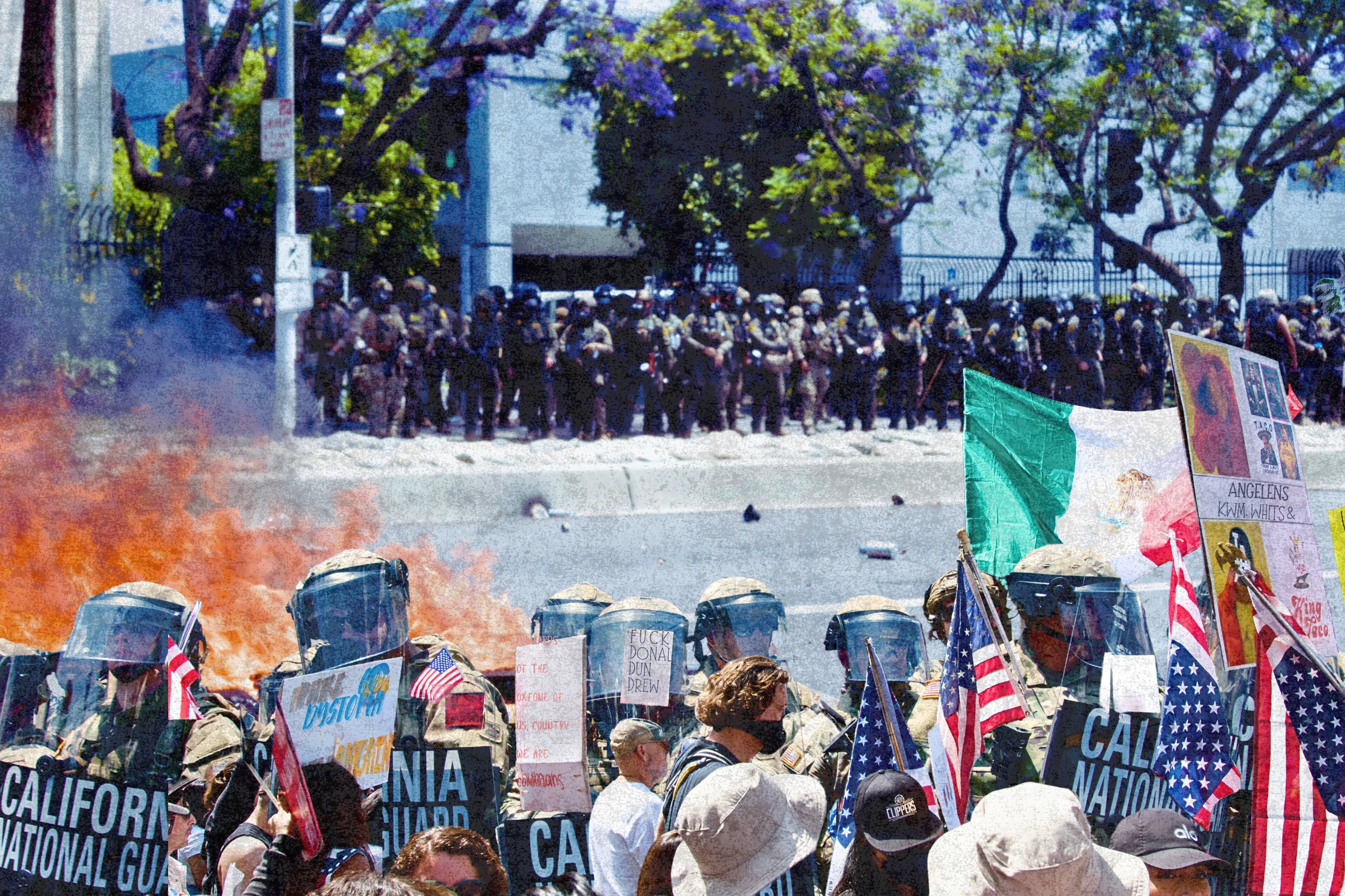
What this expansive infrastructure and ideological diversity allows for is rapid adaptation to changing tactics. When Home Depots and car washes were exclusively targeted, organizers and community members created defense hubs at these locations for basic 24/7 support. So as we see these ebbs and flows towards radical explosions of class and social rage, such as when thousands blockaded the federal detention center in downtown LA and attempted to ram a dumpster through the gate, or the times of communities erecting barricades and burning down private property like Waymo and police cars, we also see this fallback defensive layer that has saved untold thousands from being kidnapped by ICE and effectively disappeared. The tireless and thankless work of volunteers around the clock on these efforts is heroic.
However, we have to understand that all this activity was still largely defensive. The most explosive examples of resistance were, in effect, unorganized. What happened in Huntington Park was just thousands of people from the surrounding neighborhoods coming to save their friends and family. I was there: as I was running with the masses away from the most recent volley of tear gas and rubber bullets, I realized none of us were really prepared for that type of struggle; choking from the toxic air, people were crying and shouting that they knew the people kidnapped behind that fascist police line. It was pure emotion, pure anger, pure desperation that made us keep going back, attempting to break their line and will.
How do we organize that emotion and rage to go beyond the defensive? It’s difficult to ask people to risk their lives, but that’s the unfortunate reality on the ground. It’s us protecting our own communities, friends, and family. It’s pulling back a friend behind a car as a hail of “less-than-lethal” munitions are shot at you. It’s cases like Alejandro Orellana who had to fight for his freedom in court for simply giving out masks at a protest.
We also have to realize that this is a fight beyond ICE. Yes, we have to abolish ICE. But it’s also the local and state police, Marines, and National Guard. All of these institutions have completely supported the fascist and colonial violence that is happening on our streets. Right now, we are outgunned, but as a CSDC and UdB leader said:
"Don't forget where you're standing. This is South Central Los Angeles…[ICE] are not the only ones with guns in this city. Don't forget that. And I don't say that because I'm calling for violence; I'm saying that because the people have every right to defend themselves against masked, unidentified gunmen. The people have every right to defend themselves," he added. "That's not violent. That's intelligent.”
In the 1960s and 70s we saw organized resistance and “shooting back” against police and fascist violence in self-defense. Groups in the New Left like the Black Panther Party engaged in armed struggle, the Weather Underground engaged in bombings, and groups received training from socialist countries on guerrilla warfare. In Los Angeles, we saw extreme state violence against the Black Panthers and Communist Party, with the LAPD infamously laying siege to the BPP HQ, which also had members of the dual-card Che-Lumumba CPUSA club, according to Gerald Horne’s Armed Struggle. As we wrote about with the NSPM-7 case in Prairieland, there is an urgent history of lessons we need to understand about legal defense aid when it comes to the ‘illegal’ clandestine work that is necessary when facing fascist paramilitaries in a still semi-legal democratic society.
Los Angeles’ rapid response networks show that it’s necessary to have mass coalitions, working in concert to adequately organize community defense on a large scale. We need dozens and dozens of organizations coming together, a consistent space to meet and communicate, and the ability to channel that rage into productive efforts. But when looking at the spontaneous and more violent actions of community defense, there’s an understandable hesitancy to engage in that work–to leave it up to individuals or to sectarian groups. The focus on the legal struggle is not useless either, and the better organized that struggle is, the more it relieves the more radical efforts and also works as another layer of collective protection.
Unfortunately, the LA Left remains divided into two camps: the more progressive liberal wing with DSA-LA at its head, and the ‘radical wing’ headed by the CSDC. It’s important to note that the CSDC largely draws on people of color and immigrant communities. It’s led effectively by Chicano/a, Filipino/a, and Indigenous activists, teachers, and community members, while the DSA is still a largely white organization. It’s vital to also understand that this type of fascist violence also has a colonial and imperial dynamic. It is largely targeting people who have migrated from countries facing extreme US imperial oppression and “non-white” and “illegal” people. It’s a playbook of dehumanization and social othering that is foundational to US settler colonial society and modern fascism. ICE is the US cavalry conducting colonial genocide to maintain the modern white Manifest Destiny, the slave catchers of the South, and the Gestapo.
The more conservative wing of the LA Left is attempting to win the mayorship by backing Nithya Raman, with little effort, to build that divide with the radical wing through electoral victory (and it should be stated that at this point, it doesn’t seem the radical wing has attempted to court or sway the semi-controversial Raman. It’s two passing ships in the night–in some cases, such as May Day this year, we even saw competing protests that never met in downtown LA, which passed each other on different sides of City Hall).
The CSDC event was attacked by police, and people had to be dragged away from police beating them with batons. The more liberal protest played music on the other side of the park and kept marching. According to one member of DSA-LA, their organization does not have “an especially close relationship” with the CSDC. The oddity is that there is overlap of DSA-LA members in both CHIRLA and the CSDC rapid response networks, but there is no internal struggle or structure for more long-term strategic planning between these different sides of the Left in Los Angeles.
This is tragic. It is necessary for these two factions to engage with each other and build inroads with each other in order to achieve higher levels of social struggle. For example, the LAPD was issued a restraining order for brutalizing protesters and media, followed by an injunction, all of which has been utterly ignored by Karen Bass. DSA-LA’s electoral elements are themselves fractured, with every DSA city council member endorsing Bass over DSA-LA-endorsed Nithya Raman. However, if the CSDC or DSA-LA and Raman’s team reach out to each other and build a coalition, we could make anti-ICE policies more pronounced and enforced. ICE is a weak spot in Karen Bass’s administration that can and should be pressured.
Some might point–understandably–to NYC Mayor Zohran Mamdani’s lack of police reform or steps to stop NYPD collaboration with ICE as reasons why it might be pointless to think Nithya Raman or DSA-LA would effectively push for these anti-ICE policies in office. But, as materialists, we have to understand the relevant social trends beneath the surface: the United States is nearing a social rupture, regardless of whether individual actors are capitulating to capitalist or fascist pressure, which will be a crisis throughout society. Our goal can’t be purely individual political advancement, but training and organizing the masses for when social ruptures occur, no matter where those masses are. If you want to engage in revolutionary direct action, you need intensive support structures—safe houses, training, connections to international support, etc. But that all starts at the community level. We can’t build mass resistance without first developing community support into mass political action.
Raman on paper is clearly the better candidate than Bass on anti-ICE policies, but from we have seen with Mamdani in NYC is that if the political forces are not coalesced or have the proper strength, individual socialists in office will capitulate. Whether or not she acts depends on the total set of forces, which we should fight to make maximally favorable for mass action.
Malcolm Harris wrote in What’s Left? about the Left utilizing a conceptual framework of "quantum walking" where a "particle or impulse of some kind advances down several paths toward its destination at once, only collapsing into a single reality when it finds the fastest route—or if someone tries to take a peek at the process." We all are working towards the horizon of social transformation, and the reality is that none of us have the exact roadmap showing us how to get there. It will take experimenting with a variety of tactics while always centering the horizon of a radical and transformative change to our society to end exploitation and oppression. But we can’t fully understand and evaluate our experiments if we are divided in this struggle.
We have to engage on every front, simultaneously and in ever greater forms of coalition and mass struggle. Ultimately, we have to force these contradictions out into the open if we are to be successful. If that means we have to resist the reformist elements within the Left, then we do that, but we can’t let the fear of reformism and opportunism keep the radical elements from the more mass-oriented and sometimes reformist elements of our society and Left. Building up our street capacity, or our ability for potential armed struggle, is not separate from the mass mobilization and organizing that electoral struggles require of the people. We have to figure out how to get the ideologically eclectic parts of our movement in concert with each other while allowing for open debate and experimentation. We have to build on uneven ground of the masses own uneven consciousness and readiness for the struggle. We have to plant a thousand flowers; eventually, one will bloom.