
Nov 4, 2026
“I’ll Smoke Him By 7”: Abdul El-Sayed’s Victory Puts Left Populism in the US Senate as Democrats Sweep Congress
The Democratic sweep of the Senate and House of Representatives poses a crisis for both Trump and the moderate wing. Can the left insurgency take advantage of it?
by Kolya Ludwig
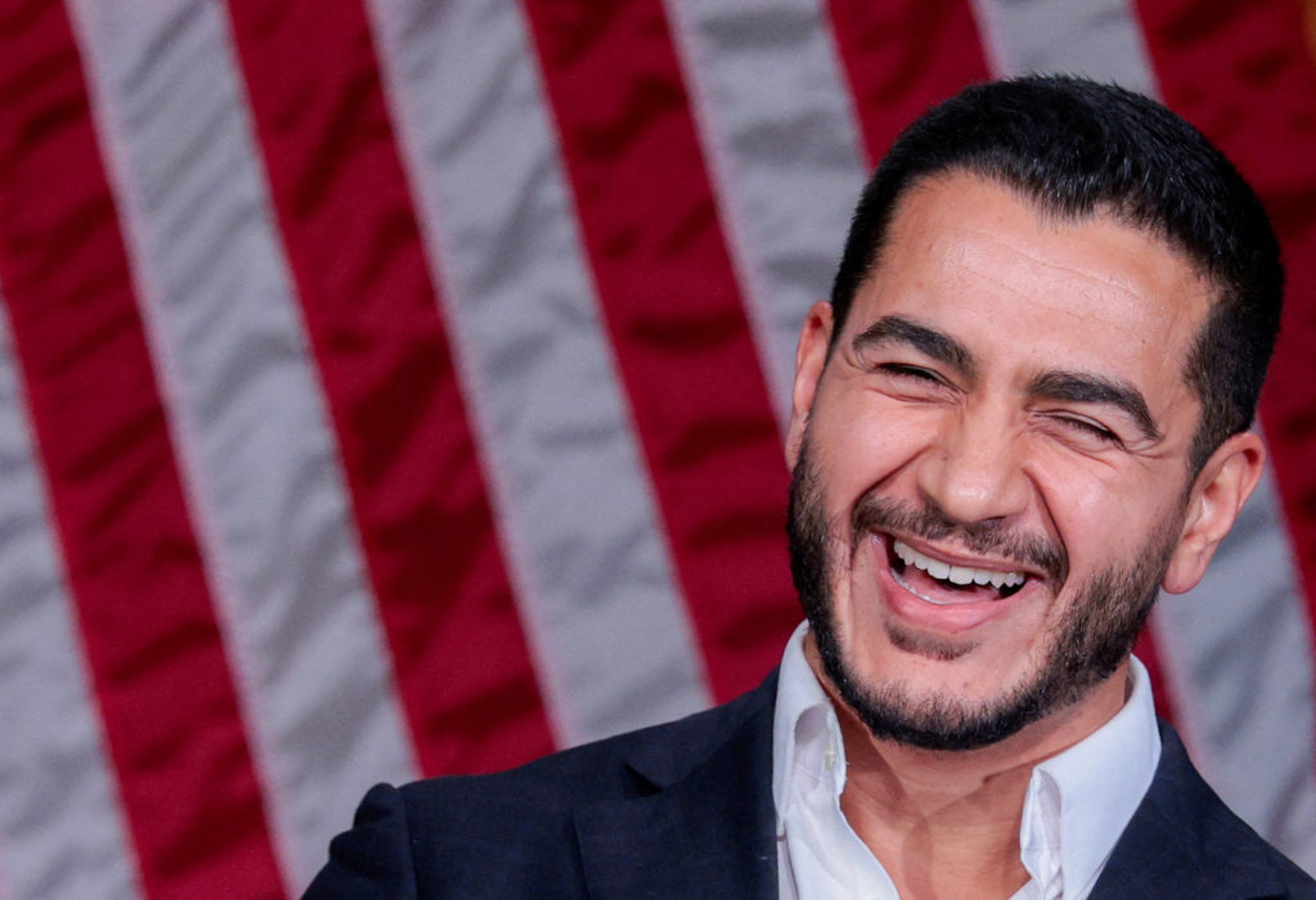
On Wednesday morning, people across the country woke up to the news that Democrats had swept the Senate and the House of Representatives, and had secured governor seats in states where it was, until yesterday, deemed impossible. Among these victories was Michigan’s crucial Senate race, in which insurgent left candidate Abdul El-Sayed had easily beaten his MAGA-backed opponent. The victory punctuates a historic Senate contest in an already historic year for US elections. Whereas before 2025, populist momentum was largely monopolized under Trump’s banner, with meaningful opposition sequestered to the embattled “Squad”, some fellow travelers, and protest movements that struggled to find political representation, all of that would change this election cycle—an auspicious year for the left whose main characteristics would be showcased in the Michigan contest. As primary season turned to the general and the final weeks of campaigning, the drama would range from inspiring, to horrifying, to downright bizarre. It is only by analyzing this strange sequence of phenomena that we may offer a tentative diagnosis of the contemporary American political moment.
The principal and defining issue of this Democratic sweep, and of the left-populist insurgency in particular, may be summarized as implication. After destabilizing events over the last several years, the dominant political groupings now find themselves in a hopelessly discordant logic with no reasonable path of escape. For Trump, the Iran war and the heightened cost of living crisis—self-induced wounds to his own alleged agenda—are pushing even his loyal base to the point of madness. But a similar process is now working its way through the liberal establishment, whose associations with progressive values and rational governance are also being exposed as untenable fictions.
In Michigan’s Democratic Party primary, in which two members of the same party sought to advance to the general and defeat MAGA vassal Mike Rogers, over sixty million dollars was spent against El-Sayed to prop up his corporatist opponent, Haley Stevens. Half of that—thirty million—was spent by AIPAC. It is the most money the Israel lobby has spent on a single race. It is also quite fitting that it has gone toward defeating a candidate whose infectious and oft-repeated slogan is “Money Out of Politics, Money in Your Pocket, Medicare for All.”
The scale of this intra-party rupture is amplified by its timing: its grotesque excess comes amidst, and on behalf of, a contemporary genocide of Palestinians in Gaza—enabled by the American government—in which at least tens of thousands of children have been killed, hundreds of journalists massacred, hospitals, schools and universities systematically bombed or sieged, and two-thirds of the area’s structures destroyed. This is not to mention the deliberate and prolonged prevention of food deliveries to a starving population. Moreover, all of this is common knowledge and politically salient in a way that previous American and Israeli war crimes simply were not.
Not only that, but the very state carrying out these atrocities, and funneling millions into American elections where their prerogatives may be subject to challenge, is also at the center of the ongoing Epstein scandal—a conspiracy involving the blackmail of American politicians and elites who have had various forms of correspondence with the late sadist, child trafficker, and known Israeli asset, Jeffrey Epstein. The nature and extent of the crimes in this scandal are unfathomable and reach the very upper echelons of American society, including, most notably, the sitting president. This is also common knowledge.
At these crossroads of misfortune stands the old guard of the Democratic Party—a cohort that operates in the same circuits of political influence and campaign finance as the MAGA coalition, to which they claim to be opposed. The hollowness of the liberal establishment’s opposition, however, could only be fully revealed at the moment that a new progressive coalition—following the watershed Mamdani election in 2025 and the sweeping victories of insurgent candidates throughout the Democratic Party primaries this year—began to assert itself in earnest.
Given the material threats posed by the growing movement of leftist and democratic socialist politicians—whose voices have already begun to articulate the nature of the establishment’s involvement in genocide and child abuse, and its complacency regarding the compound crisis of the second Trump term—great efforts are being made to preserve a disintegrating political status quo and a pre-crisis sense of normalcy. Three tactics are available to moderate Democrats in this regard: join the Trumpian right in its rhetorical attack on the left while sustaining formal independence from the right; join the ranks of the rightist party or its front groups; or discipline the left through non-antagonistic absorption. We will begin by addressing the first two tactics, which pursue an open antagonism with the left insurgency.
Attacks on the left have, broadly, featured accusations of anti-semitism and hatred for Israel, and the branding of candidates as dangerous communists. While there was a time, not that long ago, when these tactics would have been enough to retain a rhetorical advantage, those days are behind us. By adopting these talking points now, the Democratic establishment implicates itself in the very signifiers that have become toxic for most Americans—AIPAC and MAGA—with which these tactics are most identified.
A case in point was the duplicate interventions of far-right racist Laura Loomer, who once called for sending undocumented immigrants to be eaten by alligators, and moderate House Democrat Michael Gottlieb, urging Florida venues not to host the “Chomp the Oligarchy” event for Senate Democratic primary candidate Angie Nixon in August. Loomer and Gottlieb referred to the event as “communist” and “Jew-hating”, and “anti-Israel” and “anti-Jew”, respectively. While two successive venues canceled the event under media pressure, likely costing the rally in attendance, the joint liberal-rightist sabotage represented another Streisand-effect moment for pro-Israel politics; Nixon would go on to defeat her own AIPAC-backed primary opponent Alex Vindman by eight points.
This brings us to Michigan. After record corporate and Israel lobby spending to keep El-Sayed off the November ballot, he advanced anyway—albeit more narrowly than polls anticipated. His consistent message, and his aggressive campaigning across the state—which filled even small-town venues with hundreds of supporters—continued into the general election. The writing was on the wall.
El-Sayed’s message is beautifully simple, and easily identifiable with the left-populist insurgency nationwide, for which he is one of a handful of clear strategic and rhetorical leaders. He wants to tax billionaires eight percent of their wealth to fund Medicare for All. He wants to end all US military aid to foreign governments (most notably Israel). And he wants to end corporate control of American politics, which includes a plan to institute fifty-percent public ownership of the very AI companies that have filled his opponents’ war chests. Adding to this the charisma of a bona fide star-in-the-making, with such legendary jabs as the Mike Rogers low-T attack ad (“ask your doctor if Endless War is right for you”), suggestions that Trump may have oval office bowel emergencies, and his effortless dispensing of right-wing plants at campaign rallies like the mononymous heckler calling himself “Tommy” (later discovered to be a Republican operative), Abdul’s campaign has been the model for the present insurgency in both content and form.
He developed this agenda out of conversations with constituencies throughout the state, including the poorest areas of Detroit—which he often compares to areas of the third world (including Alexandria, Egypt, where his father emigrated from) in terms of their lack of access to the hope and opportunity always promised, and portrayed as uniquely American, but never actually delivered by the political establishment. Patriotism, in fact, has been an important part of El-Sayed’s message from the beginning. In one memorable spectacle, El-Sayed led a small room of supporters to chant “U-S-A” to drive out an Islamophobic provocateur. His logic is that in the wake of multiple social crises and the rise of the far right, the nation’s values and self-concept have become disarticulated. At stake in all this is the very purpose of American society and our shared values as a people.
For El-Sayed, the answer involves a rearticulation of those values, and their reformation on a more principled ground. Of all the promising candidates of the left opposition, Abdul’s has been perhaps the clearest and most resolute in his attentiveness to these larger concerns. Some of his rhetoric even sounds quaint and old-fashioned in today’s context: he reminds us of what are supposed to be sacrosanct, democratic rights under the constitution, including the right to worship according to one’s own faith. In this way he closes the cultural antagonism posited by the right (and opportunistically intimated by moderate Democrats) between, for example, Jewish safety and “Sharia Law”, and reopens the antagonism as a question of whether or not we support universal rights of citizenship. Furthermore, he extends this basic principle to American policy regarding the ethnostate of Israel (as he did in his great 60 Minutes interview with Ross Douthat). It is this gesture—this consistently applied democratic position—that, I think, has proven indigestible for establishment narratives.
The issue of Israel is at the center of all of this. It is the exceptional case that has heretofore made all other exceptions legible. And now this special case is the site of an extreme condensation of major political struggles. Israel represents the cardinal hypocrisy in a political logic that wants to sustain its progressive identity while wantonly undermining democracy and human rights in its foreign policy, and effectively siding with MAGA in an increasing desperation to go on as before. The revelation of the Trump-Epstein files, the collaboration between Democrats and Republicans on Israel funding and anti-left hysteria, the soft-playing by Democratic leadership in response to Trump’s lethal ICE raids, and the general failure to address the basic social problems of everyday life have resulted in an impossible bind; and its culmination in the absurd finale of this Senate election revealed the true extent of the moderates’ quandary.
For Haley Stevens, the primary result was probably a traumatic shock to her expectations of inheriting Michigan’s junior senate seat. Despite this, she did make some initial gestures of support to El-Sayed in the general—but they would quickly deteriorate into counterproductive concern-trolling, and finally her outright rebuke of the party itself in a bewildering, eleventh-hour endorsement of Rogers. Stevens thus takes up the second, more radical establishment tactic: join the right in both rhetoric and party allegiance. Images of Stevens laughing it up with Rogers on Sunday—the man she once said represented a potential MAGA Senate seat “we cannot afford to give”—induced reactions of disdain far and wide, including from her former peers. Rogers’ and Stevens’ choice for the site of this photo-op, the traditionally Black Perfecting Church in Detroit, partly corresponds to the appearance she didn’t make at the North End Church of God, where El-Sayed and several Black faith ministers held their own media event that day.
But the move was also in line with her cynical calculations throughout the primary season: that she could leverage class and ethnic tensions between Arab and Black communities to paint herself as the true candidate of Black Michiganders. After all, she was “endorsed by Obama”—as was claimed in one AIPAC-sponsored Stevens ad over the summer (which omitted that this endorsement was from 2018). But given AIPAC’s now high-profile status in American elections, the ruthlessness with which the Israel lobby exploits ethnic tensions and loyalties to its own ends is no longer part of the subtext of this race; it is a headline feature. Even the church leaders thrown into this political theater are refusing to play their part. The classic tactics of the establishment are running aground in this enigmatic election year; nothing that was previously reliable can be taken for granted anymore.
If the Stevens incident spells the end of one politician’s career, it is only a symptom of the greater collapse of establishment logic. Despite Anderson Cooper’s incredulity during his surreal interview with Stevens, and despite the outrage she prompted from former staffers, etc., there is a rationality to Stevens’ decision that must be acknowledged: Abdul El-Sayed, and the left-populist wave we are seeing now, are truly inconsonant with so-called moderate Democratic politics. For all the left’s dismissals of the media hysteria around El-Sayed campaigning with Hasan Piker—which it correctly reads as a reactionary charade meant to distract from the key issues of the campaign—the proximity of the communist left to El-Sayed is not irrelevant to the larger dynamic playing out between the insurgency and the establishment. The left-populist program, such as we can call it at this stage, really cannot be reconciled with the AIPAC money, co-governance over a genocide, vicarious support for Trump’s military campaigns, and corporate giveaways and detente with oligarchy that are definitional for establishment politics, and merely exaggerated in the case of Haley Stevens’ stooge campaign.
Stevens, in other words, recognized the fraught position she was in as someone who received mountains of cash from interests that had already rerouted their bottomless resources to the Republican candidate. In such a case, party loyalty becomes a more complex question. One could even argue that Stevens made a politically principled decision to abandon her party. To go along with Elissa Slotkin’s dog-and-pony show of disingenuous support for Abdul was a bridge too far for this poster child of corporate largesse. The problem for such Democrats is that whichever path they choose, their identity encounters a crisis; in both scenarios the horizon of what they believe they are working toward collapses.
Crucially, what we mean by collapse is not a logical fallacy that exists abstractly but that we still sustain by ignoring it—this, of course, has been the practice of Democrats since time immemorial. A true collapse only occurs when we ourselves have lost faith in the fallacy; when its consequences become too visible to us in the context of an overproximity of conflict.
The richness of the Stevens debacle invites a psychoanalytic interpretation. It recalls a well-known passage from Freud’s first major work, in which he describes the dream of a man whose child is dying in a fire (“Father, don’t you see I am burning?”). The dream becomes too traumatic to endure, so he wakes up to the reality that he is in fact sleeping beside the coffin of his recently deceased son. Freud observes that we will often prolong a dream by incorporating into its narrative a potentially intrusive sensation from the outside world (in this case, a candle that had started a small fire in the sleeping man's room). Freud’s point in recounting this story is that the fantasy worked out in a dream can prove more overwhelming than the ordinary reality of the waking world—in this case, the notion that one may have been in some way guilty of his own child’s death. So, the effort to remain asleep is abandoned, and we awaken to the more stable array of horrors we have come to know as reality.
And what do we know about Haley Stevens’ dreams?—that she is visited in them by Israel. Stevens, in a rare moment of authenticity, committed to the dream, assuming its damning implications to the fullest extent. In her final act of this storied election year, she would have made every good psychoanalyst proud: she did not give ground relative to her desire.
This leaves the third, and most formidable tactic available to the moderates: cynical absorption of leftist energies to maintain political superposition. This is the preferred category of the most adept enemies of the insurgency. The rope-a-dope counter to Trump’s 2024 victory, articulated by James Carville, is here applied to the left. Neera Tanden exemplified this approach in her recent debate with Mehdi Hasan, in which she was always prepared, after a few obligatory deflections, to cheerily concede the point and maintain the illusion of a collaborative political ground. We have already named Elissa Slotkin, the senior Michigan senator who stumped for El-Sayed in the final weeks of the general election. Stevens made the suggestive remark in her Cooper interview that Slotkin “was carrying a lot of water here”. This is certainly true—but it would be foolish to expect the callous technocrats to join Stevens in her sacrifice at the altar of Democrats for Mike Rogers. They have made other arrangements.
However, as we have already said, this more intelligent posture—the rope-a-dope with the left—loses its consistency upon even the most cursory analysis. Establishment decadence has become such a spectacle that everything the Slotkins and Tandens have worked to safeguard is now threatened. Giving the left its moment—which those like Haley Stevens have refused to concede—still exposes profound problems for the mainstream. In particular, a person might be compelled to ask: if, as Tuesday’s results indicate, the left is the force truly capable of beating Trump, what do we need the moderates for?
It is already palpable that, for example, Slotkin’s cameo at a Kalamazoo rally for El-Sayed last week bore all the awkwardness of incongruous company. Tupac’s “Changes” played—appropriately—to the former CIA analyst exiting the stage after a few platitudes, followed by El-Sayed’s far superior speech before a screaming audience. I wonder if Slotkin herself, or her bosses at the intelligence agencies, would agree to Abdul’s offer to Trump that night: “I will walk through a metal detector if you sit down for a lie detector.” To be fair to Slotkin, she carried her water better than New Jersey senator Cory Booker. After refusing to endorse in the Michigan primary, where he instead famously called for the “Michigan fist” of unity in the general, he again failed to endorse in the general. Booker, we might say, has invented an unexpected fourth tactic: pure vitality lacking any substance whatsoever.
The massive Democratic sweep on Tuesday, though an unmistakable blow to the MAGA project, was only a partial victory for the insurgency and socialist leadership in the broader democratic struggle. AIPAC favorite and rising Democratic star Jon Ossoff’s double-digit trouncing of Mike Collins, and the narrow defeat of the promising underdog Angie Nixon in Florida (who, with the exception of two local chapters, was not endorsed by DSA), indicate that the left has far more work to do to vie for political leadership in the coming sequence.
For those parts of the left that pick their battles based on what they believe to be sacred signifiers, which do not appear in El-Sayed’s vocabulary, to even be seen on stage with someone of Slotkin’s pedigree would be deemed a hopeless concession to capitalist power. Of course, they had already abandoned Abdul when he admitted that he thinks of himself as more of a capitalist than a socialist. For the vast majority of people, though, this statement is nothing but refrigerator artwork on which only the left is fixated. Meanwhile, the Velázquez hanging in the entryway—the question of the future of American democracy and the ethical structure of our society—is what attracts the eyes of the people. Abdul El-Sayed is sensitive to this reality, as are the best of the other insurgent candidates. For the left’s part, they may soon find themselves implicated, and battling intrusive feelings of guilt, as they consider some of the close and crushing defeats of yesterday’s results; the fact is, we could have taken more ground, won more races, taken more states under the banner of left populism.
It is clear that any loss we suffer now will only bolster the far-right project that the moment is crying out for us to stop. I wonder: does the left fear that their message will not be taken up, and that as a result the insurgency will fail? Or do they actually fear that it will succeed on terms not decided by them, and that they will be carried kicking and screaming into another conjuncture in which all coordinates appear foreign to their theoretical models?
My hope is that the abstentionists, who undoubtedly paid close attention to last night’s results, do in fact care about the real concerns of masses of people; that it is only, as I once heard somewhere, that “nobody wants to do their own politics anymore.”
That is not the case for El-Sayed, who, with the support of his insurgent cohort and the tens of thousands of volunteers nationwide organizing and strategizing to put him in office, promised early on that this race wouldn’t be close: “I’ll smoke him by 7. Bet on it.” He wasn’t far off.