
Sep 29
NYC-DSA Must Take a Position on NYCHA Demolitions
What does it mean for a socialist mayor to tear down public housing?
by Ant L
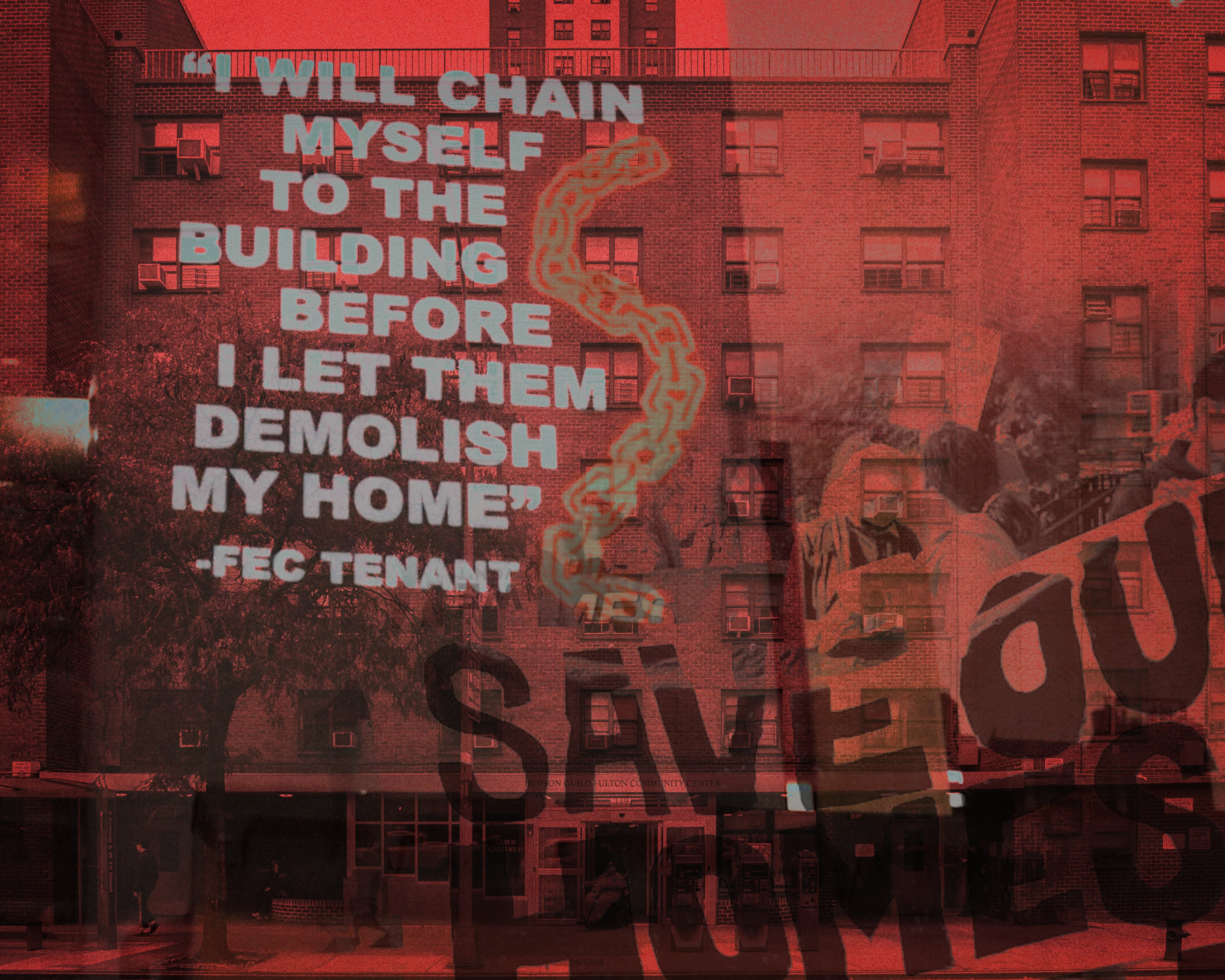
As of last week, The City Reporter reports that the inhabitants of four households are refusing to leave a seniors-only building in NYCHA’s Fulton Houses, and have been served eviction notices by the housing agency. These eviction notices have arrived within the larger context of the slated demolition of 18 buildings in 3 different housing projects in Manhattan’s Chelsea neighborhood. The Fulton, Elliot, and Chelsea houses, taken together, are often referred to by the acronym FEC. What I will argue, though, is that “FEC” stands in rhetorically not just for 18 buildings in 3 housing projects, but indeed a set of unresolved internal contradictions in New York City leftism which the demolition of the buildings brings into clear relief. Why on earth would we not oppose the conversion of public housing into market rate apartments?
In the City Reporter, tenants report that they received confusing communication from NYCHA about the status of their alternative units or the demolition schedule, among other issues. On this basis, the 4 households have decided to stay put, refusing their removal from the building and by extension blocking the building’s demolition.
On its face, their reasoning is obvious: NYCHA tenants have no reason to trust the agency to not leave them in the street, and even if one were indifferent to their concerns the demolition of a NYCHA complex to create private housing would set a very foreboding precedent not only for the future of public housing in New York City but indeed every agency and system in the city which serves its poorest and most excluded residents. And yet, the central hub of New York City’s organized left has broadly taken no position on the situation, and our soi-disant socialist mayor is in fact supportive of the demolition. It is difficult to imagine how any leftist could look at the situation facing these four households and not be moved by its moral urgency. Many of us may be, in fact.
Somehow, however, it appears that NYC-DSA’s leadership is willing to take a non-position on what is self-evidently an inflection point for New York’s future in the 21st century. At best, these demolitions will be followed by the continued removal of poor Black and Brown New Yorkers from lower Manhattan; at worst, they will create a set of conditions for the removal of those groups from the city altogether. Perhaps the thinking is that their replacement by “college educated renters” will hasten the coming of socialism in America via the ballot box. In either case, objectively the situation for New York’s dispossessed is dire indeed if their legacy politicians continue to sell them out to real estate developers with total impunity and the insurgent socialist left does the same while much more effectively blocking any effort to stop it.
We could stop there, but as always that would be the easy way out. In what follows, I invite the reader to consider my view that the avoidance (or support) of the FEC demolitions by New York’s socialist Left in its aggregate (with no disrespect to the principled comrades working to fight this disposition within their organizations) is downstream of two unresolved specters which haunt New York leftism.
- How we ought to orient ourselves to the flawed but not yet realized social projects of the 20th century, including NYCHA.
- Whether the growing subset of New Yorkers excluded from the formal economy and political system have any claims to make on the political Left.
My answer to the former is that every single one of them must be vigorously defended, and my answer to the latter is yes. Generally speaking, I would say that nobody in the organized left would go on record as debating either point.
When it is time to concretize these commitments, however, so often we see American socialists taking a non-position, known otherwise as abstention. In the past year or so wherein the controversy over the FEC demolitions has intensified, comrades who are quick to make public pronouncements on the essential moral or political character of other issues have shrewdly evaded the question. There is the notable exception of the Left-YIMBYs, who at least have the decency (or temerity) to argue seriously that a combination of technocracy and electoral victories among those disposed to technocracy can deliver on socialist goals. Do I agree with this premise?
Definitely not, but I respect the honesty of those arguing these positions and I have even been moved to support some of their proposals despite disagreeing with the reasoning for them. Let’s imagine the argument that increasing the overall housing supply is in the interest of the “entire working class” although it may come at the expense of a few residents of a particular complex, in this case FEC. On its face, this makes sense until we remember that “the entire working class” is an abstraction which we have been asked to prioritize over living, breathing human beings. Most importantly, the residents of public housing could never be convinced to sacrifice their homes so that “the entire working class” can hypothetically benefit at some point in the future. And yet, these arguments persist. Why? Simple: nobody making them plans on explaining them to the persons impacted. So while this argument fails upon contact with people who don’t already agree with the technocratic worldview, the person making it is at least willing to take a position. They’re wrong, but wrong in an honest way.
The forces abstaining on this issue, however, can’t be taken in good faith on the basis that if they had a strong affirmative position either way it would be in their interest to argue it plainly and publicly. Their abstention, then, is a tacit admission that they cannot argue a compelling case for their position. A non-position on an ongoing situation is, of course, a tacit endorsement of what’s happening, as we all understand when something bad is happening to us. If there is in fact a strong case to be made for abstention on the issue of FEC, it should be made publicly and clearly. Otherwise, we can safely assume that those who fail to oppose the FEC demolition either support it or don’t oppose it enough to sacrifice political capital in other areas. Either way, they should state this plainly. Preferably to the residents of NYCHA themselves, but at the very least to their fellow socialists.
In any case, it is impossible to debate a position that hasn’t been stated, and thus I have no other choice but to analyze debates 1 and 2 briefly in the context of the history of American leftism. After all, there is still time to reverse course and defend FEC.
First things first, a cursory glance at the history of public housing in New York City reveals a glaring and particularly twisted irony. Those of us who paid close attention to Zohran Mamdani’s mayoral campaign noticed a particular insistence on comparison between Mamdani and early 20th century mayor Fiorello LaGuardia, the idea being that Mamdani fits within a tradition of progressive mayors in New York City and harkens back to the era of progressivism and sewer socialism. Of course, there is a lot of truth and utility to this narrative. What it obscures, however, is that the most recent truly progressive mayor, who was himself a DSA member, was David Dinkins. Why might socialists want to avoid the Dinkins comparison? This question deserves its own essay, but suffice it to say that the easy answer is that Dinkins served a single term and was defeated by the combined forces of reaction in the election which brought Giuliani to Gracie Mansion.
And indeed, one of the hallmarks of Giuliani’s reign was a series of attacks on New York City’s public sector which took aim not only at the fruits of the Civil Rights movement but also the creations of earlier progressive waves in New York’s history, including CUNY, NYCHA, the public schools, and so on. Ironically, NYCHA was created under LaGuardia’s administration, and the irony that his supposed second coming is presiding over its demolition seems to have escaped even some of our brightest socialist historians. Not only that, but when NYCHA’s first original constructions took shape before the eyes of the teeming 1930s masses, they were segregated. Indeed, many of the early 20th-century accomplishments socialists hold so dear either required accommodations with racism to be imaginable at all or were directed by minds holding ideas either explicitly racist or content to coexist with it. This specter continues to haunt American socialism today, revealing itself in inflection points like the FEC demolition.
This is an important point in the history of New York City: many of its important social projects date from several decades before the Civil Rights movement, and in many cases anti-segregation activism in the 1960s and 1970s involved pushing back against racism and exclusion within realms of organized human life which themselves were creations of socialist or socialist-adjacent movements. This legacy continues today in the way that ostensibly race-blind policies or positions adopted by the Left often in fact reinforce or even exacerbate structural racism.
One easy example is the insistence on points of reference from the prewar period and a focus on class and affordability at the expense of “identity politics”. This might make sense if New York City was still over 90% white, as was the case well into the 20th century. I am already hearing that “my ethnicity was not considered white in the 1930s” which begs the question of how this was assessed when it was time for residents to move into the all white Williamsburg Houses and all Black Harlem River Houses in the late 1930s. Were ethnic whites simply barred from all public housing because it was too confusing to place them? Of course, the point of this narrative is not its dubious truth content, but rather the rhetorical work it performs: obscuring the stubborn truth of America’s foundations in slavery and settler colonialism, and how both continue to structure America’s political economy and democracy. American socialism, then, is socialism within a particular framework which persists regardless of the availability of free childcare.
Generally speaking, it is easy to disguise this contradiction given that the broad mass of America’s population faces a continued decline in their living standards and most class-based issues are disproportionately visited on Black and Brown people. Thus, universal programs are an easy sell and lift all boats. This analysis, however, papers over deeper forms of exclusion, and thus falters in situations like the demolition of FEC. It also neglects how social projects like NYCHA and CUNY have become fundamentally racialized in the context of the late 20th century and onward, which returns us to Dinkins, and the second half of the problematic I posed. Thus, we see socialists fighting to the death to defend some government programs while being willing to sacrifice others, and those with basic pattern recognition can identify the underlying logic.
Why else might we compare Mamdani to Dinkins rather than LaGuardia? Simply, the two men have governed a New York City shaped by the Great Society, the Civil Rights movement, racist backlash to both, and neoliberalism with its killer jails and hollowed-out schools. While LaGuardia faced unforeseen challenges, he governed at a time when American society was becoming more open to massive state projects and the use of government on a bigger scale to tackle social problems. Dinkins and Mamdani, on the other hand, have in common a situation where they have to simultaneously defend a hulking city edifice plagued by disinvestment and outright federal assault and confront a political landscape shaped by forms of racial and class politics which did not exist in 1930s New York.
Yes, 1930s New York was marked by ethnic conflict and economic inequality. However, its political culture was not defined by a backlash to the then embryonic Civil Rights movement, and the city had not yet become the playground for the world’s ultra-rich. Most importantly, when NYCHA and other social projects were created, they did not occupy a racialized position the way they do now. Finally, mass incarceration, Stop and Frisk, and a militarized NYPD had not even been dreamed of. The total exclusion of larger and larger swaths of the city’s population from formal employment and formal politics and the construction of a state confinement apparatus designed to manage, confine, and kill them had not yet been devised. Thus, the comparison between Mamdani and LaGuardia functions to obscure the dramatically different world Mamdani and we occupy from the latter. I recently saw an article comparing Bangladeshi immigrants of today to the Irish of New York’s past given their emerging participation in politics. One wonders if this comparison is apt, given that a militarized NYPD with capabilities to bug Irish Catholic parishes and spy on Irish communities did not exist in the 1920s.
In any case, we return to the four holdout households and Mamdani’s choice to preside over the demolition of their homes and, by extension, their evictions. What does it mean for a socialist mayor to demolish public housing? Either we have to rethink our historic disposition toward defending our social projects against all odds or confront the contradictions of a mayor steeped in an American socialist tradition which continues to deny its own racial blind spots. New York City is not 90% white, and its poorest are defined as such by their exclusion from the city’s formal economy, more so than by their exploitation in wage labor. Most importantly, the destruction of NYCHA will be the first domino to fall in a larger assault on the public sector, one which will be coming for the employers, pensions, unions, and ultimately human dignity of everyone reading this at some point. If we make the choice to cast off our most vulnerable neighbors in hopes of “building socialism” in the future, we will fully deserve the consequences. We can make another choice. There is no alternative to defending public housing, as a massive federal investment in New York City’s housing crisis is not forthcoming. If “college educated renters” replace longtime residents, the latter will be offered shelters, killer jails, and homelessness. We cannot look away.