
Oct 28, 2026
What Haunts the United States? An Interview With Andrew Rakich
Andrew Rakich (Atun-Shei Films) speaks about his new film, The Vampires of New Orleans, the Southern Gothic, and the various other demons that haunt the United States.
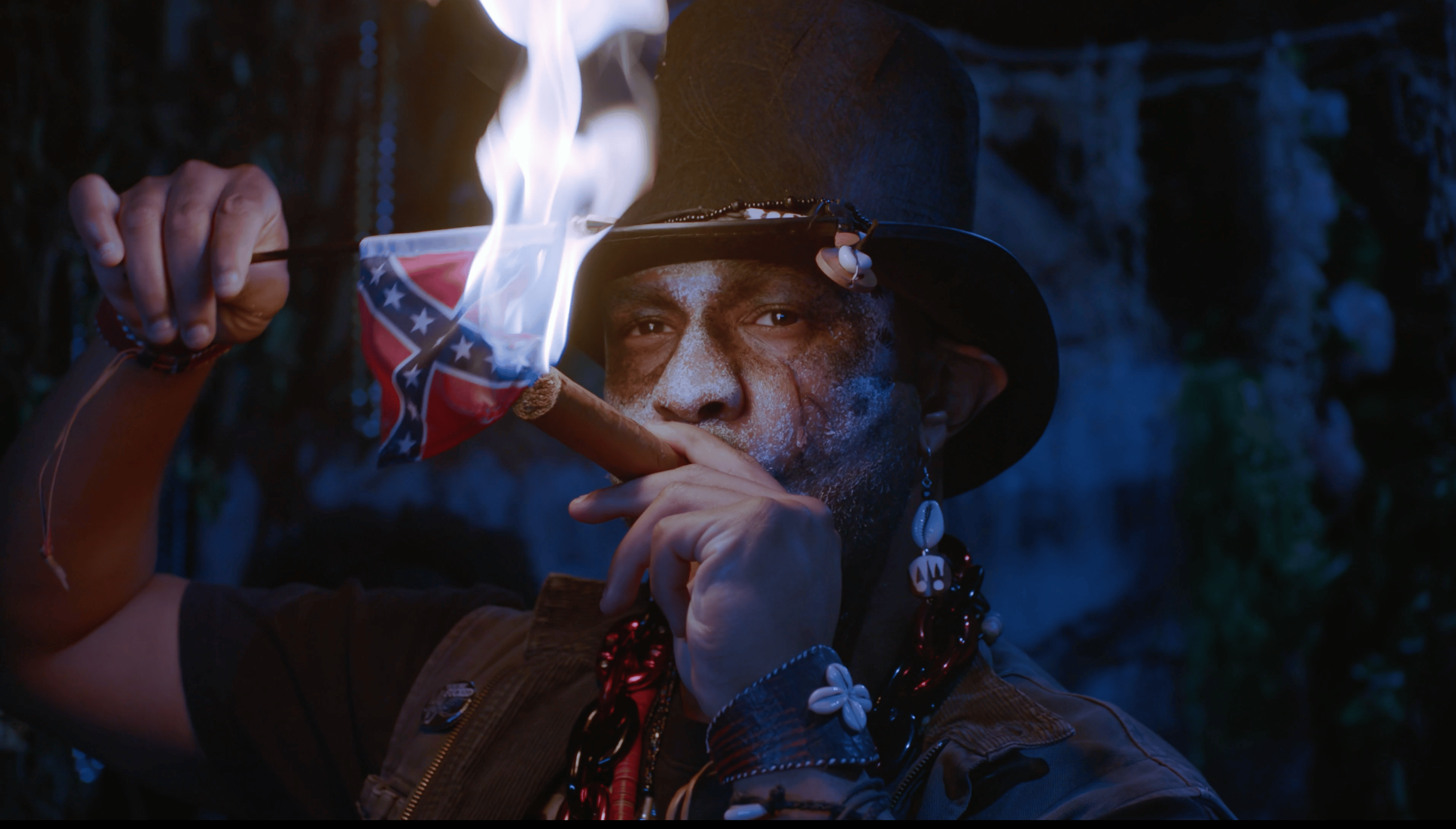
The gothic and occult permeate the artistic perception of the American South broadly and the city of New Orleans in particular. Over the history of literature and film it came to appear as a haunting specter for the broader United States. Andrew Rakich is the director and host of the YouTube-Channel Atun-Shei Films, where he and his team release documentaries and video essays that cover American history from a critical perspective. He recently released his second feature film, the docudrama The Vampires of New Orleans. In it he introduces the viewer into the occult history of New Orleans and explores which evils still linger in the old house that is the United States. It is available for purchase or rent at https://atunsheifilms.vhx.tv/. In this interview with Geese he elaborates on the ghosts he sees possessing Americans every day, his inspirations for the movie, political film in general, and how he produced a self-funded independent movie.
This interview has been edited for length and clarity
Your movie, The Vampires of New Orleans is unusual in its structure, a hybrid of a documentary on the occult of New Orleans and interspersed with a narrative of actual vampires. When did this structure begin to take shape? Where did you get the idea of this movie?
When my first movie, The Sudbury Devil, came out, a really interesting piece of feedback we got was that watching the documentaries that I had made about the historical topics surrounding the movie—namely King Philip's War—made the movie a much richer experience. So I was thinking about how to use this feedback to inspire the making of a uniquely new media film. Working with a very low budget with just a local indie production company obviously can be very limiting. You're broke all the time and you don't have enough time and money to do anything. The freeing part of that is that you can make movies that literally no one has ever seen before. When I, personally, sit down to watch an indie film, I want to be shocked and want to see something experimental, something I've never seen before. The Vampires of New Orleans was a perfect topic to explore in a docudrama format, which is not necessarily original to me but maybe to newer audiences. We took a lot of inspiration from the Italian neorealists, particularly the movie The Battle of Algiers (1966) with its use of non-actors, its use of cinema vérité photography, and sometimes explicit documentary elements. We wanted to take some of those ideas and specifically adapt them to the YouTube age to make a neorealist video essay that is mixed in with a movie. Vampires, specifically New Orleans vampires, was the perfect topic to approach this because the very essence of the New Orleans Vampire myth is a mixture, a mess, if you will, of fact and fiction.
It is fact and fiction interlocking in very interesting and varied ways. The narrative portions were a response to Anne Rice, who invented the vampire myth of New Orleans with her novel Interview with a Vampire, updating it to our current situation. But it was also inspired by consistently commuting past a location that we ended up shooting large parts of the movie in, Lindy Boggs Medical Center, which is a hospital that has been abandoned since Hurricane Katrina and is now just this colossal gothic ruin in the middle of this beautiful neighborhood that to me is always a tangible reminder of what happened in 2005. Going past it and just thinking, “Wow, that looks like Dracula's castle. What if a vampire actually lived there? A vampire that is tied to the history, folklore, and my lived experience as a New Orleanian.” I've lived in New Orleans longer than I've lived anywhere.
This is me working through my very complicated feelings about New Orleans. The movie is a question: what is the soul of New Orleans? Is this city a dream or a nightmare? Is this movie a love letter to the city or is it a suicide note? To me, that is the major unanswered question and the heart of the movie and for me on a personal level. It just seemed like the movie very much found itself. Mixing the documentary and narrative aspects was very much a process of discovery. I always knew that we had a badass vampire movie inside us, but I always knew that it would also be much more interesting and much more meaningful if the themes that it was speaking to were grounded in very hard fact.
Can you go in a bit deeper? Tell me more about your feelings about New Orleans.
New Orleans is a city with a lot of beauty and a lot of darkness. It's a place of lots of contradictions. It has one of the most vibrant cultures of any American city. The artistic exports alone from New Orleans have changed the world. Jazz music, for instance. It has changed the world and it began in the brothels and gin joints of New Orleans. It’s a city where you can live life to the fullest. At the same time, it is a city that was built on extractive capitalism. It exists because of the slave trade and never changed in this regard. Slavery may have been abolished, but only outside our prisons. And we still have the oil and gas industry, which captures all of our elected officials and who basically operate unregulated in the same parishes that used to be the heart of sugar cultivation during slavery. And the tourism industry. That’s an extractive economy that takes value from the culture and commodifies it while at the same time driving out the people who make that culture so vibrant. The movie itself is like one of these tours. It is my vampire tour of New Orleans, which is a big industry here. The ghost tour industry is a big focus of the documentary portions of the movie.
You can't understand vampires in New Orleans without understanding the tourism industry. So, the movie itself is structured like a ghost tour. It is an episodic story where you are taken from one in one spot and the tour guide sits you down and tells you a bunch of facts and then tells you something made up. And then you decamp and you walk and you go over somewhere else and you hear a different story that typically starts with fact and ends with fiction or folklore. But there's a lot of dysfunction to the city of New Orleans. There's a lot of poverty and I feel like many of us are conditioned to accept it as part of the city's charm, like “Oh, it's just a quirky city, you know, the pothole on my street hasn't been filled in 10 years.” It's, “oh, it's so quirky here. Everything is just run so slow.” And people are fucking dying. You go on Claiborne Avenue in the city and you see a whole tent city under the bridge. There's people are fucking dying. People are homeless. People are starving in the streets, and there's no reason for that to happen. And I am very much haunted by the villains of our film. In just living in New Orleans, going around in New Orleans, I wanted to take that nightmare out of my imagination and inflict it upon you all.
When I was watching the movie, I thought that it works within the Southern Gothic as almost an ultra-orthodox work. The Southern Gothic is very flexible with its iconography, especially in the movies. And you chose to translate the iconography from the English Gothic very faithfully. Why did you want to transfer it so faithfully?
I think it's principally out of a love for what you call the English Gothic. I would describe it as capital-R Romanticism. There is a lot of Stoker in it, with Gary Oldman flair. Stoker was coming up with the idea for Dracula while he was wandering around Whitby Abbey, this ruined abbey in the north of England and just contemplating the dust of what had come before, contemplating these ruins and this idea of the barbaric past trying to claw its way to the present. In Stoker's case it’s the barbaric feudal past represented by this invasive immigrant, Count Dracula, infringing upon the progressive, technologically advanced Anglo-American capitalism. And for us it's the ruthless chattel-slavery past of colonial capitalism clawing away all of the progress that we've made in the past 150–200 years. It is revealing itself as the through-line and the basis of our society.
You update the rule Anne Rice’ vampire has, not harming people, to make it more historically accurate by making his definition of people only cover white people. This absence of race is in my opinion very significant in the movie side of the Southern Gothic mode. That is changing of course, with recent entries like “Sinners” (2025) and “Is God Is” (2026), but was America too repressed to tackle the issue of Race?
Southern Gothic has tackled Race in literature a few times. But when you take a look at Anne Rice, she was exploring something very specific, her first book is very much about grief, about alienation, about living as an outcast, and that's what has resonated. It's often like a queer power fantasy. But when it comes to race, I think it is always undergirding the Southern Gothic, even if it's not explicitly mentioned. New Orleans' myths and legends are tinged with race, sometimes explicitly, sometimes implicitly, but it is always there. Just the fact that the protagonist is a plantation owner. She doesn't engage with it that directly, but she stated years later “He's always been a parasite,” and we build on that. He feels a lot of angst about taking human life, so he eats animals. But realistically, if you were an 18th-Century plantation owner, you would regard people of color as essentially animals. We're taking the hood off and showing you who he really is.
Speaking of pulling the hood off, in the movie you sometimes become very literal. You announce the interpretive frame, you spell things out, like this tangent of the Vampire on the absurdity of eating meat. Were you afraid of being interpreted in bad faith?
I wouldn't necessarily agree. I don't think I'm afraid of being misinterpreted. But the scene that you're talking about is the way in which D’Hemecourt justifies himself extremely historically accurately. The fact that I'm vegan and I have these beliefs is almost irrelevant, because that is literally, historically, how slave owners justified themselves. There's a really vile booklet from the early 19th Century from the British-colonized Caribbean, where one slave owner writes how you get the most value out of the people that you own. He was talking about abolitionists and said, “Yeah, these abolitionists want to free the slaves. What's next? Animal rights?” Like, they literally said this. I would dispute quite vehemently that that's somehow me being preachy. I think the docudrama format necessitates spelling things out a little bit, because it is a movie with a factual basis. But I certainly would agree that I'm not necessarily a subtle filmmaker.
You asked “What is the soul of New Orleans?” which I think is also a theme of the Gothic mode, which asks for the soul of what it’s tackling. At its core is, in my opinion, disruption. In the English Gothic, the Enlightenment gets disrupted by this violent past, and in the Southern Gothic, the national myth of the United States that gets disrupted by this very violent South. It's racist. It's misogynist, it’s everything the United States doesn't want you to believe to be true about themselves. Why do you think the South is this screen the United States is projecting this abject on?
The South has always had a contentious relationship with the national projects of the United States, sometimes very violently contentious. I think it comes down to the different economic paradigm in the South throughout much of its history, which was as cash crop colonies, essentially. It was always somewhat doing its own thing, with its own economic structure, with its own leaders and obviously with a very strict racial hierarchy.
Growing up in a small town in New England, we would always get those books assigned that were taking place in the South, which had to do with racism and portrayed the region very badly. But when I moved to the South for the first time in 2009, I was struck by how kind they were here comparatively. How friendly, light and breezy, how hospitable. But the more time that I've spent down there, more of the cracks start to show. There's something about the South where sometimes there is an unspoken feeling in the air, an unspoken electricity, in some of these small towns. Here you just know if you stay past dark, they're gonna kill you. There's just something about that insular nature to things, this suspicion of outsiders, which is just very creepy. Any challenge to the established order in the South is immediately met with violence. That violence is always bubbling beneath the surface. But weirdly enough, I think there's a romance to places like that, which is shared by places like the Wild West, where life is fast, short, and eventful. It also always just comes back to slavery. Millions of people over centuries were held in bondage in this way. That’s a stain that'll never come out.
Has moving to the South changed your view of the United States?
Moving to the South was certainly a wake-up call, you know? It's wonderful being exposed to a lot more diversity, different cultures and different ways of thinking than the place that I grew up in. But it also makes you appreciate just how much further we have to go as a society. Particularly as a Louisiana resident in 2026, seeing our state government steadily taking away voting rights, becoming much more authoritarian, and openly just being owned by the oil and gas companies eroding our coastlines to the extent that New Orleans itself probably will not be there for that much longer unless something very drastic is done. That got me very principally angry but also energized to expose the injustices in our society and do what little I can to make the world a better place.
In watching your videos I also noticed that you get more angry to the point that you almost break with your role as YouTuber. Do you still feel that way?
What do you mean by “I almost break my role as a YouTuber?” That's very interesting.
You argue in a reaction to a video the far-right commentator Matt Walsh made on Indigenous people that you don't want to cuddle up with these—I think you call them sword people—any more.
Mediocre white sword bros, yes.
But what's your role as a history educator and as a filmmaker? Is this documentary supposed to change minds?
I don't particularly care if it does or doesn't. I'm not really interested in changing minds. What I was interested in is articulating something very deeply personal, which is the relationship to my home. But the work that I do and the work that a lot of my colleagues do, changing minds and having an impact, I think a lot of that was vanity and hubris and self-aggrandizement. I think if that is true, if YouTubers move the needle one way or another, then clearly people with my beliefs have failed.
Obviously, our country is a fascist authoritarian hellhole. So whatever good we might have done to change minds, even if we did change minds, it clearly didn't really matter. There's lots of wonderful people doing what I do, like Mariana [Collin, The Morbid Zoo], amazing, thoughtful creators who have egalitarian perspectives that challenge power and stuff like that. But as I've done more activism in the real world, you see what actually makes a difference and saves lives, and it tends to be these very small asks, like little pressure campaigns that can get a company to stop doing a specific bad thing. Like, those are the great victories, in my mind. Those are the things that actually save lives. In my opinion, the idea that making a little YouTube video is somehow more impactful than literal life-saving activism that these tireless organizers do every day is laughable. That clearly comes from vanity.
Specifically, online history education is a little bit right-coded. And what you end up inevitably doing is pushing back against these pop histories, which are whitewashed and often have racist or nationalistic narratives. You tend to fall into a bit of a role of a white boy whisperer, as I did with my most famous series, Checkmate Lincolnites. “Like, can you stop being so racist?” I've just come to think that centering the feelings and the sensibilities of these people is not the best use of our time, and also exclusionary, right? At this point in my career, rather than tiptoe around certain topics to, you know, avoid offending moderate to right 20-something white dudes who are not really giving that much thought to this worldview, I would rather try to make the trans people in my audience feel safe by just being like “I'm gonna talk about queer issues in a way that shows that I know about it.”
The character of Nate, I think you did something very interesting with him, but he felt more like an archetype than a real character. He felt like one of these sword boys. He felt like this mediocre white boy who suck up to the next most powerful person in the room. Was he supposed to be a stand-in for this group of people?
No, not necessarily a Sword Boy stand-in, but Renfield by way of Patrick Bateman by way of Charlie Kirk. Or well, actually, Clavicular was the main inspiration for Benton Guinness. But yes, he is just the shitty idiot white conservative guy who, like you said, sucks up to power and also just is gleefully palling around with the literal slave owners. But he's also a total cuck, right? I mean, there's that great scene between him and me at the beginning where he's pathetically begging me to turn him into a vampire. And says, “I want to be your equal.” And I say, “We will never be equals.” And he replies, “Of course, you will always be the master. You will always be the master.” Which was not terribly subtle, but a fun way to explore the psychological nature of a lot of these mediocre white fascists, who need their daddy. They need to be told what to do.
I think we need to talk a bit about this about the ending. The vampire grows another head of the Hydra and returns, and I felt at this moment that you are quite pessimistic about the antifascist fight, history return, updating itself, gathering the old supporters. When did this moment of updating itself happen in the United States?
I feel like it's continuously happening, right? And I mean, that's the constant dialectic between oppression and liberation. I consider myself a bit of a utopian, but certainly I don't think it'll ever completely go away. I think that it was important to have the forces of liberation strike a blow at the end and also be affirmed by the last wonderful, very, very fun monologue from Monica Harris, who plays Aunt Saffron, which are the counterpoint to D’Hemecourts. But it can't be that easy, right? Like, it can never be that easy. You can strike a blow, but you can never truly vanquish the evil, I think.
It would feel completely improper in the times that we live in to have that Dracula ending, where Dracula gets his head cut off by a cowboy and everything's fine. It's never gonna be that easy. The reason that we decided to use our Vampire Hunter theme over the end credits was that this will continue. Brigitte, the main character, will hunt him again. The two of them will be locked in battle for a long time. I think maybe it is pessimistic, but I also think it's truthful, at least to me. This moment that we're living in in America right now, I just think it would have been a mistake to have a purely happy ending.
What were the movies that inspired the Vampires of New Orleans?
So the first one principally would be the 1994 Interview with the Vampire film. Specifically, there's a scene in that movie where Louis comes to visit Lestat in the modern day, and Lestat is in this crumbling, abandoned building, and he's still wearing his 18th-Century clothes, and he doesn't know what an electric light is. That was a key image in terms of creating our vampires, who are very much figures out of time, they're in arrested development, they haven't moved on from the times in which they're alive, and that gets to the heart of the historical horror and villainy of the film. The second one would be The Ninth Gate, which I have always regarded as the best movie about the occult ever made. It's a bit of a mess, but the idea of an occult noir is a genius idea. I love the pervasive sense of evil that that movie has through its entire runtime, and I wanted to have a pervasive sense of evil in my movie.
Even if the movie doesn't entirely pull it off, it's still a really fucking cool movie and a really cool idea. Obviously from some of the things that we lovingly ripped off, Bram Stoker's Dracula is another influence and is my favorite vampire movie. I love how big it is, I love how bold it is, I love how bizarre and uneven it is. I think the greatest vampire movie ever made. I have already mentioned the Battle of Algiers, but the Battle of Algiers was a very, very important frame of reference in the spots in the movie where we do meld the fiction and the documentary. Some of the documentary stuff is shot in painterly, cinematic style. Our animations are, for example, very heightened and very cinematic. But also some of the narrative scenes are meant to be shot as though there's a guy with a camera in the room. Some of my favorite parts of the movie, and where I think we pulled it off the best, are the sequences where we basically throw in a fictional character in an ostensibly documentary setting, and you find out later that it's an actor playing a part.
Your first movie, The Sudbury Devil (2023) was produced as a Co-Op. What does it mean to produce a movie as a co-op?
The core cast and crew who were there the whole time would take either no upfront fee or a very small upfront fee, but they would get a sizable proportion of the net gross. Our lead got ten percent, which is quite a huge percentage. The producer got ten percent. I only made fourteen percent of the money from my own movie. And every year they get paid out what the Sudbury Devil made that year, which ended up being quite substantial, considering its budget. Of course we paid day players or people who were there for a couple of days upfront. I was very, very happy to do right by my people and I now have that little troop of folks who I have to come back in Vampires and very much the next one as well. It’s very exciting to work with the same people and have them trust you in that way and feel included, not only artistically and creatively, but also financially, it’s really great.
Was The Vampires of New Orleans also produced as a co-op?
No, it wasn't. We paid people wages upfront, since the budget went so crazily out of control, we are not going to do that again. Vampires was such a huge production. It’s like the cast of Lawrence of Arabia. It's this huge, sprawling cast, with tons of locations and tons of crew. But we're going to do the next one as a co-op as it makes more economic sense doing it that way, even if it is deferred payment for some of the people.
Was this production only a financial cooperative or was the creative process of The Sudbury Devil also structured in this egalitarian way? How would you describe their role in the creative process in comparison to a regular production?
In comparison to a big studio film, I'd say that they have immense creative freedom and immense creative input, but I wouldn't exactly call our sets democratic as far as creative decisions are concerned. I do think that there's an element of filmmaking where it is collaborative, but I think there does need to be a strong hand at the tiller, guiding it in a particular direction. It's not exactly a dictatorship, but if I want to overrule what people think, then I do what I want to do. I don't think it's ego, or at least I like to think it's not ego, but I worked on plenty of short films in my 20s where there were lots of cooks in the kitchen and it ended up being a mess. I think there's a strong authorial stamp on all of my films, like there is on my YouTube videos.
But these movies were only ten percent as good without this specific team of people who we've cultivated and who are not just creatively included but also have a sincere passion for the project and believe in the project and aren't just like, "Oh, it's this fucking piece of shit indie thing.” Every single core member of that cast and crew is just fanatically devoted to this film, right? And they are happy to be there, happy to be amongst their friends, being creative and being in community with each other. Making YouTube videos is very lonely, but making movies is communal and fun.
What do you like about YouTube as a filmmaker?
The most value it has is this direct connection that you as an artist have with your audience. And what you lack in budget and in infrastructure, you gain in direct, unfiltered expression. The Vampires of New Orleans is a movie that is unlike most things you've ever seen, unless you've seen Häxan or The Battle of Algiers, you know what I mean? Most modern audiences will be like, “What the fuck is this?” Formally, it is a huge leap. And you would just never be able to do that in a traditional production model. You would get laughed out of the financier's office. But to be honest I like it increasingly less and less as the algorithm becomes very TikTokified.
This platform certainly isn’t what it once was. And I fear for the future. I'm afraid that it's become a bit of a race to the bottom as viewers on YouTube get so filtered away from their subscriptions and from their curated list of creators that they watch just recommendations, just like TikTok or Instagram Reels. And that's bad for us as artistically, because then we have to cater to that and that degrades our work, I think, and it also degrades the viewer experience because they have less control and it devalues our labor because we create immense amounts of value and increasingly in that recommendation-based style we're increasingly disposable.
Andrew, the filmmaker, and Atun-Shei Films, the YouTube channel. How do they interact with each other?
I think there's an element of a public-facing persona to the channel, which can be sometimes beneficial but also sometimes hard to navigate. But I just make whatever I want to make. I really don't think about it that much. I'm not a particularly disciplined artist. I just go wherever my nose leads me and wherever my passion takes me, and I just do that thing. And if people like it, then great. If they don't, then it’s almost irrelevant, because it was something that I had in me that needed to come out. I've been very blessed to have the audience that I've had and to have the platform that I've had. In that sense, I'm very grateful to be a YouTuber. At the same time, though, I find the platform endlessly frustrating. For the value that I create, I'm not paid nearly enough by fucking Google. It’s certainly a love-hate relationship.
Do you use YouTube as a testing ground? Do you sometimes think of “I want to do this in a movie”, do you test this on YouTube first?
I did that a lot for the first film. I shot a whole documentary in 4-by-3 just to see if it would work for the vibe and then shot our movie in 4-by-3. I certainly tend to go through phases. Obviously I've been in a vampire phase. I made a video about cannibalism on slave ships, which is obviously very appropriate for the themes of Vampires of New Orleans. Very much entering a romantic poetry phase, which we'll see where that leads, but I think fun places.
What have you carried from producing The Sudbury Devil into The Vampires of New Orleans?
When working in the indie world and working for very little money but having a large audience, it's important to prioritize your strengths. Vampires is a YouTube movie and it’s gonna go on YouTube, so it will feel more like a video essay than a movie. We leaned into this with the documentary style. There will always be technical drawbacks or things that will be hard to pull off on a low budget. But the thing that you can get—not for free, but for cheap if you know what you're doing—is the story, performances, emotion, theme, and just the fun of watching it. And that's very much what I want to focus on in my films. I want to make films that are unforgettable experiences. The worst thing anybody could be is being bored. Even if they hate it, I want them to be angry about it. It needs to hit emotionally.
YouTube movies and movies from YouTubers have been frowned upon over the last 10 years. And then recently Curry Baker and Kane Parson entered the scene. These were two people who were coming from YouTube. Is there something changing about the relation between YouTube and the legacy movie industry?
Totally. What we're seeing across the world in the moment of this polycrisis that we find ourselves in is a collapsing of institutions generally. And that's what's happening with the film industry as well. I think old media and new media are just becoming media, for better and for worse. There's opportunity there, but there's also danger. We have seen a lot of mediocrity rise to the top on YouTube and a lot of amazing artists and creators just sinking like stones. I think it's too early to tell what the exact impact of that is and what the result of that is going to be. But I'm certainly hoping that it is an opportunity for all of us in this rising generation of filmmakers to be able to make more daring and relevant films. And I'm very happy to be a part of it.
Is there more money coming into the YouTube space?
While there has been some amazing interest from old media people since Obsession and Backrooms came out there's also been a lot of clearly predatory headhunters. Old media is just looking to strip-mine new media rather than giving money and opportunities to artists.
Closing this Interview, how do you become a vampire hunter?
You've just got to pick up a stake and maybe a cane knife, and you've just got to start doing it. Don't let anybody keep you from your dreams. You have everything you need. You just need to maybe go to Home Depot, max out a credit card. It's easy. I was able to do it. So many people have been able to do it. Look where Van Helsing started. He started, he was just a neurotic, perverted Dutch doctor, and now look at him. I believe in all the young vampire hunters out there. Don't give up on your dreams.